AQA · GCSE · French
Course version: 8658 · Version from Sept 2016
Verbs: perfect infinitive
At Higher tier, the perfect infinitive describes an action completed before another action, often translated as 'after having done' something.
- Point 18 of 20
Study notes
From the teaching notes for this specification point.
The idea
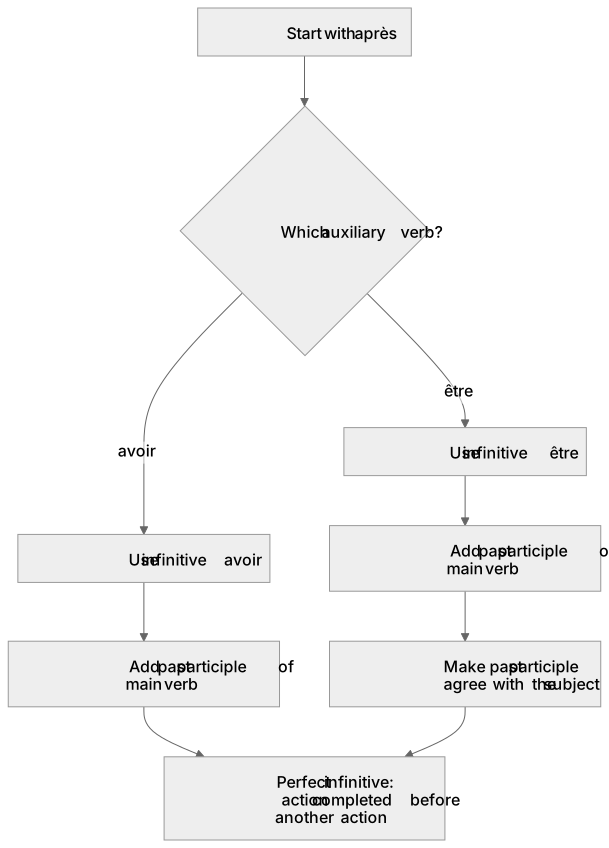
At Higher tier, the perfect infinitive describes an action completed before another action, often translated as 'after having done' something. It is formed with après followed by the infinitive of avoir or être and the main verb's past participle: après avoir mangé means 'after having eaten' and après être allé means 'after having gone'. When être is used, the past participle agrees with the subject, for example après être rentrée for a feminine subject. Recognise and use this structure accurately.
What earns the marks
- Identify the correct auxiliary verb (avoir or être) in its infinitive form following après.
- Select the correct past participle of the main verb.
- Apply correct agreement to the past participle when the auxiliary is être.
- Recognise the meaning of the perfect infinitive as an action completed before the main clause.
Common mistakes and how to put them right
Using the conjugated auxiliary verb instead of the infinitive (e.g., après j'ai mangé).
Put it right: Use the infinitive form of the auxiliary after après (e.g., après avoir mangé).
Forgetting to make the past participle agree when using être (e.g., elle est sortie après être arrivé).
Put it right: Ensure the past participle agrees with the subject when être is the auxiliary (e.g., après être arrivée).
Using the present infinitive instead of the past participle (e.g., après avoir manger).
Put it right: Use the past participle of the main verb (e.g., après avoir mangé).
Exam tips
- Look for the word après as a strong indicator that a perfect infinitive might be required or used in the text.
- Double-check whether the main verb takes avoir or être in the perfect tense to choose the correct infinitive auxiliary.
- When writing, use the perfect infinitive to link two past actions smoothly and demonstrate complex grammatical knowledge.
Try the lesson
The start of the Verbs: perfect infinitive lesson, made from teaching notes for this specification point.
Have a go first
Which sentence correctly uses the perfect infinitive to translate "After finishing his homework, he watched television"?
Listen
At Higher tier, the perfect infinitive describes an action completed before another action, often translated as 'after having done' something. It is formed with après followed by the infinitive of avoir or être and the main verb's past participle: après avoir mangé means 'after having eaten' and après être allé means 'after having gone'. When être is used, the past participle agrees with the subject, for example après être rentrée for a feminine subject. Recognise and use this structure accurately. A strong answer earns marks for these points. Identify the correct auxiliary verb (avoir or être) in its infinitive form following après. Select the correct past participle of the main verb. Apply correct agreement to the past participle when the auxiliary is être. Recognise the meaning of the perfect infinitive as an action completed before the main clause. A common slip: Using the conjugated auxiliary verb instead of the infinitive (e.g., après j'ai mangé). Instead, use the infinitive form of the auxiliary after après (e.g., après avoir mangé). Exam tip: Look for the word après as a strong indicator that a perfect infinitive might be required or used in the text.
See it
There is more to this lesson
The full lesson goes on to check your understanding and help you earn the marks. Create a free account to carry on, with your progress saved.
A week of Premium from your first lesson · Then the free plan continues · No card, no charge
Test your understanding of Verbs: perfect infinitive
Active recall beats re-reading. Take an instant quiz now to test what you’ve learned and lock it into long-term memory.
A week of Premium from your first lesson · Then the free plan continues · No card, no charge