AQA · GCSE · French
Course version: 8658 · Version from Sept 2016
Verbs: present
The present tense in French is used to describe actions happening now, regular habits, or general truths.
- Point 2 of 20
- 4 key terms
Study notes
From the teaching notes for this specification point.
The idea
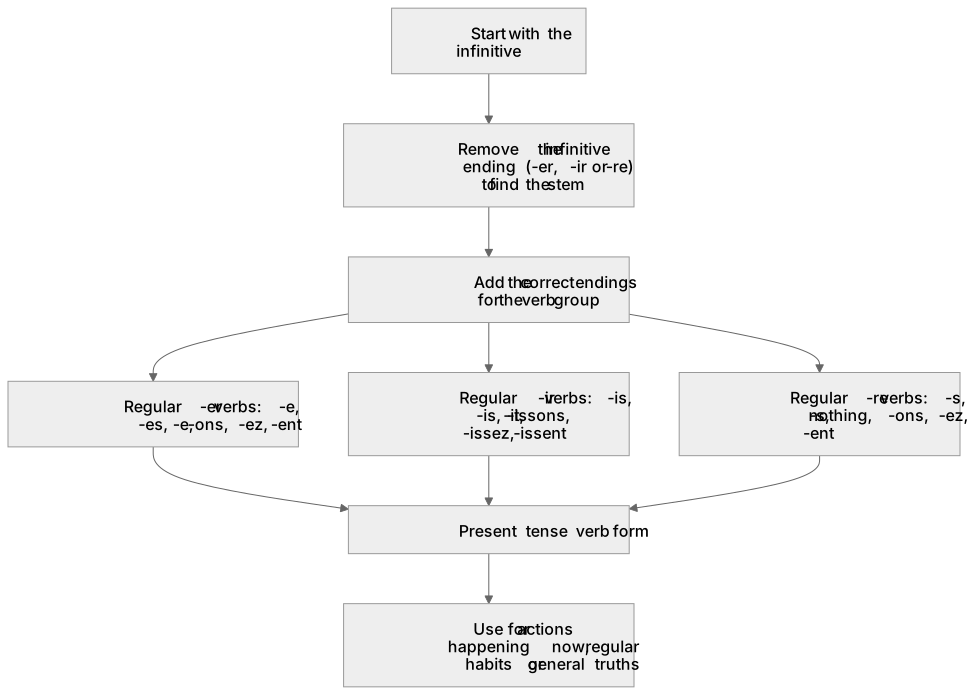
The present tense in French is used to describe actions happening now, regular habits, or general truths. To form the present tense of regular verbs, remove the infinitive ending (-er, -ir, or -re) to find the stem, then add the appropriate endings. For example, regular -er verbs take -e, -es, -e, -ons, -ez, -ent (e.g., 'je parle', 'nous parlons'). Regular -ir verbs take -is, -is, -it, -issons, -issez, -issent, and -re verbs take -s, -s, nothing, -ons, -ez, -ent.
What earns the marks
- Form the present tense of regular -er, -ir, and -re verbs using the correct stem and endings.
- Conjugate high-frequency irregular verbs (e.g., être, avoir, faire, aller) in the present tense.
- Use the present tense to describe current actions, ongoing situations, and general truths.
- Recognise present tense verb forms in reading and listening passages to establish the timeframe.
Common mistakes and how to put them right
Applying -er verb endings to -ir or -re verbs.
Put it right: Memorise the distinct present tense endings for each of the three regular verb groups.
Translating the English present continuous (e.g., 'I am playing') literally into French.
Put it right: Use the simple present tense in French (e.g., 'je joue') to express both 'I play' and 'I am playing'.
Misspelling the 'nous' form of -ger verbs.
Put it right: Add an 'e' before the '-ons' ending (e.g., 'nous mangeons') to maintain the soft 'g' sound.
Exam tips
- Check the subject pronoun carefully to ensure you select the correct verb ending.
- Learn the present tense conjugations of 'être', 'avoir', 'aller', and 'faire' thoroughly, as they are essential for forming other tenses.
- Look for time markers like 'maintenant' (now) or 'tous les jours' (every day) which indicate the present tense is required.
Try the lesson
The start of the Verbs: present lesson, made from teaching notes for this specification point.
Have a go first
Which of the following is the correct present tense form of the regular verb 'parler' for the pronoun 'nous'?
Listen
The present tense in French is used to describe actions happening now, regular habits, or general truths. To form the present tense of regular verbs, remove the infinitive ending (-er, -ir, or -re) to find the stem, then add the appropriate endings. For example, regular -er verbs take -e, -es, -e, -ons, -ez, -ent (e.g., 'je parle', 'nous parlons'). Regular -ir verbs take -is, -is, -it, -issons, -issez, -issent, and -re verbs take -s, -s, nothing, -ons, -ez, -ent. A strong answer earns marks for these points. Form the present tense of regular -er, -ir, and -re verbs using the correct stem and endings. Conjugate high-frequency irregular verbs (e.g., être, avoir, faire, aller) in the present tense. Use the present tense to describe current actions, ongoing situations, and general truths. Recognise present tense verb forms in reading and listening passages to establish the timeframe. A common slip: Applying -er verb endings to -ir or -re verbs. Instead, Memorise the distinct present tense endings for each of the three regular verb groups. Exam tip: Check the subject pronoun carefully to ensure you select the correct verb ending.
See it
Key words
Say what each word means before you turn the card.
Current actions
Try answering aloud or in your head before turning the card.
Daily routines
Try answering aloud or in your head before turning the card.
General facts
Try answering aloud or in your head before turning the card.
Verb morphology
Try answering aloud or in your head before turning the card.
See every definition
- Current actions
- The present tense in French is used to describe actions happening now.
- Daily routines
- The present tense in French is used to describe regular habits.
- General facts
- The present tense in French is used to describe general truths.
- Verb morphology
- To form the present tense of regular verbs, remove the infinitive ending (-er, -ir, or -re) to find the stem, then add the appropriate endings.
Label the diagram
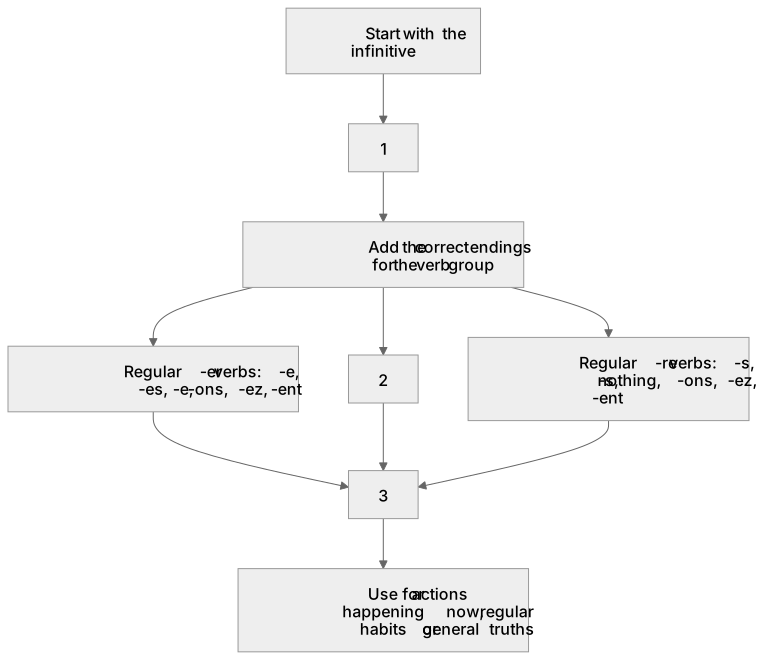
Some boxes have lost their names. Pick the right name for each number.
1Box 1
2Box 2
3Box 3
There is more to this lesson
The full lesson goes on to check your understanding and help you earn the marks. Create a free account to carry on, with your progress saved.
A week of Premium from your first lesson · Then the free plan continues · No card, no charge
Test your understanding of Verbs: present
Active recall beats re-reading. Take an instant quiz now to test what you’ve learned and lock it into long-term memory.
A week of Premium from your first lesson · Then the free plan continues · No card, no charge