AQA · GCSE · French
Course version: 8658 · Version from Sept 2016
Verbs: perfect
The perfect tense (le passé composé) is used to describe completed actions in the past.
- Point 3 of 20
- 4 key terms
Study notes
From the teaching notes for this specification point.
The idea
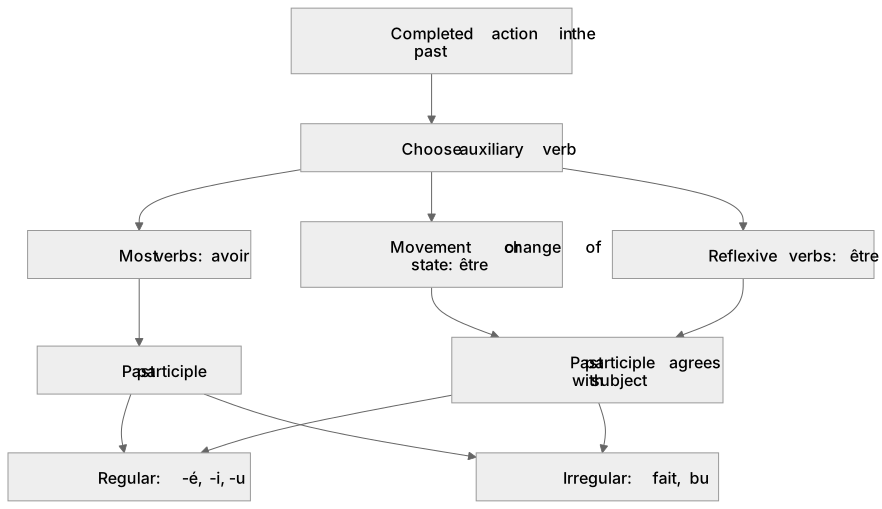
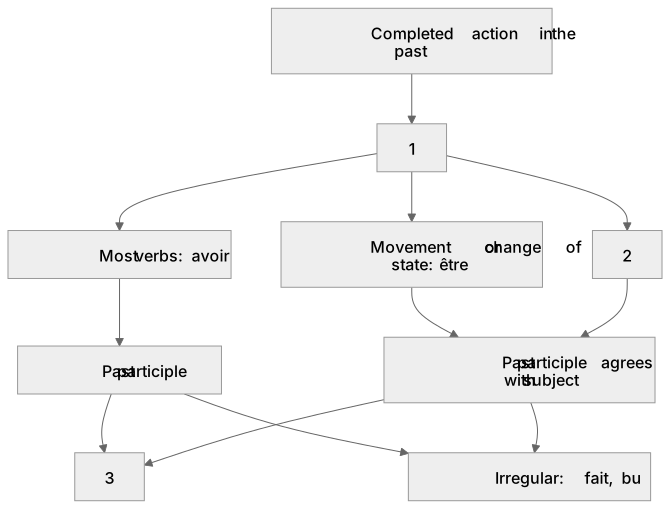
The perfect tense (le passé composé) is used to describe completed actions in the past. It is formed using two parts: an auxiliary verb (either the present tense of 'avoir' or 'être') and a past participle. Most verbs use 'avoir' (e.g., j'ai mangé - I ate). A specific group of verbs, often indicating movement or a change of state (like aller, venir, arriver, partir), use 'être' (e.g., je suis allé(e) - I went). Reflexive verbs also use 'être'. When using 'être', the past participle must agree in gender and number with the subject (adding -e for feminine, -s for plural). Regular past participles end in -é for -er verbs, -i for -ir verbs, and -u for -re verbs, but many common verbs have irregular past participles (e.g., faire -> fait, boire -> bu).
What earns the marks
- Identify the correct auxiliary verb ('avoir' or 'être') for the given subject pronoun.
- Select the correctly formed past participle for regular -er, -ir, and -re verbs.
- Recognise and apply irregular past participles for common verbs such as 'faire', 'boire', and 'prendre'.
- Apply agreement rules to the past participle when the auxiliary verb is 'être', matching the gender and number of the subject.
Common mistakes and how to put them right
Omitting the auxiliary verb entirely and only using the past participle.
Put it right: Include the conjugated form of 'avoir' or 'être' before the past participle.
Using 'avoir' as the auxiliary for verbs of movement or reflexive verbs.
Put it right: Memorise the specific verbs and reflexive verbs that require 'être' as their auxiliary.
Adding agreement to the past participle when the auxiliary is 'avoir' (without a preceding direct object).
Put it right: Only make the past participle agree with the subject when the auxiliary verb is 'être'.
Exam tips
- When checking your work, ensure every perfect tense verb has two distinct parts: the auxiliary and the past participle.
- Memorise the irregular past participles of high-frequency verbs, as these are frequently tested in reading and listening tasks.
- Pay close attention to the subject of the sentence to ensure the auxiliary verb is conjugated correctly and any necessary agreements are made.
Try the lesson
The start of the Verbs: perfect lesson, made from teaching notes for this specification point.
Have a go first
Which of the following sentences correctly uses the perfect tense to say 'I played football'?
Listen
The perfect tense (le passé composé) is used to describe completed actions in the past. It is formed using two parts: an auxiliary verb (either the present tense of 'avoir' or 'être') and a past participle. Most verbs use 'avoir' (e.g., j'ai mangé - I ate). A specific group of verbs, often indicating movement or a change of state (like aller, venir, arriver, partir), use 'être' (e.g., je suis allé(e) - I went). Reflexive verbs also use 'être'. When using 'être', the past participle must agree in gender and number with the subject (adding -e for feminine, -s for plural). Regular past participles end in -é for -er verbs, -i for -ir verbs, and -u for -re verbs, but many common verbs have irregular past participles (e.g., faire -> fait, boire -> bu). A strong answer earns marks for these points. Identify the correct auxiliary verb ('avoir' or 'être') for the given subject pronoun. Select the correctly formed past participle for regular -er, -ir, and -re verbs. Recognise and apply irregular past participles for common verbs such as 'faire', 'boire', and 'prendre'. Apply agreement rules to the past participle when the auxiliary verb is 'être', matching the gender and number of the subject. A common slip: Omitting the auxiliary verb entirely and only using the past participle. Instead, include the conjugated form of 'avoir' or 'être' before the past participle. Exam tip: When checking your work, ensure every perfect tense verb has two distinct parts: the auxiliary and the past participle.
See it
Key words
Say what each word means before you turn the card.
Past actions
Try answering aloud or in your head before turning the card.
Verb conjugation
Try answering aloud or in your head before turning the card.
Auxiliary verbs
Try answering aloud or in your head before turning the card.
Past participles
Try answering aloud or in your head before turning the card.
See every definition
- Past actions
- Completed actions in the past are described using the perfect tense, which is formed using two parts.
- Verb conjugation
- The present tense of 'avoir' or 'être' is conjugated accurately to form the auxiliary component of the perfect tense.
- Auxiliary verbs
- Either the present tense of 'avoir' or 'être' is used before a past participle, and most verbs use 'avoir'.
- Past participles
- Regular forms end in -é for -er verbs, -i for -ir verbs and -u for -re verbs, but many common verbs have irregular forms.
Label the diagram
Some boxes have lost their names. Pick the right name for each number.
1Box 1
2Box 2
3Box 3
There is more to this lesson
The full lesson goes on to check your understanding and help you earn the marks. Create a free account to carry on, with your progress saved.
A week of Premium from your first lesson · Then the free plan continues · No card, no charge
Test your understanding of Verbs: perfect
Active recall beats re-reading. Take an instant quiz now to test what you’ve learned and lock it into long-term memory.
A week of Premium from your first lesson · Then the free plan continues · No card, no charge