AQA · GCSE · French
Course version: 8658 · Version from Sept 2016
Verbs: subjunctive mood: present, in commonly used expressions (R).
The present subjunctive mood is used to express doubt, necessity, emotion, or uncertainty.
- Point 20 of 20
- 4 key terms
Study notes
From the teaching notes for this specification point.
The idea
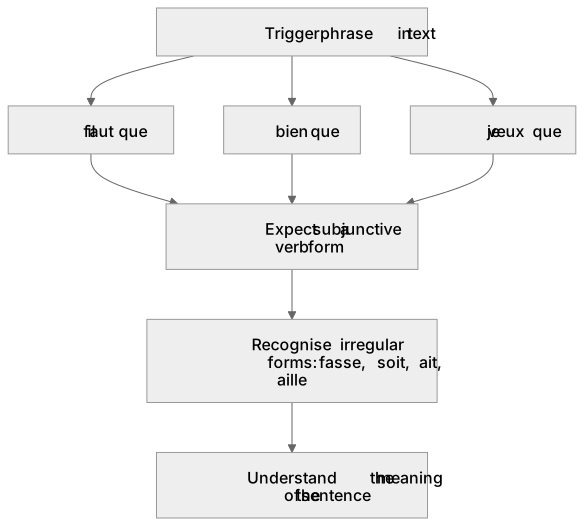
The present subjunctive mood is used to express doubt, necessity, emotion, or uncertainty. At GCSE, students are only required to recognise (R) the present subjunctive in commonly used expressions, rather than produce it from scratch. Key phrases that trigger the subjunctive include il faut que (it is necessary that), bien que (although), and je veux que (I want that). For example, in the sentence il faut que je fasse mes devoirs (I must do my homework), fasse is the subjunctive form of faire. Recognising these set phrases and their corresponding irregular subjunctive verb forms (like soit for être or ait for avoir) is essential for understanding complex texts.
What earns the marks
- Recognise common subjunctive triggers such as il faut que and bien que.
- Identify the present subjunctive forms of high-frequency irregular verbs like faire (fasse), être (soit), avoir (ait), and aller (aille).
- Understand the meaning of sentences containing these common subjunctive expressions.
- Distinguish the subjunctive mood from the indicative mood in reading and listening passages.
Common mistakes and how to put them right
Confusing the subjunctive form fasse with a form of the verb savoir.
Put it right: Recognise that fasse is the subjunctive of faire, often seen in il faut que je fasse.
Misinterpreting bien que as "good that" instead of "although".
Put it right: Learn bien que as a set conjunction meaning "although" which is followed by the subjunctive.
Assuming the present subjunctive can refer only to a present or simultaneous action.
Put it right: Recognise that it can also refer to a future action, for example il faut que tu fasses tes devoirs demain.
Exam tips
- Memorise the subjunctive forms of être, avoir, faire, and aller as they appear most frequently in reading and listening texts.
- When you see il faut que, expect the following verb to look slightly different from its normal present tense form.
- Use your knowledge of the context to deduce the meaning of an unfamiliar subjunctive verb form following a trigger phrase.
Try the lesson
The start of the Verbs: subjunctive mood: present, in commonly used expressions (R). lesson, made from teaching notes for this specification point.
Have a go first
What is the correct English translation of the following sentence?
*Il faut que j'aille au collège.*
Listen
The present subjunctive mood is used to express doubt, necessity, emotion, or uncertainty. At GCSE, students are only required to recognise (R) the present subjunctive in commonly used expressions, rather than produce it from scratch. Key phrases that trigger the subjunctive include il faut que (it is necessary that), bien que (although), and je veux que (I want that). For example, in the sentence il faut que je fasse mes devoirs (I must do my homework), fasse is the subjunctive form of faire. Recognising these set phrases and their corresponding irregular subjunctive verb forms (like soit for être or ait for avoir) is essential for understanding complex texts. A strong answer earns marks for these points. Recognise common subjunctive triggers such as il faut que and bien que. Identify the present subjunctive forms of high-frequency irregular verbs like faire (fasse), être (soit), avoir (ait), and aller (aille). Understand the meaning of sentences containing these common subjunctive expressions. Distinguish the subjunctive mood from the indicative mood in reading and listening passages. A common slip: Confusing the subjunctive form fasse with a form of the verb savoir. Instead, Recognise that fasse is the subjunctive of faire, often seen in il faut que je fasse. Exam tip: Memorise the subjunctive forms of être, avoir, faire, and aller as they appear most frequently in reading and listening texts.
See it
Key words
Say what each word means before you turn the card.
Expressing necessity
Try answering aloud or in your head before turning the card.
Expressing emotions and doubt
Try answering aloud or in your head before turning the card.
Conjunctions
Try answering aloud or in your head before turning the card.
Irregular verbs
Try answering aloud or in your head before turning the card.
See every definition
- Expressing necessity
- Using a trigger phrase such as il faut que, meaning it is necessary that, which is followed by the present subjunctive.
- Expressing emotions and doubt
- One of the uses of the present subjunctive mood, which is used to express doubt, necessity, emotion, or uncertainty.
- Conjunctions
- Set phrases such as bien que, meaning although, which is followed by the subjunctive.
- Irregular verbs
- High-frequency verbs such as faire, être, avoir, and aller, whose present subjunctive forms like fasse, soit, ait, and aille must be recognised.
Label the diagram
Some boxes have lost their names. Pick the right name for each number.
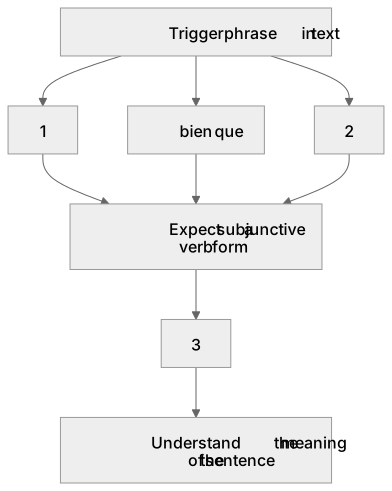
1Box 1
2Box 2
3Box 3
There is more to this lesson
The full lesson goes on to check your understanding and help you earn the marks. Create a free account to carry on, with your progress saved.
A week of Premium from your first lesson · Then the free plan continues · No card, no charge
Test your understanding of Verbs: subjunctive mood: present, in commonly used expressions (R).
Active recall beats re-reading. Take an instant quiz now to test what you’ve learned and lock it into long-term memory.
A week of Premium from your first lesson · Then the free plan continues · No card, no charge