AQA · GCSE · French
Course version: 8658 · Version from Sept 2016
Verbs: present participle, including use after en
The present participle in French is equivalent to the English "-ing" form of a verb.
- Point 19 of 20
- 4 key terms
Study notes
From the teaching notes for this specification point.
The idea
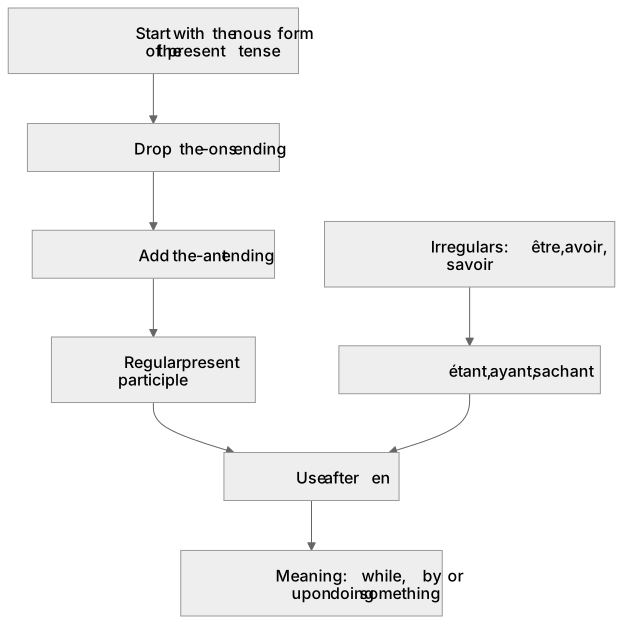
The present participle in French is equivalent to the English "-ing" form of a verb. It is formed by taking the nous form of the present tense, dropping the -ons ending, and adding -ant (e.g., jouer -> jouons -> jouant). There are three irregulars: être (étant), avoir (ayant), and savoir (sachant). The present participle is frequently used after the preposition en to mean "while", "by", or "upon" doing something. For example, en écoutant de la musique means "while listening to music". This structure is excellent for describing two simultaneous actions performed by the same subject, adding fluency and complexity to sentences.
What earns the marks
- Derive the correct stem from the nous form of the present tense.
- Add the -ant ending to form the regular present participle.
- Identify and use the irregular present participles for être, avoir, and savoir.
- Translate the structure en + present participle accurately as "while", "by", or "on" doing an action.
Common mistakes and how to put them right
Forming the present participle from the infinitive stem instead of the nous form (e.g., finissant is correct, not finant).
Put it right: Find the nous form of the present tense first, drop -ons, and add -ant.
Translating the English continuous tense directly using the present participle (e.g., je suis mangeant).
Put it right: Use the standard present tense in French for continuous actions (e.g., je mange).
Forgetting the irregular forms and applying the regular rule to être, avoir, or savoir.
Put it right: Memorise étant, ayant, and sachant as exceptions.
Exam tips
- Use en + present participle in your writing to describe simultaneous actions and access higher marks for complex structures.
- When reading, recognise that en followed by a word ending in -ant usually indicates "while" or "by" doing that action.
- Remember that the subject of the main verb must be the same as the subject performing the action in the present participle clause.
Try the lesson
The start of the Verbs: present participle, including use after en lesson, made from teaching notes for this specification point.
Have a go first
Which phrase correctly translates "by listening to the radio" using a present participle?
Listen
The present participle in French is equivalent to the English "-ing" form of a verb. It is formed by taking the nous form of the present tense, dropping the -ons ending, and adding -ant (e.g., jouer -> jouons -> jouant). There are three irregulars: être (étant), avoir (ayant), and savoir (sachant). The present participle is frequently used after the preposition en to mean "while", "by", or "upon" doing something. For example, en écoutant de la musique means "while listening to music". This structure is excellent for describing two simultaneous actions performed by the same subject, adding fluency and complexity to sentences. A strong answer earns marks for these points. Derive the correct stem from the nous form of the present tense. Add the -ant ending to form the regular present participle. Identify and use the irregular present participles for être, avoir, and savoir. Translate the structure en + present participle accurately as "while", "by", or "on" doing an action. A common slip: Forming the present participle from the infinitive stem instead of the nous form (e.g., finissant is correct, not finant). Instead, find the nous form of the present tense first, drop -ons, and add -ant. Exam tip: Use en + present participle in your writing to describe simultaneous actions and access higher marks for complex structures.
See it
Key words
Say what each word means before you turn the card.
Simultaneous actions
Try answering aloud or in your head before turning the card.
Verb formations
Try answering aloud or in your head before turning the card.
Prepositions
Try answering aloud or in your head before turning the card.
Complex sentences
Try answering aloud or in your head before turning the card.
See every definition
- Simultaneous actions
- Two actions performed by the same subject at the same time, which the present participle after en is excellent for describing.
- Verb formations
- The present participle is formed by taking the nous form of the present tense, dropping the -ons ending, and adding -ant.
- Prepositions
- The present participle is frequently used after en to mean "while", "by", or "upon" doing something.
- Complex sentences
- Using en with the present participle adds fluency and complexity to sentences, which is excellent for describing two simultaneous actions.
Label the diagram
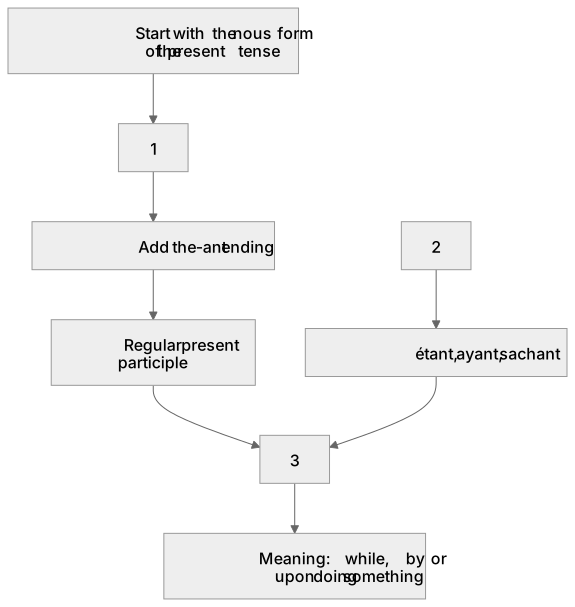
Some boxes have lost their names. Pick the right name for each number.
1Box 1
2Box 2
3Box 3
There is more to this lesson
The full lesson goes on to check your understanding and help you earn the marks. Create a free account to carry on, with your progress saved.
A week of Premium from your first lesson · Then the free plan continues · No card, no charge
Test your understanding of Verbs: present participle, including use after en
Active recall beats re-reading. Take an instant quiz now to test what you’ve learned and lock it into long-term memory.
A week of Premium from your first lesson · Then the free plan continues · No card, no charge