Pearson Edexcel · A-Level · French
Translation Skills
Master the art of translating French into natural English with this comprehensive GCSE guide. Discover the 5-step examiner-approved method, learn to spot common traps, and build the grammatical confidence needed to secure top marks.
- 5 min read
- 3 worked examples
- 5 practice questions
- 6 key terms
Study Notes
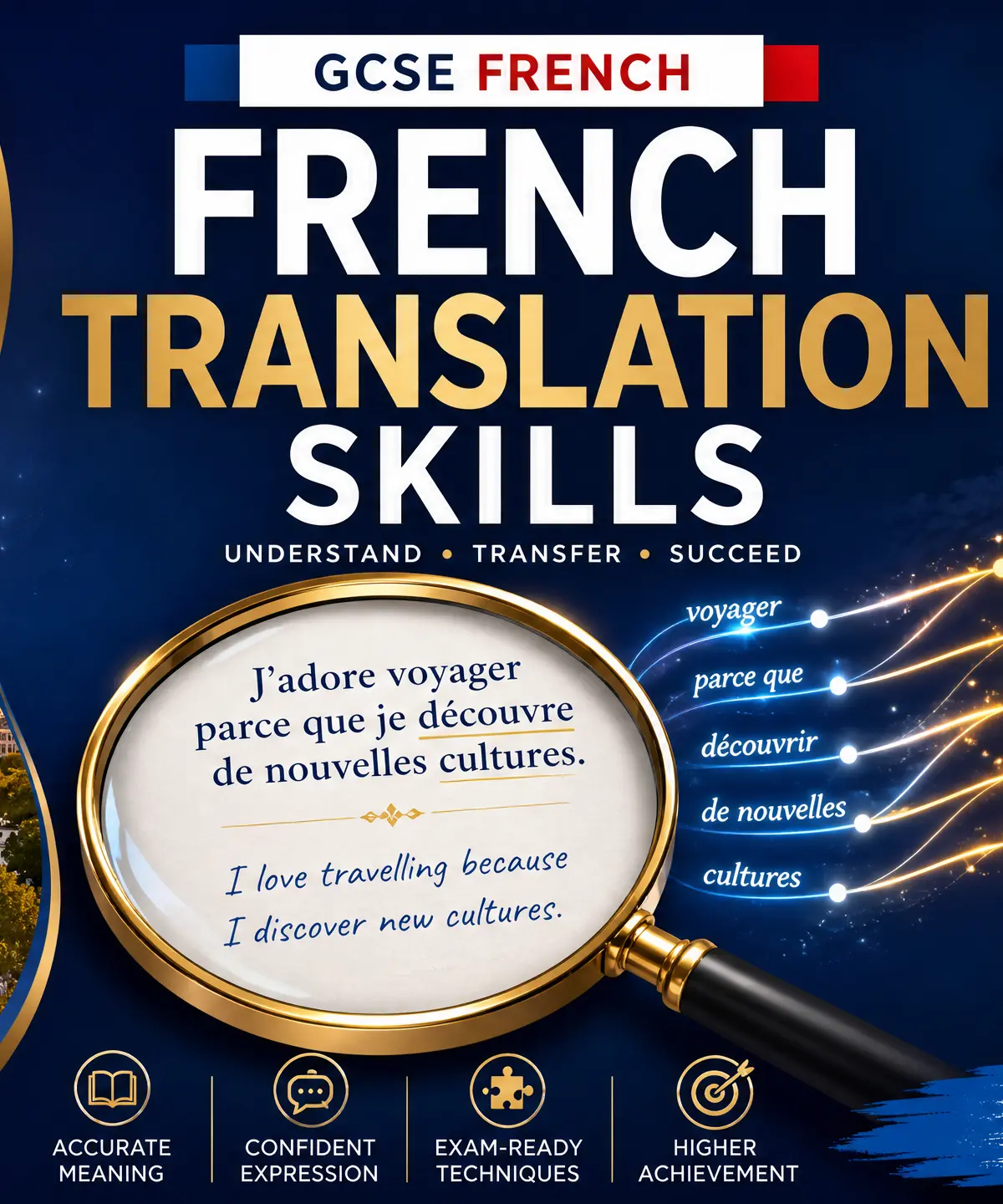
Overview
Translation from French into English is a core skill assessed across all major GCSE French exam boards (AQA, Edexcel, OCR, WJEC). Typically worth around 10 marks in the Reading paper, this task requires you to translate a short passage (50-75 words) that draws on vocabulary and grammar from various specification themes. Examiners are not looking for a literary masterpiece; they are assessing your ability to accurately convey the meaning of the French text into natural, grammatically correct English.
Many candidates lose marks not because they lack vocabulary, but because they translate word-for-word, miss key grammatical structures (like tenses or negatives), or fall for 'false friends'. This guide breaks down the translation process into a systematic, 5-step method that will help you decode complex sentences, avoid common pitfalls, and maximise your marks.
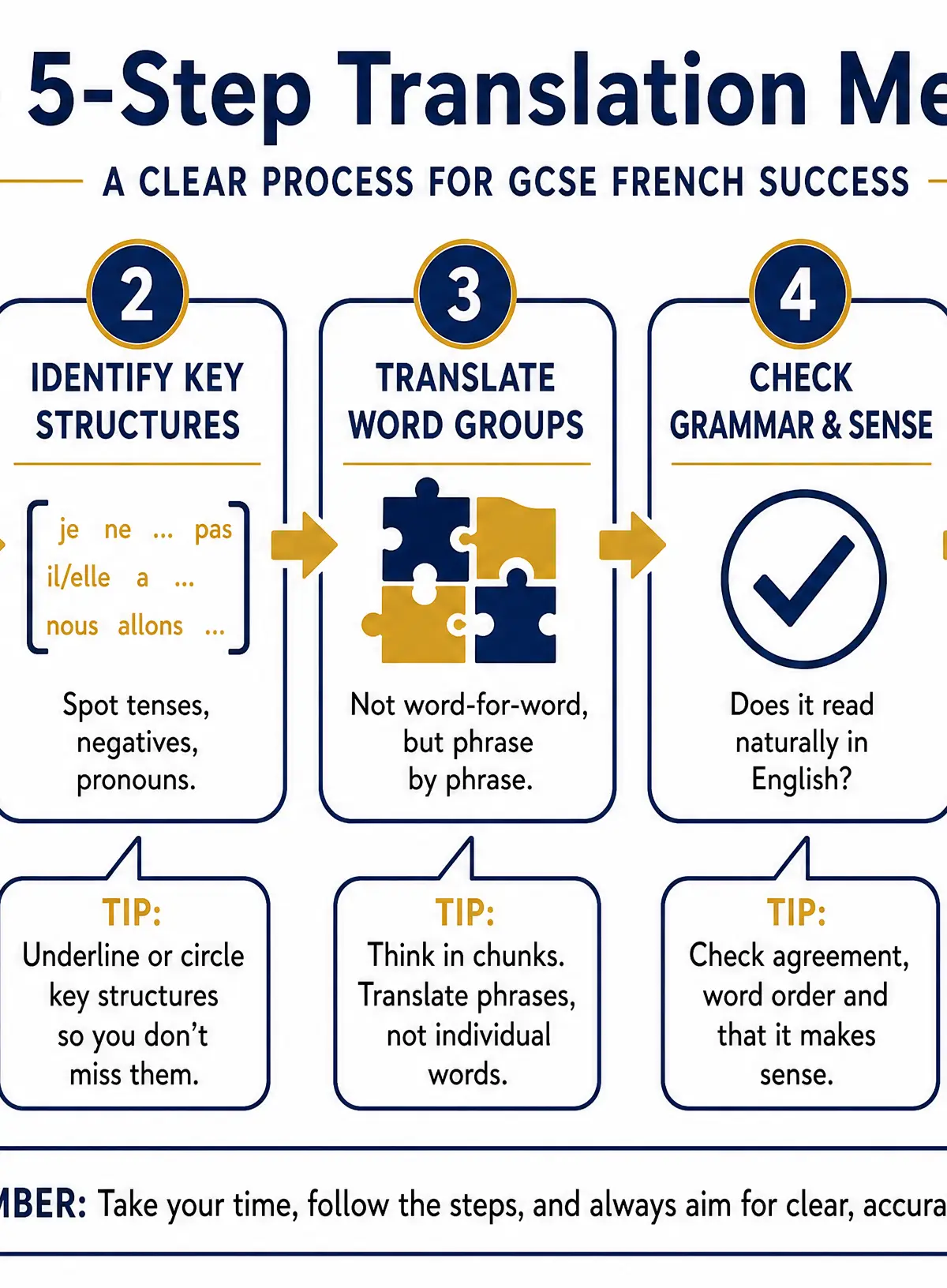
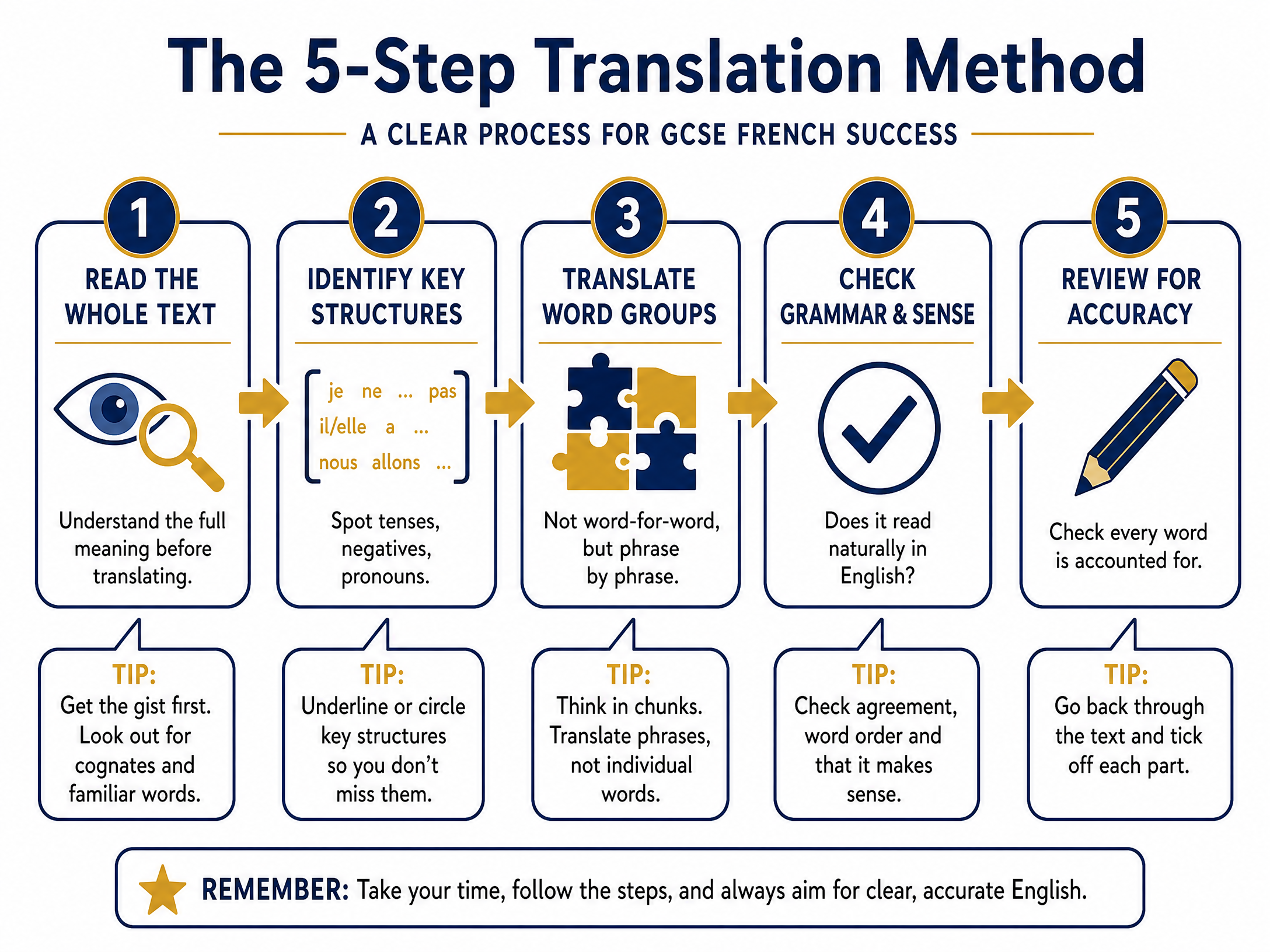
The 5-Step Translation Method
Step 1: Read the Whole Text
What to do: Read the entire French passage before translating a single word.
Why it matters: Understanding the overall context (e.g., is it about a past holiday or future career plans?) helps you make accurate vocabulary choices. Words can have different meanings depending on the context.
Step 2: Identify Key Structures
What to do: Go through the text and physically underline or circle verbs, tenses, negatives, and complex pronouns.
Why it matters: These are the 'high-tariff' elements where marks are won or lost. Identifying that a verb is in the imperfect tense (je mangeais) rather than the present (je mange) is crucial for accuracy.
Step 3: Translate Word Groups
What to do: Break sentences down into logical chunks or phrases, rather than translating word-by-word.
Why it matters: French and English have different word orders (e.g., adjectives usually follow nouns in French). Translating in chunks ensures you reorder the words correctly for English.
Step 4: Check Grammar & Sense
What to do: Read your English draft. Does it sound like natural English?
Why it matters: If your translation sounds clunky or doesn't make sense, you have likely mistranslated an idiom or structure. Your final English must read fluently.
Step 5: Review for Accuracy
What to do: Compare your English translation against the original French text, ticking off words as you go.
Why it matters: Examiners penalise omissions. Ensure you haven't missed small but important words like aussi (also), très (very), or ne...jamais (never).
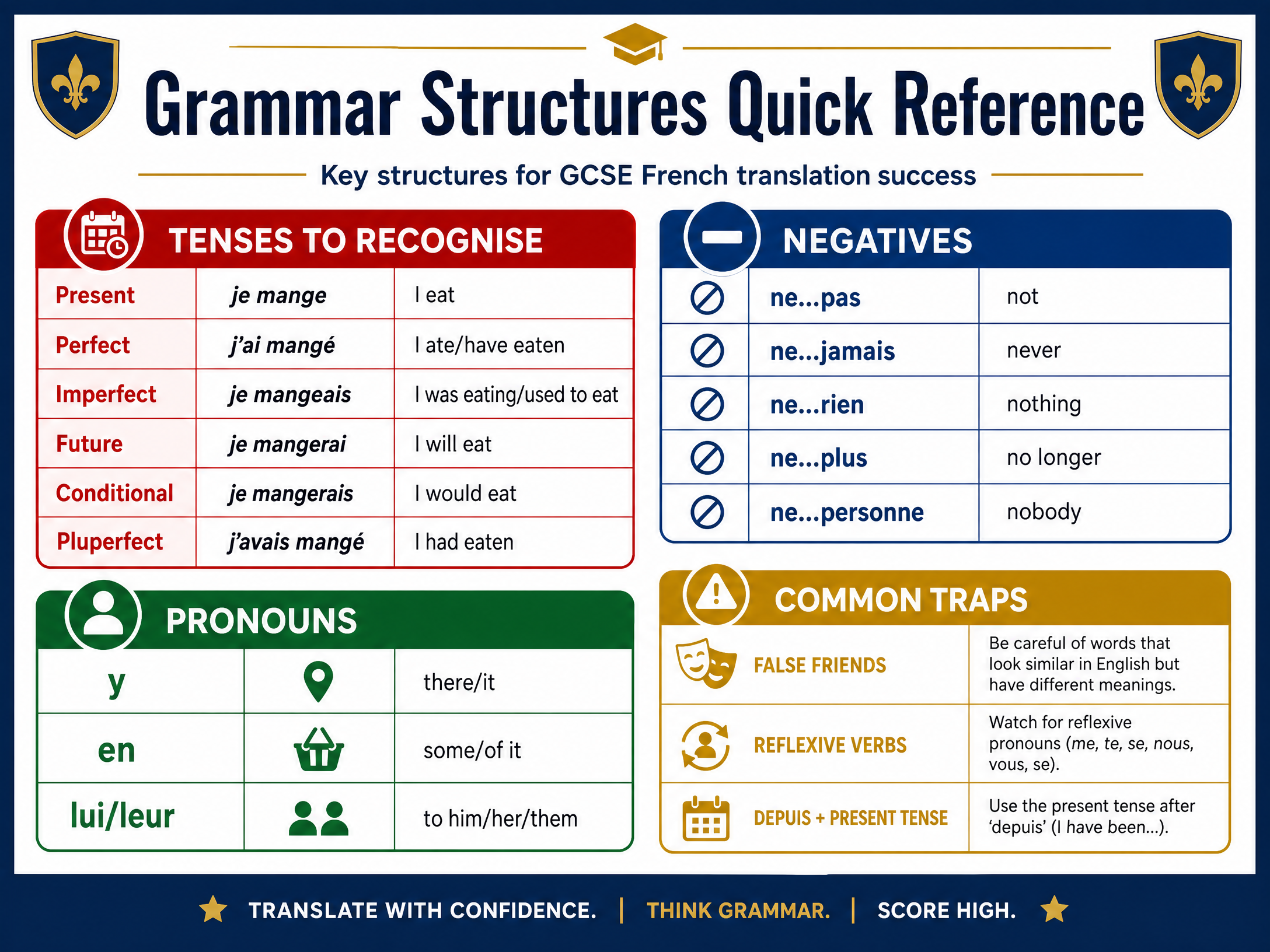
Essential Grammar Structures
To succeed in translation, you must be able to confidently recognise and translate key grammatical structures.
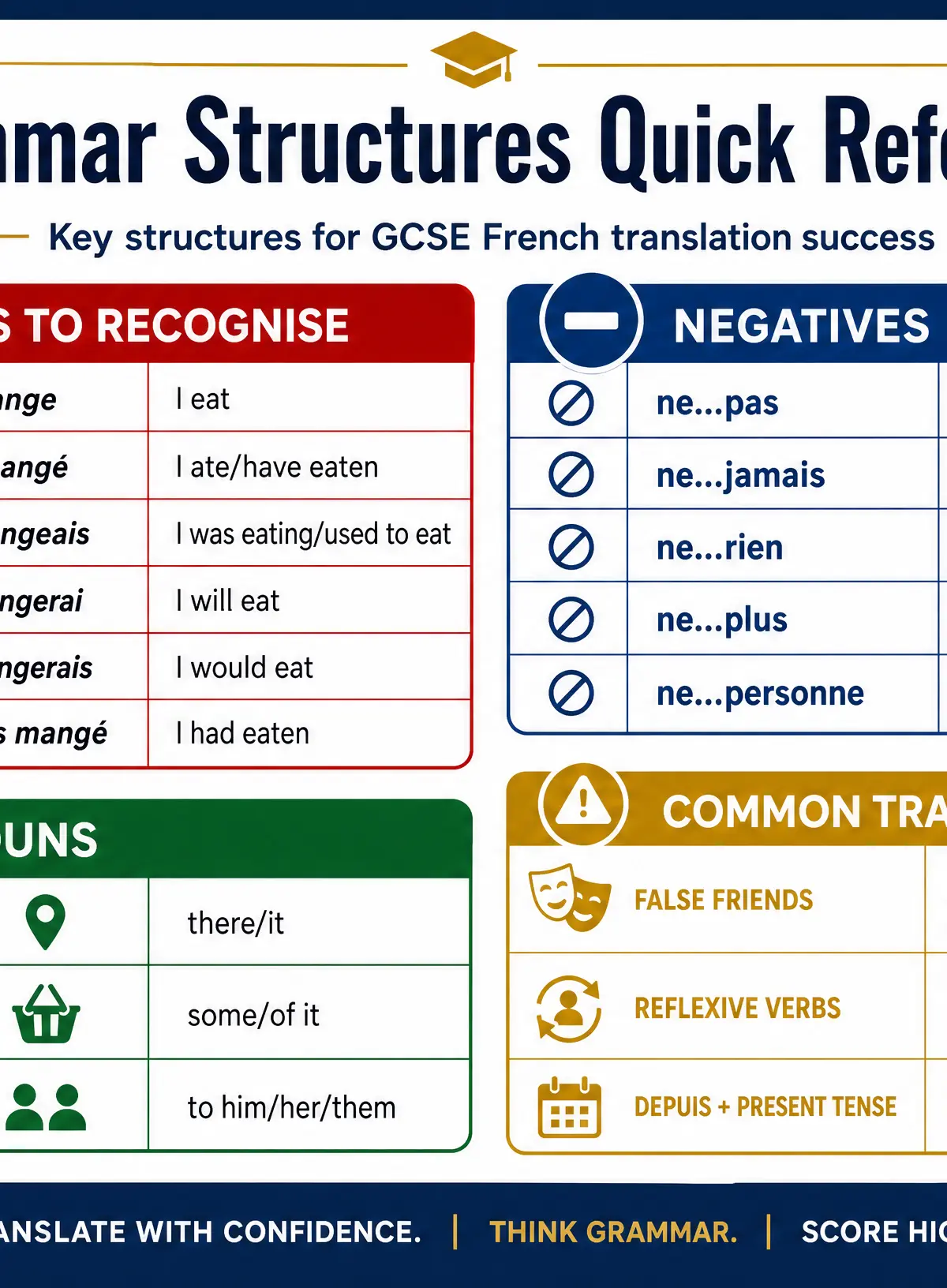
1. Tenses
You must accurately identify the timeframe. A common examiner comment is that candidates lose marks by translating past or future events in the present tense.
- Present: Je joue (I play / I am playing)
- Perfect (Past): J'ai joué (I played / I have played)
- Imperfect (Past): Je jouais (I was playing / I used to play)
- Future: Je jouerai (I will play)
- Conditional: Je jouerais (I would play)
2. Negatives
Always look for the two parts of a French negative (usually ne + another word) wrapping around the verb.
- ne... pas (not)
- ne... jamais (never)
- ne... plus (no longer / not anymore)
- ne... rien (nothing)
- ne... personne (nobody)
3. Key Pronouns: 'Y' and 'En'
These small words often cause confusion.
- Y: Usually translates as 'there' or 'it' (referring to a place or thing already mentioned). J'y vais = I am going there.
- En: Usually translates as 'some', 'any', or 'of it/them'. J'en ai deux = I have two of them.
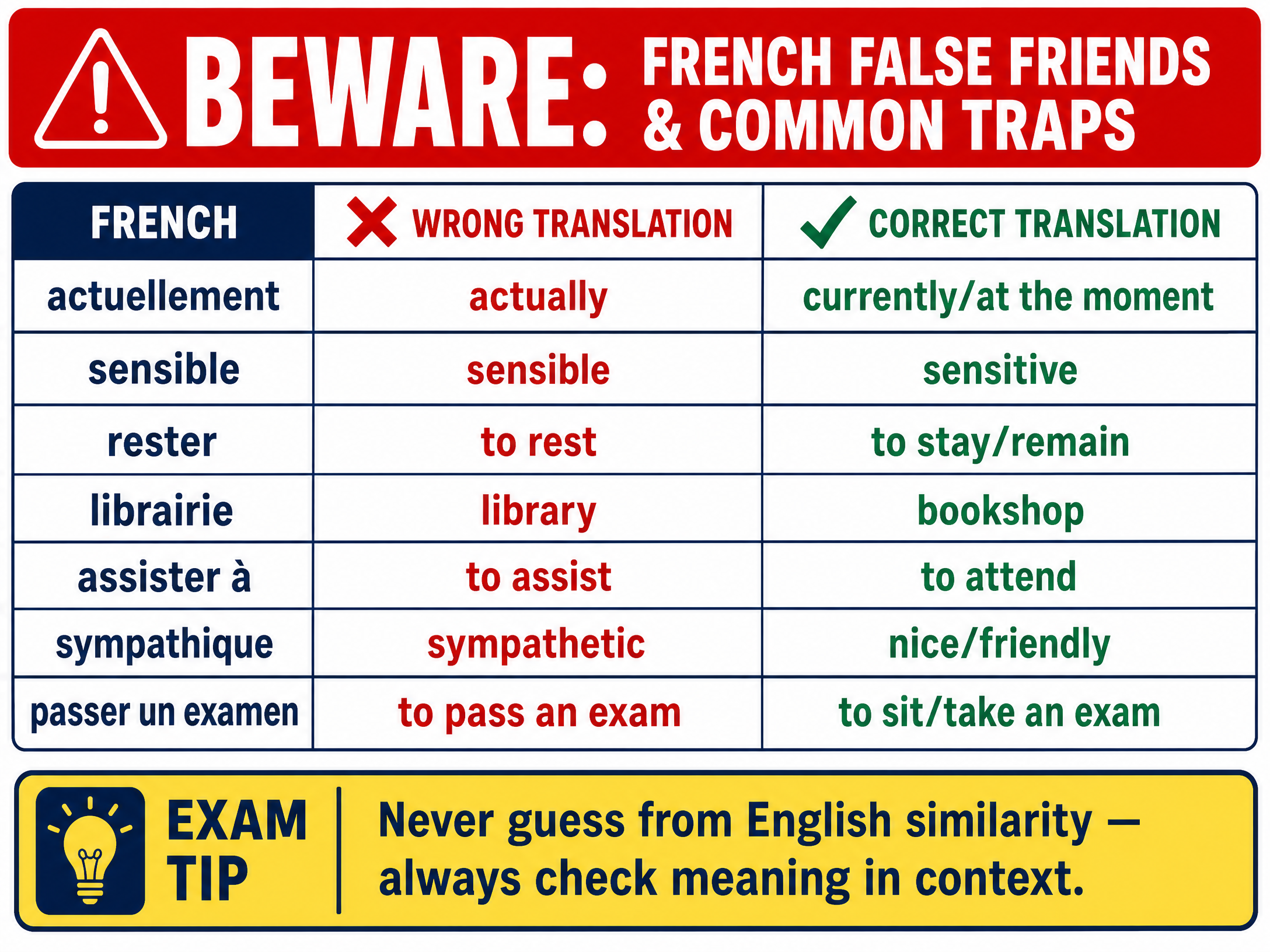
Common Traps & False Friends
Examiners deliberately include 'false friends' (faux amis) — words that look like English words but have different meanings — to test your precision.
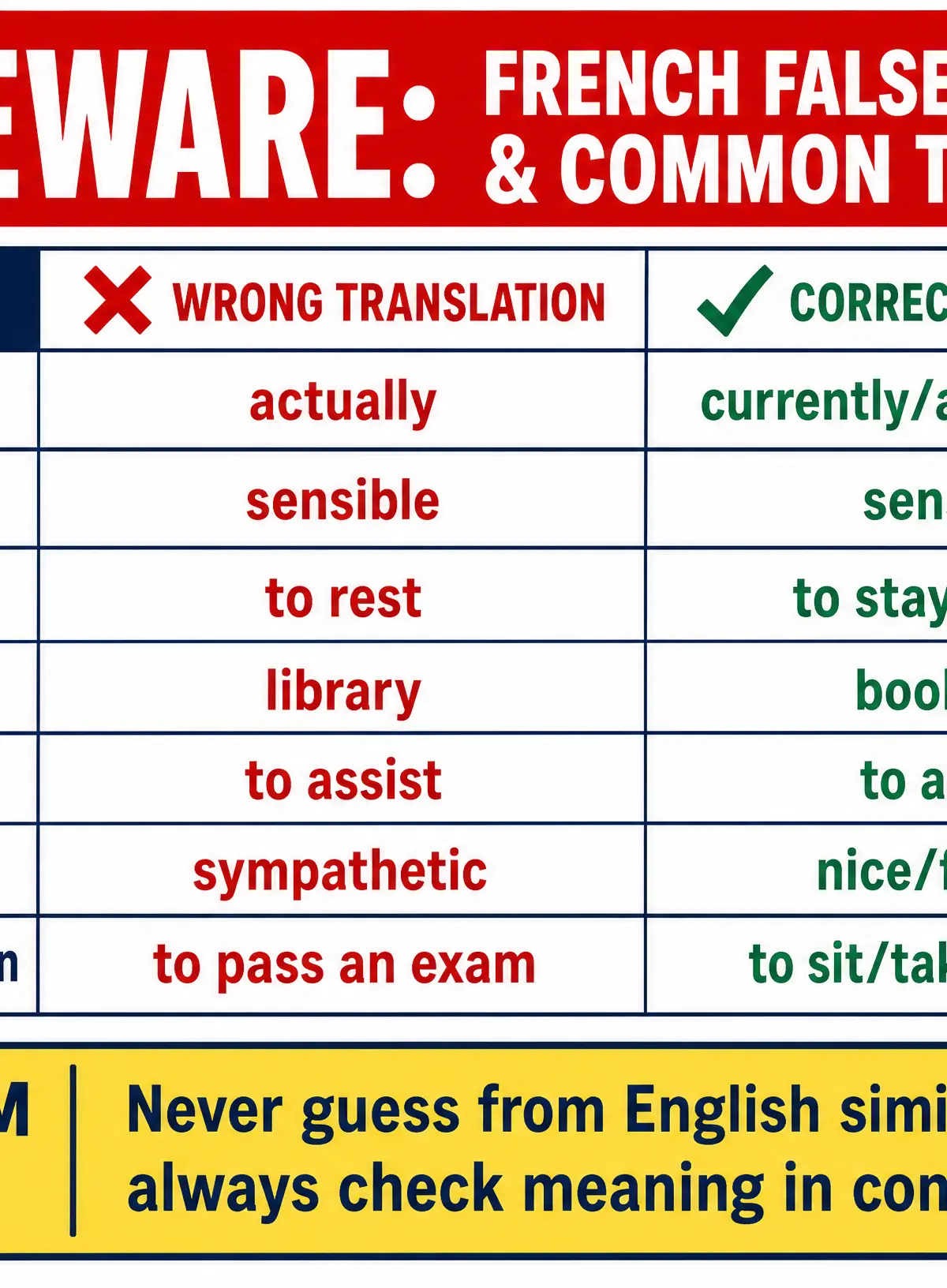
The 'Depuis' Trap
In French, using depuis (since/for) with the present tense describes an action that started in the past and is still continuing. In English, we use the present perfect continuous.
- French: J'habite ici depuis cinq ans.
- Incorrect English: I live here for five years.
- Correct English: I have been living here for five years.
Audio Resource: Podcast Revision
Listen to this 10-minute podcast episode where an expert tutor breaks down the translation process, highlights common errors, and tests your knowledge with a quick-fire recall quiz.

Visual Resources
3 diagrams and illustrations
Interactive Diagrams
1 interactive diagram to visualise key concepts
Conceptual Flow Outline
The Cognitive Translation Process
Worked Examples
3 worked examples — open one to explore the question and available guidance.
Practice Questions
Test your understanding — click to reveal model answers
Translate into English: 'Quand j'étais petit, je détestais les légumes, mais maintenant j'en mange tous les jours.' (4 marks)
Hint: Watch out for the imperfect tense at the start, and remember what the pronoun 'en' means.
Translate into English: 'Si j'avais beaucoup d'argent, j'achèterais une grande maison à la campagne.' (3 marks)
Hint: Identify the tense pattern triggered by 'Si' (If).
Translate into English: 'Mon frère ne fait jamais ses devoirs, ce qui est très agaçant.' (3 marks)
Hint: Spot the negative structure and be careful with 'ce qui'.
Translate into English: 'Il faut protéger l'environnement avant qu'il ne soit trop tard.' (3 marks)
Hint: How do you translate the idiom 'Il faut'?
Translate into English: 'Actuellement, je travaille dans une librairie le samedi.' (3 marks)
Hint: Beware of two major false friends in this sentence!