AQA · A-Level · History
Course version: 7042 · Version from Sept 2017
Recognition of the new nation: the conduct of the peace negotiations, the…
Full specification wording
2G The Birth of the USA, 1760–1801 – The War of Independence, 1776–1783 (A-level only): Recognition of the new nation: the conduct of the peace negotiations, the terms of the peace settlement 1783
The recognition of the new nation was formalised through the Treaty of Paris in 1783.
- Point 4 of 4
Study notes
From the teaching notes for this specification point.
The idea
The recognition of the new nation was formalised through the Treaty of Paris in 1783. The conduct of the peace negotiations was masterminded by American diplomats Franklin, Adams, and Jay. Recognising that French interests diverged from their own, the delegation shrewdly opened separate negotiations with the British. The resulting terms of the peace settlement 1783 were exceptionally generous. Britain formally recognised American independence and granted vast territorial boundaries stretching west to the Mississippi River. Other crucial terms included American fishing rights off Newfoundland, the validation of pre-war debts owed to British creditors, and a congressional recommendation to restore confiscated Loyalist property.
What earns the marks
- Analyse the diplomatic strategy of Franklin, Adams, and Jay in securing favourable terms by negotiating directly with Britain.
- Evaluate the reasons behind Britain's willingness to offer generous territorial concessions to the new nation.
- Detail the specific geographical boundaries established by the 1783 peace settlement, notably the Mississippi River as the western border.
- Assess the economic and social terms of the treaty, including fishing rights, debt repayment, and the treatment of Loyalists.
Common mistakes and how to put them right
Stating that the peace negotiations were conducted jointly by the Americans and their French allies.
Put it right: Clarify that the American diplomats negotiated separately with the British to secure better terms, bypassing French diplomatic objectives.
Assuming the Treaty of Paris resolved all tensions between Britain and the USA.
Put it right: Note that ambiguous terms regarding border forts and the failure to compensate Loyalists led to ongoing diplomatic disputes.
Confusing the 1783 Treaty of Paris with the 1763 Treaty of Paris.
Put it right: Explicitly link the 1783 treaty to the recognition of American independence and the end of the Revolutionary War.
Exam tips
- Highlight the skill of the American negotiators in exploiting the desire of the new British Prime Minister, Lord Shelburne, to separate the USA from France.
- Memorise the specific territorial boundaries granted in 1783, as this demonstrates precise factual knowledge of the settlement terms.
- Discuss the limitations of the treaty, particularly how the weak Continental Congress could not enforce the clauses regarding Loyalist property.
Try the lesson
The start of the 2G The Birth of the USA, 1760–1801 – The War of Independence, 1776–1783 (A-level only): Recognition of the new nation: the conduct of the peace negotiations, the terms of the peace settlement 1783 lesson, made from teaching notes for this specification point.
Have a go first
Under the terms of the 1783 peace settlement, which geographical feature was established as the western boundary of the newly recognised United States?
Listen
The recognition of the new nation was formalised through the Treaty of Paris in 1783. The conduct of the peace negotiations was masterminded by American diplomats Franklin, Adams, and Jay. Recognising that French interests diverged from their own, the delegation shrewdly opened separate negotiations with the British. The resulting terms of the peace settlement 1783 were exceptionally generous. Britain formally recognised American independence and granted vast territorial boundaries stretching west to the Mississippi River. Other crucial terms included American fishing rights off Newfoundland, the validation of pre-war debts owed to British creditors, and a congressional recommendation to restore confiscated Loyalist property. A strong answer earns marks for these points. Analyse the diplomatic strategy of Franklin, Adams, and Jay in securing favourable terms by negotiating directly with Britain. Evaluate the reasons behind Britain's willingness to offer generous territorial concessions to the new nation. Detail the specific geographical boundaries established by the 1783 peace settlement, notably the Mississippi River as the western border. Assess the economic and social terms of the treaty, including fishing rights, debt repayment, and the treatment of Loyalists. A common slip: Stating that the peace negotiations were conducted jointly by the Americans and their French allies. Instead, clarify that the American diplomats negotiated separately with the British to secure better terms, bypassing French diplomatic objectives. Exam tip: Highlight the skill of the American negotiators in exploiting the desire of the new British Prime Minister, Lord Shelburne, to separate the USA from France.
See it
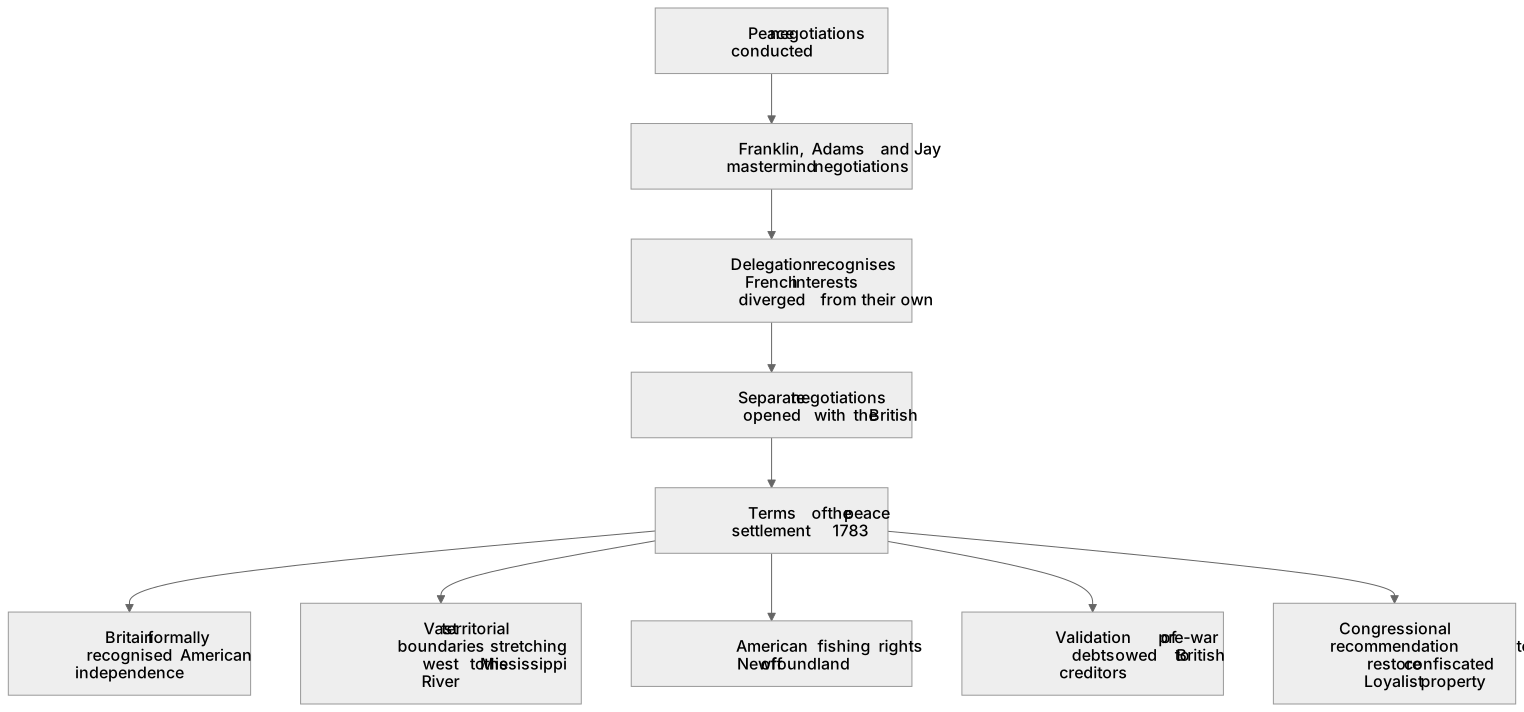
Label the diagram
Some boxes have lost their names. Pick the right name for each number.
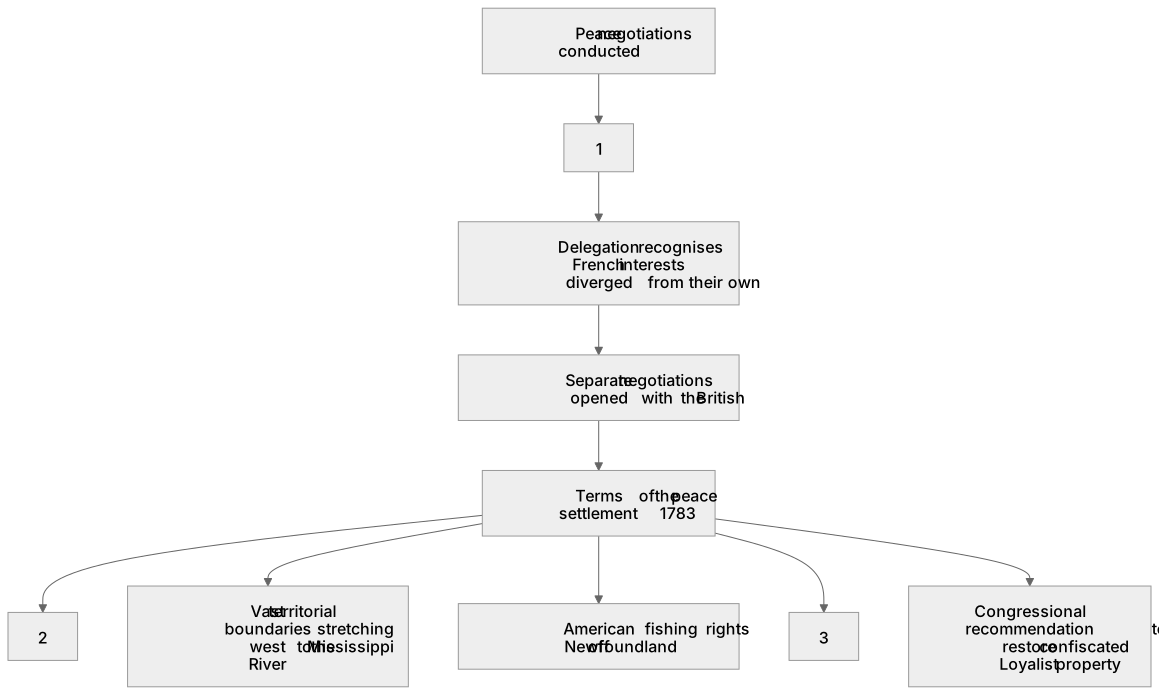
1Box 1
2Box 2
3Box 3
There is more to this lesson
The full lesson goes on to check your understanding and help you earn the marks. Create a free account to carry on, with your progress saved.
A week of Premium from your first lesson · Then the free plan continues · No card, no charge
Test your understanding of 2G The Birth of the USA, 1760–1801 – The War of Independence, 1776–1783 (A-level only): Recognition of the new nation: the conduct of the peace negotiations, the terms of the peace settlement 1783
Active recall beats re-reading. Take an instant quiz now to test what you’ve learned and lock it into long-term memory.
A week of Premium from your first lesson · Then the free plan continues · No card, no charge