AQA · A-Level · History
Course version: 7042 · Version from Sept 2017
The international context: the part played by France, diplomacy and sea…
Full specification wording
2G The Birth of the USA, 1760–1801 – The War of Independence, 1776–1783 (A-level only): The international context: the part played by France, diplomacy and sea power; the part played by Spain
The American War of Independence was transformed by its international context into a global conflict.
- Point 2 of 4
Study notes
From the teaching notes for this specification point.
The idea
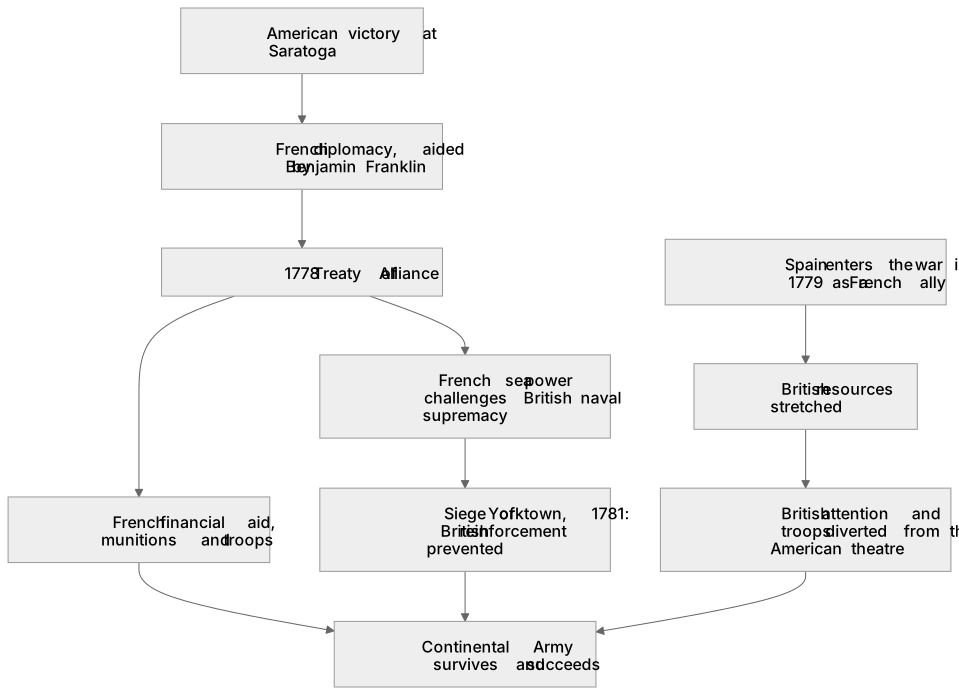
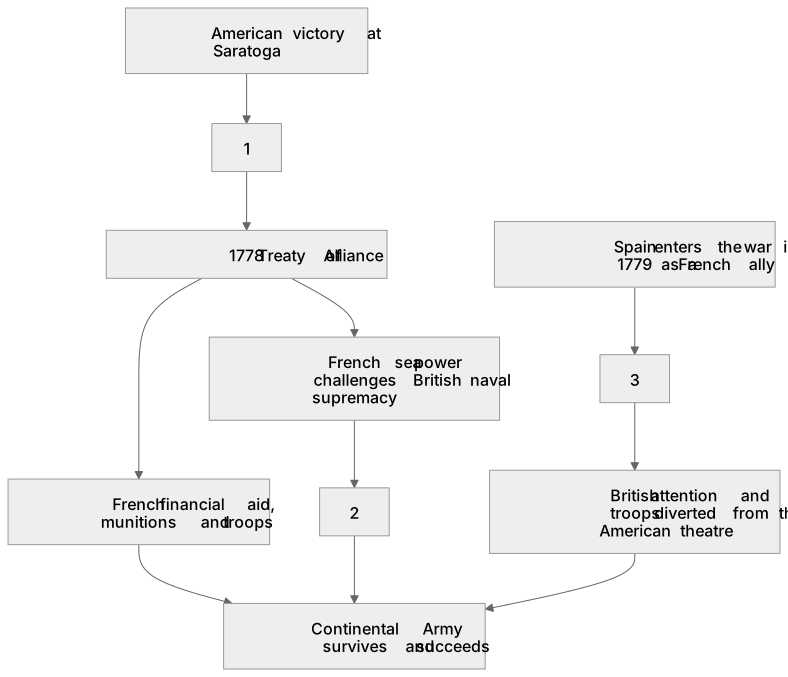
The American War of Independence was transformed by its international context into a global conflict. French diplomacy, aided by Benjamin Franklin, culminated in the 1778 Treaty of Alliance after the American victory at Saratoga. France provided crucial financial aid, munitions, and troops. Crucially, French sea power challenged British naval supremacy, preventing British reinforcement at the decisive Siege of Yorktown in 1781. Spain entered the war in 1779 as a French ally, further stretching British resources. Spain's military campaigns in Florida and naval pressure in Europe and the Caribbean diverted British attention and troops away from the primary American theatre, ensuring revolutionary success.
What earns the marks
- Analyse the diplomatic efforts, particularly by Benjamin Franklin, that secured formal French intervention after the pivotal Battle of Saratoga.
- Evaluate the impact of French sea power in neutralizing the Royal Navy's advantage, culminating in the decisive Battle of the Chesapeake.
- Assess the financial and military contributions of France, including troops, weapons, and loans, to the survival and success of the Continental Army.
- Explain how Spain's entry into the war in 1779 forced Britain to defend a global empire, diverting crucial resources from the American colonies.
Common mistakes and how to put them right
Treating the conflict as purely an Anglo-American war.
Put it right: Explicitly discuss how French and Spanish involvement turned it into a global struggle that overstretched British military capacity.
Underestimating the role of the French navy.
Put it right: Highlight that French sea power was the decisive factor at Yorktown, preventing British evacuation or reinforcement.
Confusing Spain's motivations with ideological support for the revolution.
Put it right: Clarify that Spain allied with France to regain lost territories like Gibraltar and Florida, not to support republicanism.
Exam tips
- Link diplomatic turning points, such as the victory at Saratoga, directly to the formal entry of France into the conflict.
- When discussing sea power, use the Battle of the Chesapeake (1781) as a concrete example of how French naval intervention sealed the British defeat.
- Ensure you explicitly mention Spain's role in diverting British military and naval resources to other theatres, such as the Caribbean and Gibraltar.
Try the lesson
The start of the 2G The Birth of the USA, 1760–1801 – The War of Independence, 1776–1783 (A-level only): The international context: the part played by France, diplomacy and sea power; the part played by Spain lesson, made from teaching notes for this specification point.
Have a go first
What was a primary strategic benefit of French entry into the American War of Independence?
Listen
The American War of Independence was transformed by its international context into a global conflict. French diplomacy, aided by Benjamin Franklin, culminated in the 1778 Treaty of Alliance after the American victory at Saratoga. France provided crucial financial aid, munitions, and troops. Crucially, French sea power challenged British naval supremacy, preventing British reinforcement at the decisive Siege of Yorktown in 1781. Spain entered the war in 1779 as a French ally, further stretching British resources. Spain's military campaigns in Florida and naval pressure in Europe and the Caribbean diverted British attention and troops away from the primary American theatre, ensuring revolutionary success. A strong answer earns marks for these points. Analyse the diplomatic efforts, particularly by Benjamin Franklin, that secured formal French intervention after the pivotal Battle of Saratoga. Evaluate the impact of French sea power in neutralizing the Royal Navy's advantage, culminating in the decisive Battle of the Chesapeake. Assess the financial and military contributions of France, including troops, weapons, and loans, to the survival and success of the Continental Army. Explain how Spain's entry into the war in 1779 forced Britain to defend a global empire, diverting crucial resources from the American colonies. A common slip: Treating the conflict as purely an Anglo-American war. Instead, explicitly discuss how French and Spanish involvement turned it into a global struggle that overstretched British military capacity. Exam tip: Link diplomatic turning points, such as the victory at Saratoga, directly to the formal entry of France into the conflict.
See it
Put the events in order
Put these events in the order they happened, earliest first.
- 1. Treaty of Alliance secured by French diplomacy
- 2. French sea power prevented British reinforcement at Yorktown
- 3. Spain entered the war as a French ally
Label the diagram
Some boxes have lost their names. Pick the right name for each number.
1Box 1
2Box 2
3Box 3
There is more to this lesson
The full lesson goes on to check your understanding and help you earn the marks. Create a free account to carry on, with your progress saved.
A week of Premium from your first lesson · Then the free plan continues · No card, no charge
Test your understanding of 2G The Birth of the USA, 1760–1801 – The War of Independence, 1776–1783 (A-level only): The international context: the part played by France, diplomacy and sea power; the part played by Spain
Active recall beats re-reading. Take an instant quiz now to test what you’ve learned and lock it into long-term memory.
A week of Premium from your first lesson · Then the free plan continues · No card, no charge