AQA · A-Level · Mathematics
Trigonometry
Master AQA A-Level Trigonometry, from reciprocal functions and compound angles to harmonic form and proofs. This guide provides everything you need to solve complex problems, secure top marks, and understand the maths of waves and oscillations."
- 6 min read
- 3 worked examples
- 5 practice questions
Study Notes

Overview
Trigonometry at A-Level is a significant step up from GCSE. It forms the mathematical backbone for describing any periodic, wave-like phenomena, from sound and light to alternating current and harmonic motion. For the AQA specification, your fluency in this topic is critical, as it integrates heavily with algebra, calculus, and geometric reasoning. Examiners will test your ability not just to solve equations, but to construct rigorous proofs and apply trigonometric models to abstract and real-world problems. A typical exam question might ask you to prove a complex identity, solve an equation involving reciprocal functions for a specific range, or find the maximum displacement of a modelled tide. Mastering the content in this guide will equip you to handle these challenges with confidence.
Key Concepts
Concept 1: The Unit Circle and Radian Measure
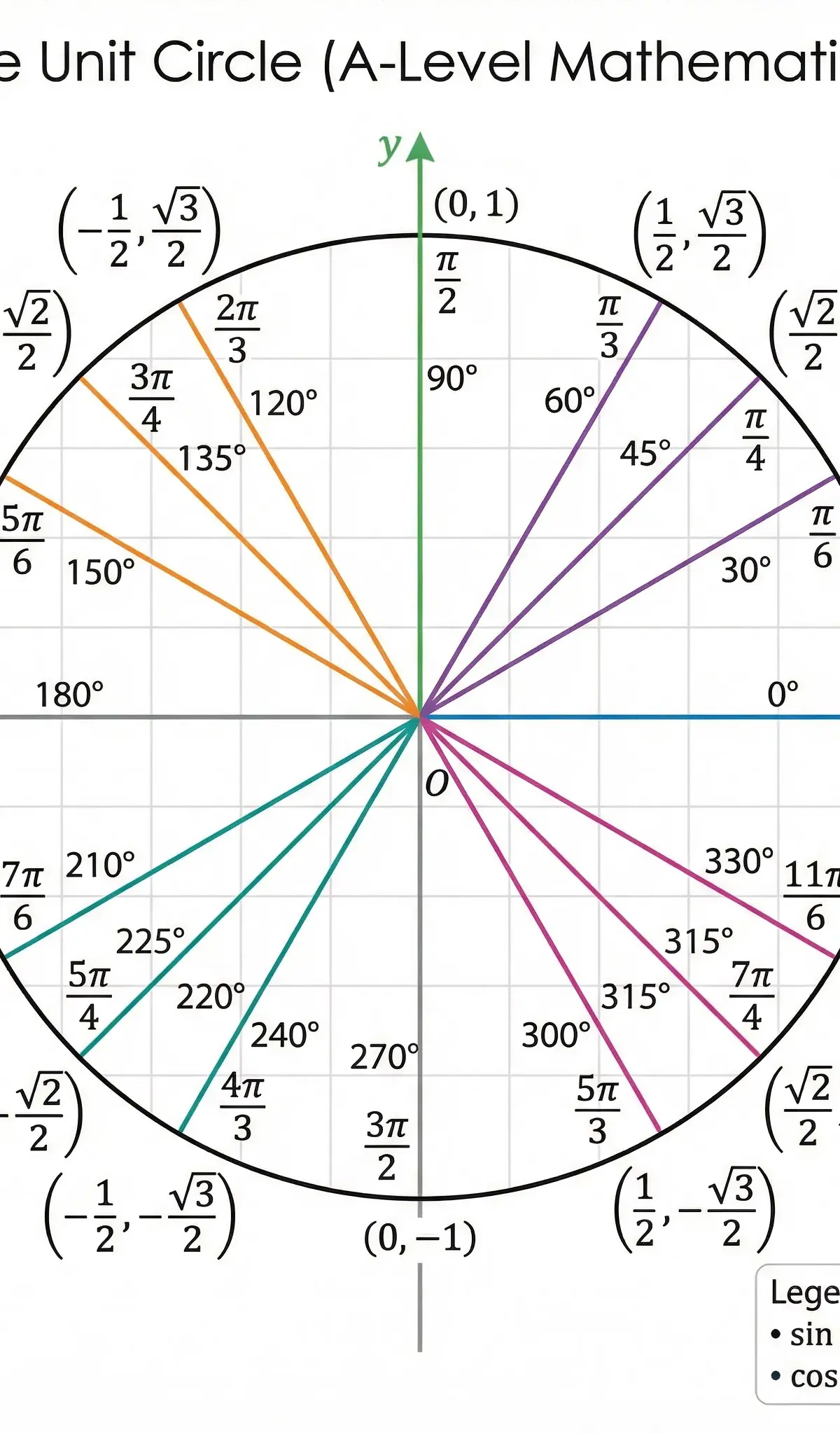
The unit circle is your new best friend. It's a circle with a radius of 1 centered at the origin, and it provides a visual foundation for all trigonometric functions. For any point (x, y) on the circle, the angle ( heta ) (measured in radians counter-clockwise from the positive x-axis) is linked to the coordinates by ( x = \cos( heta) ) and ( y = \sin( heta) ). This is why ( \cos^2 heta + \sin^2 heta = 1 ) – it's just Pythagoras's theorem on the circle! Radians are the natural unit for measuring angles at this level, especially in calculus. Remember that ( 2\pi ) radians is a full circle (360°).
Example: To find the exact value of (\cos(5\pi/4) ), you would locate the angle on the unit circle. It lies in the third quadrant, where both x and y are negative. The reference angle is (\pi/4 ), and (\cos(\pi/4) =\sqrt{2}/2 ). Therefore, (\cos(5\pi/4) = -\sqrt{2}/2 ).
Concept 2: Reciprocal and Pythagorean Identities
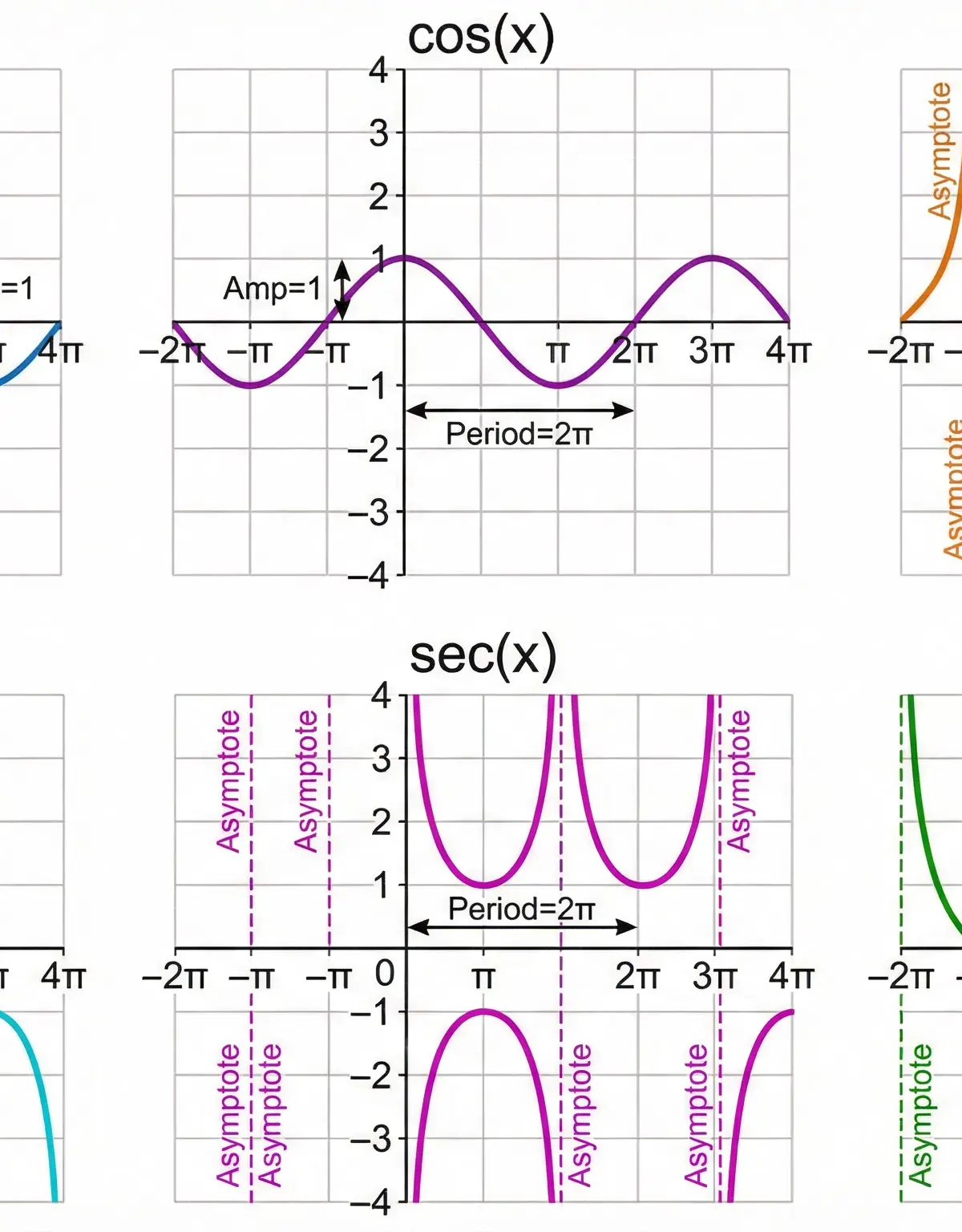
Beyond sine, cosine, and tangent, you must master the reciprocal functions: secant (sec), cosecant (cosec), and cotangent (cot).
- ( \sec(x) = 1 /\cos(x) )
- ( \csc(x) = 1 /\sin(x) ) (often written as cosec)
- ( \cot(x) = 1 / an(x) =\cos(x) /\sin(x) )
These lead to two more essential Pythagorean identities, derived by dividing ( \sin^2 heta + \cos^2 heta = 1 ) by ( \cos^2 heta ) and ( \sin^2 heta ) respectively:
- ( 1 + an^2 heta = \sec^2 heta )
- ( 1 + \cot^2 heta = \csc^2 heta )
Examiners award marks for using these identities to simplify equations into a single trigonometric function.
Concept 3: Compound and Double Angle Formulas
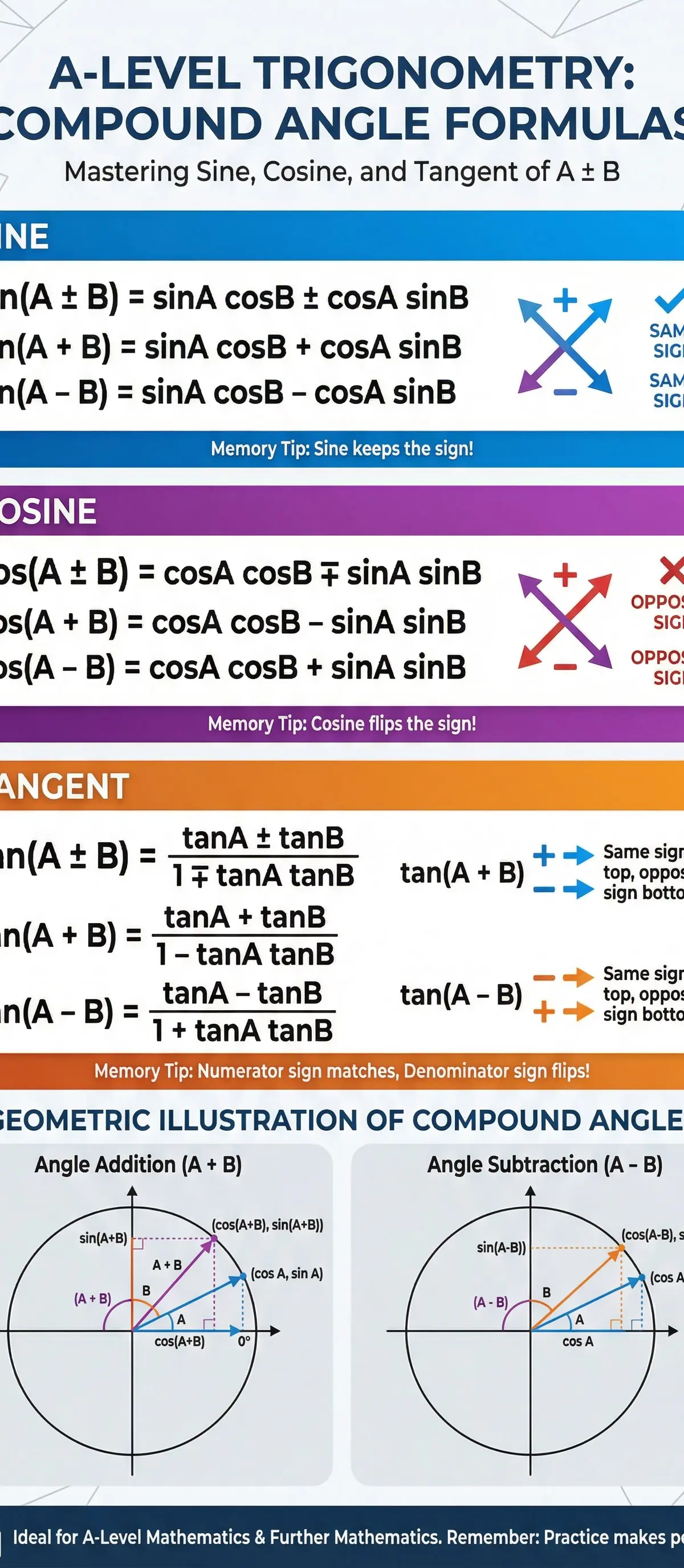
These formulas (which you must memorise) are used to expand expressions like ( \sin(A+B) ) or ( \cos(2A) ). They are fundamental for solving more complex equations and for calculus involving trigonometric functions.
Compound Angle Formulas:
- (\sin(A \pm B) =\sin A \cos B \pm \cos A \sin B)
- (\cos(A \pm B) =\cos A \cos B \mp \sin A \sin B) (Note the sign flip!)
- ( an(A \pm B) = (an A \pm an B) / (1 \mp an A an B) )
Double Angle Formulas (derived by setting A=B):
- (\sin(2A) =2\sin A \cos A)
- (\cos(2A) =\cos^2 A -\sin^2 A =2\cos^2 A - 1 = 1 -2\sin^2 A )
- ( an(2A) = 2 an A / (1 - an^2 A) )
Concept 4: Harmonic Form (R-alpha method)
Expressions of the form ( a\cos x + b\sin x ) can be written as a single sinusoidal function, ( R\cos(x - \alpha) ) or ( R\sin(x + \alpha) ). This is crucial for finding maximum/minimum values and solving equations.
To express ( a\cos x + b\sin x ) in the form ( R\cos(x - \alpha) ):
- ( R =\sqrt{a^2 + b^2} )
- Expand (R\cos(x -\alpha) = R(\cos x \cos \alpha+\sin x \sin \alpha) )
- Compare coefficients: ( a =R\cos \alpha) and ( b =R\sin \alpha). This leads to (an \alpha= b/a ).
Example: The maximum value of (3\cos x+4\sin x) is ( R =\sqrt{3^2 + 4^2} = 5 ), because the maximum value of the cosine function is 1.
Mathematical Relationships
| Formula | Status | Use Case |
|---|---|---|
| ( \sin^2 heta + \cos^2 heta = 1 ) | Must memorise | The fundamental identity. Used in almost all proofs and equation solving. |
| ( 1 + an^2 heta = \sec^2 heta ) | Must memorise | Solving equations involving tan and sec. |
| ( 1 + \cot^2 heta = \csc^2 heta ) | Must memorise | Solving equations involving cot and cosec. |
| Compound Angle Formulas | Must memorise | Expanding expressions, proofs, calculus. |
| Double Angle Formulas | Must memorise | Simplifying expressions, solving equations, integration. |
| Small Angle Approximations: ( \sin heta \approx heta ), ( \cos heta \approx 1 - heta^2/2 ), ( an heta \approx heta ) | Given on formula sheet | Used for finding limits and approximating values for small angles (in RADIANS). |
| Harmonic Form: ( a\cos x + b\sin x = R\cos(x-\alpha) ) | Must memorise method | Finding max/min values, solving equations, modelling waves. |
Practical Applications
Trigonometry is essential in many fields:
- Physics: Modelling simple harmonic motion (e.g., a pendulum), analysing AC circuits, and describing wave phenomena like light and sound.
- Engineering: Designing structures, calculating forces in mechanics, and in signal processing.
- Computer Graphics: Rotating and transforming objects in 2D and 3D space.
- Geography & Navigation: Calculating distances and positions using triangulation.
"
Worked Examples
3 worked examples — open one to explore the question and available guidance.
Practice Questions
Test your understanding — click to reveal model answers
Show that the equation ( an^2 x = 3\sin x ) can be written as ( 3\sin^2 x \cos x + \sin^2 x - 1 = 0 ).
Hint: Start by expressing tan(x) in terms of sin(x) and cos(x).
Find the exact value of ( \cos(15^{\circ}) ) using a compound angle formula.
Hint: Think of two standard angles (like 45°, 30°, 60°) that can be combined to make 15°.
A voltage V is modelled by the equation ( V = 120\cos(100\pi t) + 160\sin(100\pi t) ). Express V in the form ( R\cos(100\pi t - \alpha) ) and find the peak voltage.
Hint: This is a harmonic form question. The term \( 100\pi t \) can be treated as a single angle, say \( heta \).
Solve ( \sec^2 x - an x = 3 ) for ( 0 \le x < 360^{\circ} ).
Hint: Use a Pythagorean identity to get an equation solely in terms of tan(x).
Using small angle approximations, find an approximate value for ( \frac{\cos(4 heta) - 1}{ heta \sin(2 heta)} ) when ( heta ) is small.
Hint: Use \( \cos(x) \approx 1 - x^2/2 \) and \( \sin(x) \approx x \). Be careful with the arguments (4\( heta \) and 2\( heta \)).