OCR · GCSE · Mathematics
Angles
Master the fundamental principles of angles for your OCR GCSE Maths exam. This guide breaks down everything from basic angle types to complex geometric proofs, providing examiner insights and memory hooks to help you secure every possible mark.
- 5 min read
- 3 worked examples
- 5 practice questions
- 6 key terms
Check what you remember
Read the wording for your board, then hide it and explain Parallel Lines in your own words. Rough notes are fine. This is a self-check, with no mark or grade.
Reference: OCR
Lines in a plane that are always the same distance apart and never intersect.
Study Notes

Overview
Angles are a cornerstone of geometry and a significant component of the OCR GCSE Mathematics assessment. This topic is not just about calculating the size of an angle; it is about developing rigorous logical reasoning and communicating your method using precise mathematical language. Examiners will test your ability to apply standard geometric facts to a variety of problems, from straightforward calculations on the Foundation tier to multi-step algebraic proofs on the Higher tier. A solid understanding of angles is crucial as it forms the foundation for more advanced topics like trigonometry and vector geometry. In the exam, you can expect to see questions that require you to find missing angles in diagrams involving triangles, quadrilaterals, and parallel lines, as well as more complex problems involving polygons and circle theorems (Higher tier only). Marks are awarded not just for the correct answer, but for the clear, step-by-step justification of your calculations.
Key Concepts
Concept 1: Angle Types and Properties
Understanding the basic types of angles is the first step to success. Each has a specific property that you must be able to recall and apply.
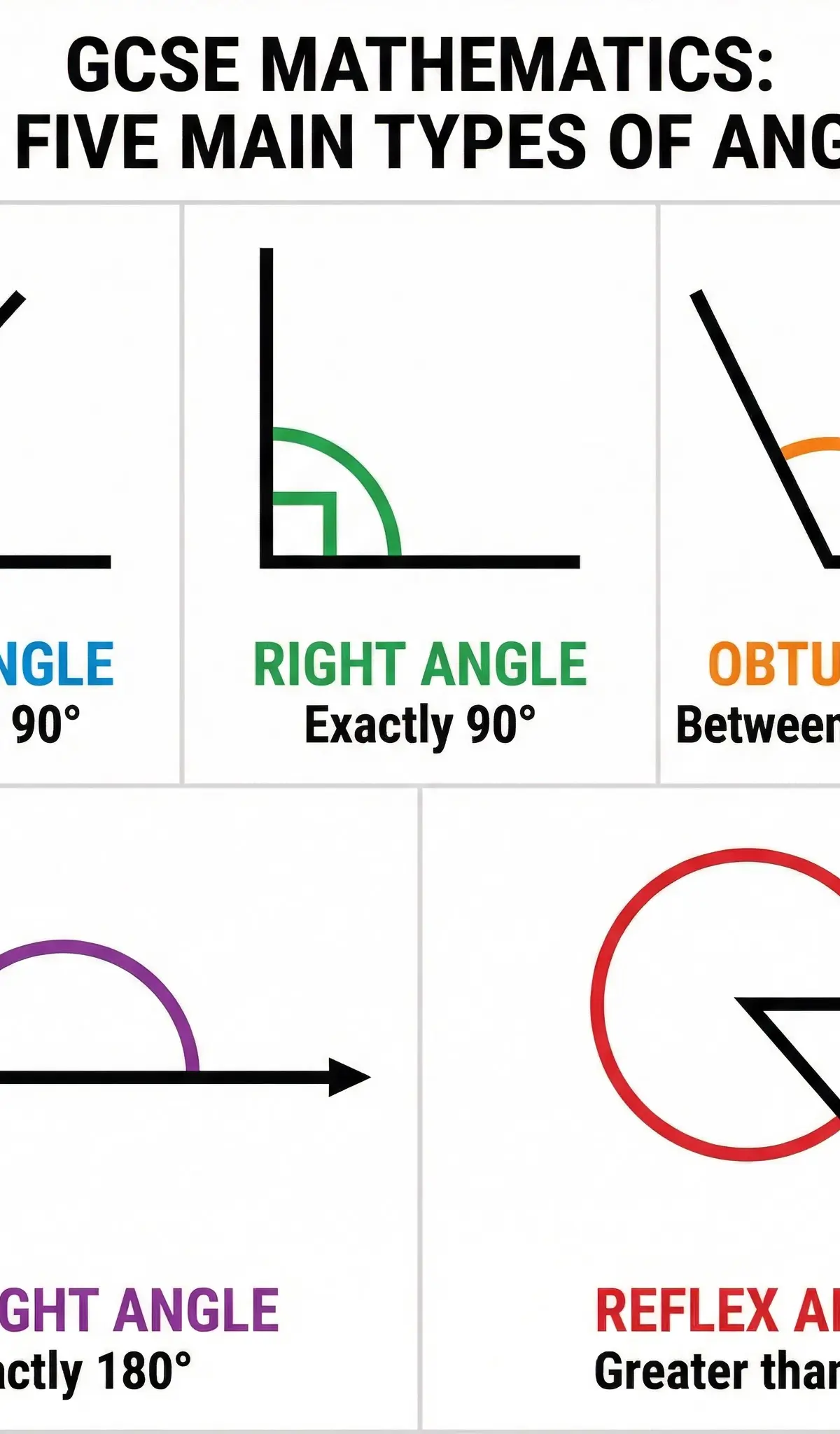
- Acute Angle: An angle that is less than 90°. Think of it as a "sharp" or "acute" point.
- Right Angle: An angle that is exactly 90°. It is always marked with a small square in the corner.
- Obtuse Angle: An angle that is greater than 90° but less than 180°. Think of it as a "blunt" or "obtuse" corner.
- Straight Angle: An angle that is exactly 180°. This forms a straight line.
- Reflex Angle: An angle that is greater than 180° but less than 360°. It represents the "outside" of a regular angle.
Beyond these types, you must know two fundamental rules:
- Angles on a Straight Line: Angles that lie on a straight line add up to 180°.
- Angles Around a Point: Angles that meet at a point add up to 360°.
Concept 2: Angles in Parallel Lines
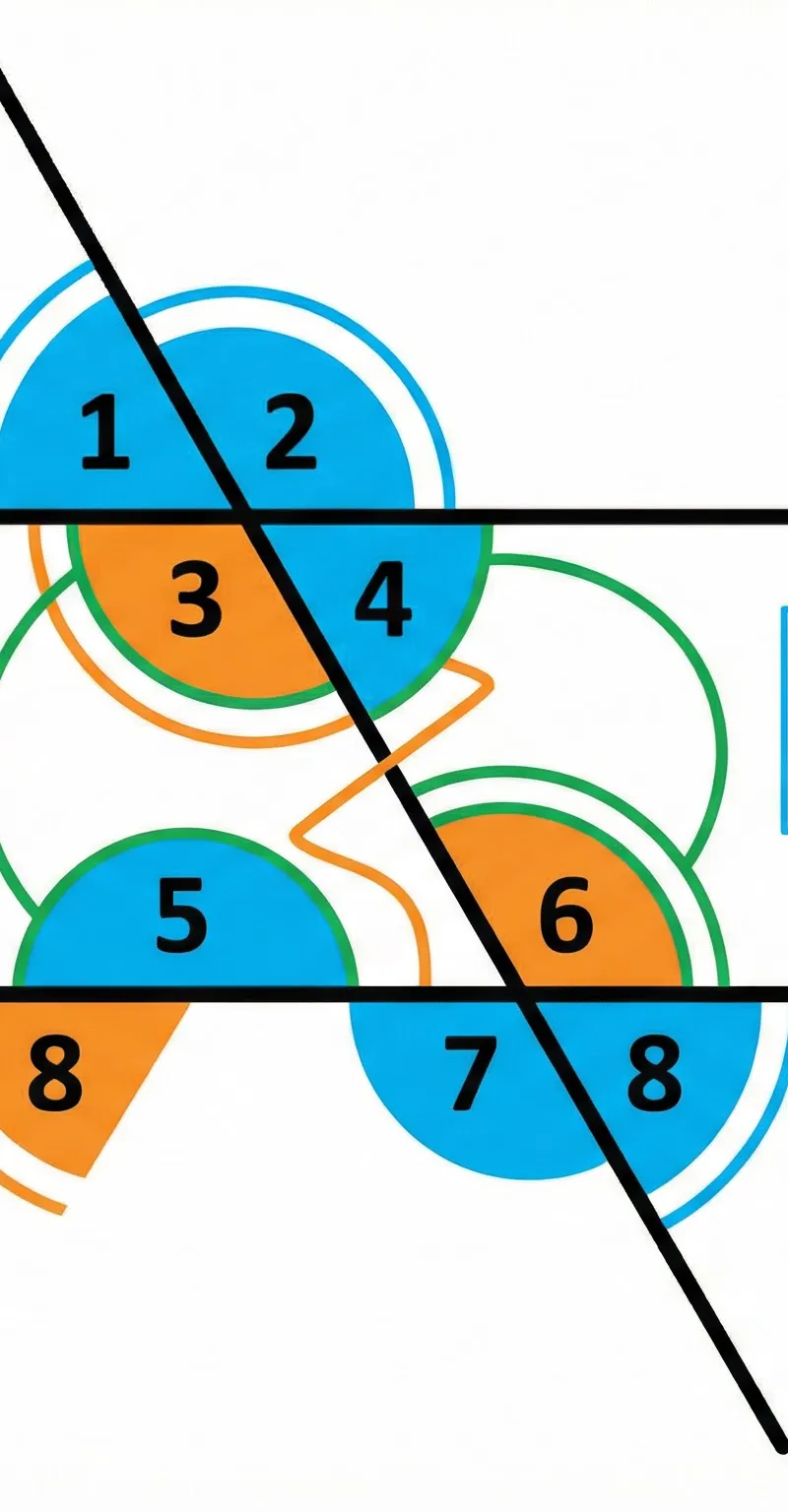
When a straight line, called a transversal, intersects two parallel lines, a set of predictable angle relationships is formed. Mastering these is essential for a huge number of exam questions.
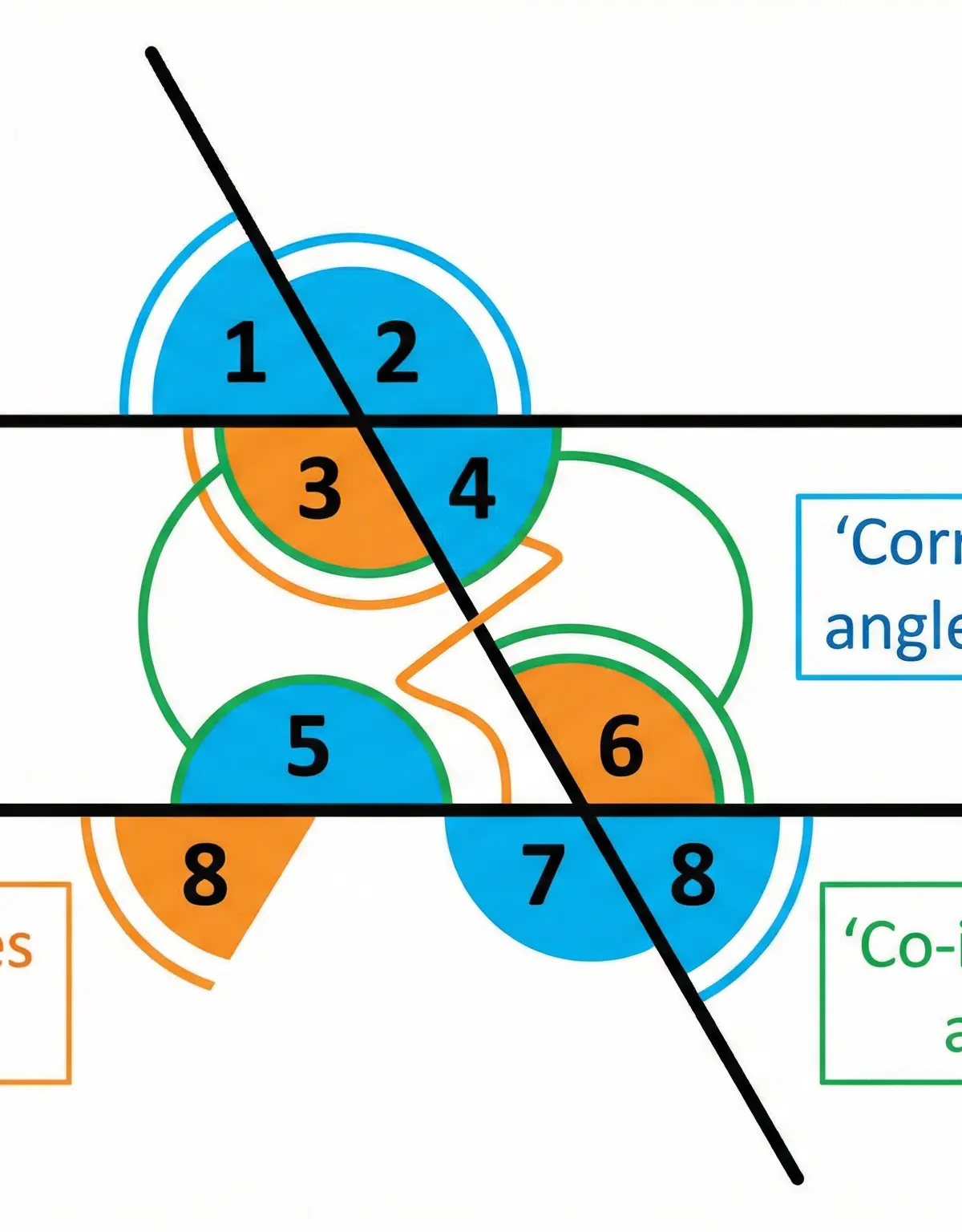
- Corresponding Angles: These are in the same position at each intersection. They are equal. A common way to remember this is to look for an "F" shape in the diagram.
- Alternate Angles: These are on opposite sides of the transversal and between the parallel lines. They are equal. Look for a "Z" shape.
- Co-interior (or Allied) Angles: These are on the same side of the transversal and between the parallel lines. They add up to 180°. Look for a "C" shape.
Examiner's Note: You will receive zero marks for reasoning if you use terms like "Z-angles" or "F-angles". You MUST use the correct terminology: alternate, corresponding, or co-interior.
Concept 3: Angles in Polygons
A polygon is a 2D shape with straight sides. The rules for their angles are a common source of exam questions.
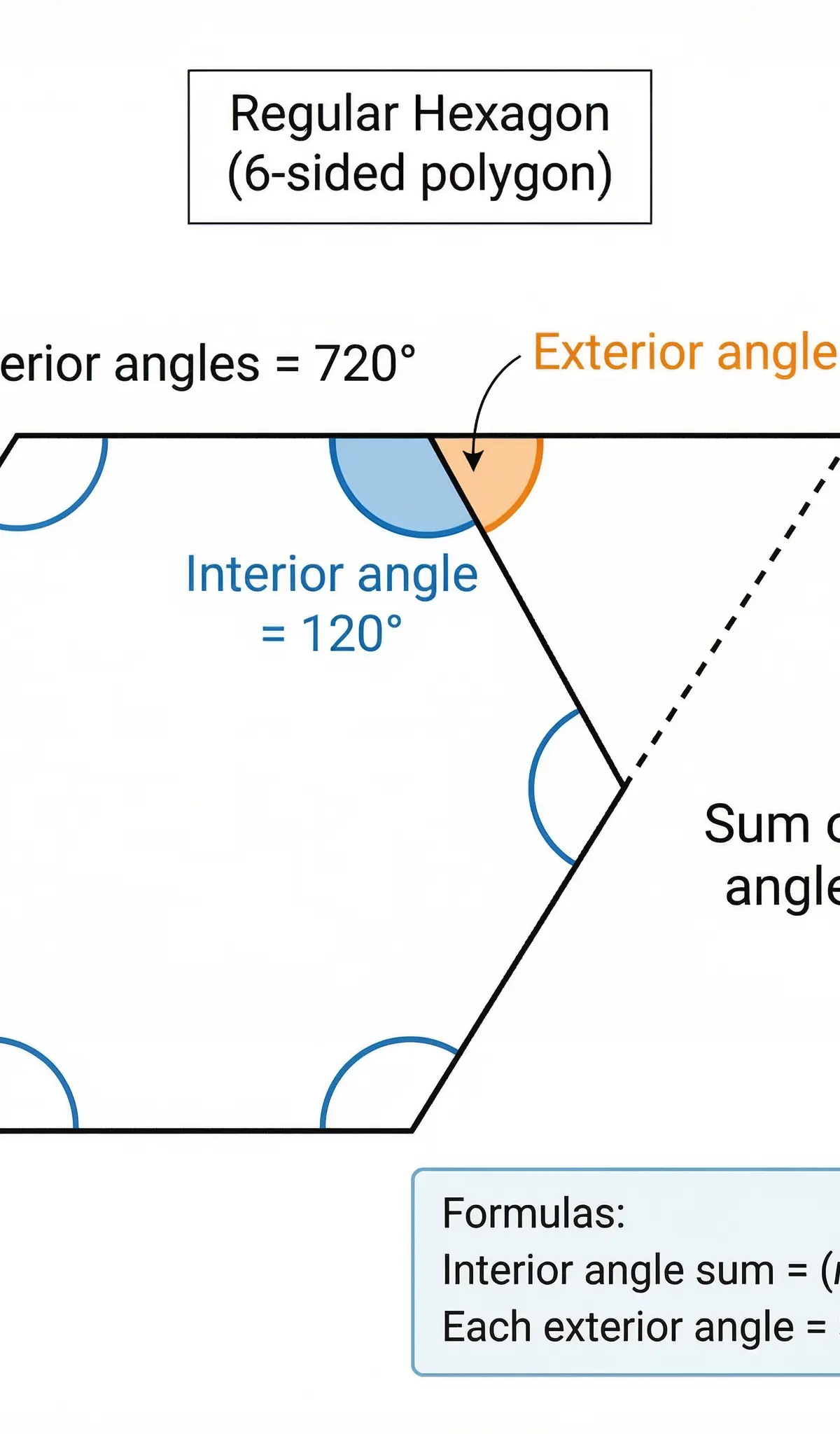
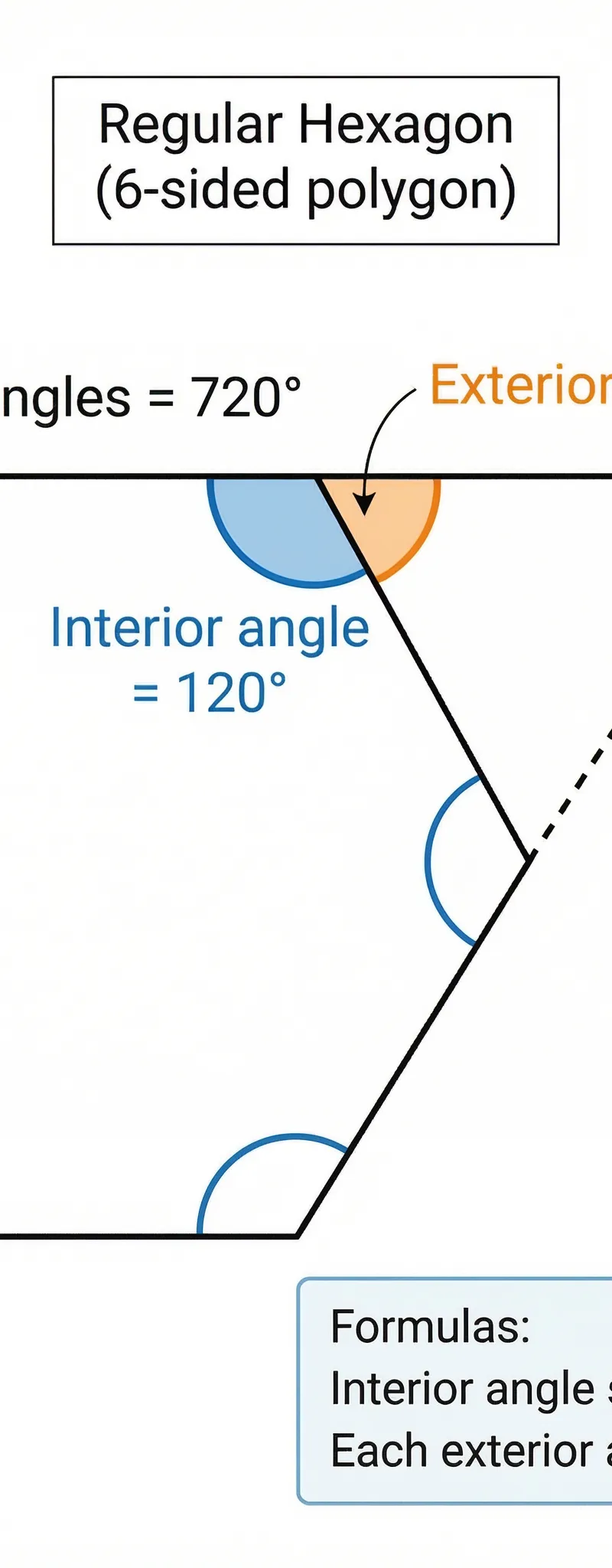
- Interior Angles: The sum of the interior angles of a polygon with n sides is given by the formula: Sum = (n - 2) × 180°. You must memorise this.
- Exterior Angles: The exterior angle is the angle formed by extending one of the sides. The sum of the exterior angles of ANY convex polygon is always 360°. For a regular polygon with n sides, each exterior angle is 360° / n.
Exam Tip: It is often quicker to calculate the exterior angle of a regular polygon first and then find the interior angle by subtracting from 180° (since they form a straight line).
Mathematical/Scientific Relationships
- Sum of angles in a triangle: A + B + C = 180° (Must memorise)
- Sum of angles in a quadrilateral: A + B + C + D = 360° (Must memorise)
- Sum of interior angles of a polygon: (n - 2) × 180° (Must memorise)
- Exterior angle of a regular polygon: 360° / n (Must memorise)
- Interior angle + Exterior angle: 180° (Must memorise)
Practical Applications
Angles are fundamental in many real-world fields. Architects and engineers use angles to design stable and safe structures, from bridges to skyscrapers. Navigators and pilots use angles (bearings) to plot courses and determine their position. In computer graphics and game design, angles are used to calculate the movement and interaction of objects in a virtual 3D space. Even in sports like snooker or football, players intuitively use angles to predict the path of a ball.
Visual Resources
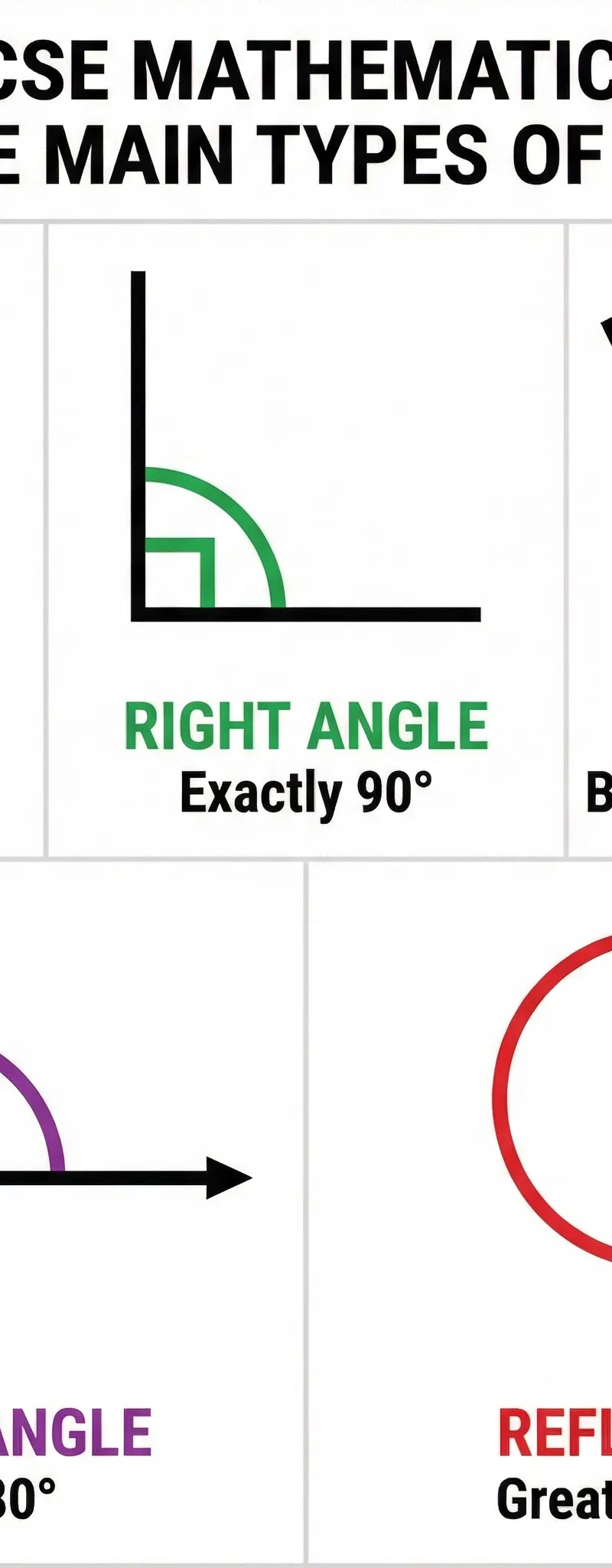
3 diagrams and illustrations
Interactive Diagrams
2 interactive diagrams to visualise key concepts
Conceptual Flow Outline
A flowchart to help decide which angle rule to apply in an exam question.
Conceptual Flow Outline
A concept map showing the importance of precise reasoning for earning marks in OCR exams.
Worked Examples
3 worked examples — open one to explore the question and available guidance.
Practice Questions
Try the question, then reveal an answer plan or example response
A triangle has angles 2x, 3x, and 4x. Find the value of x.
Hint: What do the angles in any triangle add up to?
One exterior angle of a regular polygon is 40°. How many sides does the polygon have?
Hint: The sum of all exterior angles is always the same, regardless of the number of sides.
In a diagram, two lines intersect. One angle is 65°. State the size of the vertically opposite angle and give a reason.
Hint: What is the relationship between angles formed by intersecting lines?
Find the size of angle x in the diagram provided, where line L1 is parallel to line L2. Give reasons for your answer.
Hint: You will need to use more than one angle rule. Find other angles in the diagram first to help you.
The interior angle of a regular polygon is 156°. How many sides does it have?
Hint: It's easier to work with the exterior angle first.
Exam technique
How to turn what you know into marks
How to approach the question
1. Read the question carefully and identify the command word (e.g., 'Calculate', 'Give a reason'). 2. Annotate the diagram with any information given in the text. 3. Identify the geometric properties that apply to the diagram (parallel lines, triangles, polygons). 4. Form a plan to find the required angle, working step-by-step. 5. Write down each step of your calculation and state the full geometric reason next to it.
How to structure your answer
For a multi-step 'Give reasons' question, structure your answer as a logical argument. For example: 'Angle X = 50° because angles on a straight line add up to 180°. Angle Y = 50° because alternate angles are equal.' This makes it easy for the examiner to follow your logic and award marks.
Timing
Approximately 1 minute per mark, so a 4-mark question should take about 4-5 minutes.
Common pitfalls
- Using colloquial terms like 'Z-angles' instead of 'alternate angles'. This gets zero marks for reasoning.
- Assuming lines are parallel from appearance. Look for the arrow symbols.
- Forgetting to give a reason for every step when the question asks for justification.
- Mixing up the interior and exterior angle formulas for polygons.
What the command words want
- Compare
- Identify similarities and differences between two shapes or values.
- Explain
- Provide reasons for your answer. Use the word 'because' to link your calculation to a geometric fact.
- Describe
- Provide a detailed account of the properties of a shape or transformation.
- Evaluate
- Make a judgement based on evidence, for example, which method is more efficient.
- Calculate
- Work out the value of something. You must show your working to get full marks.
- State/Give
- Write down a brief factual answer, often a single value or term.
Watch or listen (optional)
Test your understanding of Angles
Active recall beats re-reading. Take an instant quiz now to test what you’ve learned and lock it into long-term memory.
A week of Premium from your first lesson · Then the free plan continues · No card, no charge