WJEC · A-Level · Mathematics
Course version: 603/1977/X · Version from Sept 2017
Pure Mathematics A): Solution of quadratic equations in a function of the…
Full specification wording
Algebra and Functions (AS Unit 1: Pure Mathematics A): Solution of quadratic equations in a function of the unknown.
Equations that are quadratic in form can be solved by substituting a temporary variable u = g(x) to reduce them to au² + bu + c = 0.
- Point 6 of 17
- 4 key terms
Study notes
From the teaching notes for this specification point.
The idea
Equations that are quadratic in form can be solved by substituting a temporary variable u = g(x) to reduce them to au² + bu + c = 0. Common examples include quartics with even powers ax⁴ + bx² + c = 0 (where u = x²), exponential equations a(eˣ)² + beˣ + c = 0 (where u = eˣ), equations involving surds ax + b√x + c = 0 (where u = √x), and trigonometric quadratics a sin²θ + b sin θ + c = 0 (where u = sin θ). After solving for the values of u using factorisation or the quadratic formula, each root must be reversed through the inverse function x = g⁻¹(u). Critical domain restrictions must be applied: u = eˣ requires u > 0, u = √x requires u ≥ 0, and trigonometric substitutions require −1 ≤ u ≤ 1, rejecting invalid branches.
What earns the marks
- Identifying the underlying quadratic structure and stating a suitable substitution u = g(x).
- Solving the resulting quadratic equation au² + bu + c = 0 for u.
- Rejecting inadmissible values of u based on domain restrictions.
- Solving the substituted equations to find all valid values of the original variable x.
Common mistakes and how to put them right
Stopping after finding the values of u without solving for the original variable x.
Accepting negative values of u when u = eˣ or u = √x, leading to invalid logarithms or square roots.
Exam tips
- Always write down your substitution explicitly, such as 'let u = x²'.
- Check each candidate solution in the original equation to filter out extraneous roots.
Try the lesson
The start of the Algebra and Functions (AS Unit 1: Pure Mathematics A): Solution of quadratic equations in a function of the unknown. lesson, made from teaching notes for this specification point.
Have a go first
Solve the equation 2²ˣ − 5(2ˣ) + 4 = 0 for real values of x.
Listen
Equations that are quadratic in form can be solved by substituting a temporary variable u = g(x) to reduce them to au² + bu + c = 0. Common examples include quartics with even powers ax⁴ + bx² + c = 0 (where u = x²), exponential equations a(eˣ)² + beˣ + c = 0 (where u = eˣ), equations involving surds ax + b√x + c = 0 (where u = √x), and trigonometric quadratics a sin²θ + b sin θ + c = 0 (where u = sin θ). After solving for the values of u using factorisation or the quadratic formula, each root must be reversed through the inverse function x = g⁻¹(u). Critical domain restrictions must be applied: u = eˣ requires u > 0, u = √x requires u ≥ 0, and trigonometric substitutions require −1 ≤ u ≤ 1, rejecting invalid branches. A strong answer earns marks for these points. identifying the underlying quadratic structure and stating a suitable substitution u = g(x). solving the resulting quadratic equation au² + bu + c = 0 for u. rejecting inadmissible values of u based on domain restrictions. solving the substituted equations to find all valid values of the original variable x. Exam tip: Always write down your substitution explicitly, such as 'let u = x²'.
See it
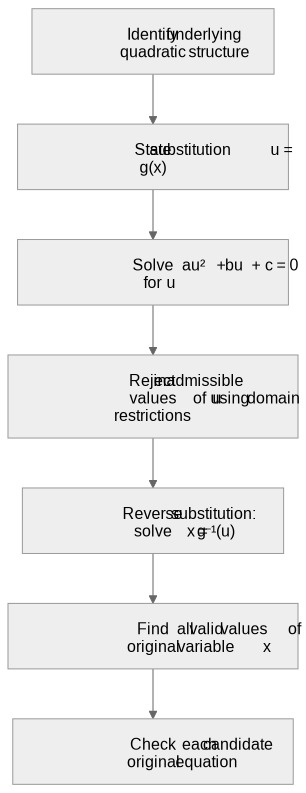
Put it in order
Put these steps in the order they happen.
- 1. Check each candidate in original equation
- 2. Find all valid values of original variable x
- 3. Solve au² + bu + c = 0 for u
- 4. Reverse substitution: solve x = g⁻¹(u)
- 5. Identify underlying quadratic structure
- 6. State substitution u = g(x)
- 7. Reject inadmissible values of u using domain restrictions
Key words
Say what each word means before you turn the card.
quadratic substitution
Try answering aloud or in your head before turning the card.
hidden quadratics
Try answering aloud or in your head before turning the card.
domain restrictions
Try answering aloud or in your head before turning the card.
disguised equations
Try answering aloud or in your head before turning the card.
See every definition
- quadratic substitution
- A temporary variable u = g(x) is substituted to reduce an equation to the form au² + bu + c = 0.
- hidden quadratics
- Equations that are quadratic in form, including quartics with even powers, exponential equations, equations involving surds and trigonometric quadratics.
- domain restrictions
- Conditions such as u > 0 for u = eˣ, u ≥ 0 for u = √x and −1 ≤ u ≤ 1 for trigonometric substitutions, rejecting invalid branches.
- disguised equations
- Equations that are quadratic in form, solved by substituting a temporary variable u = g(x) and reversing each root through the inverse function.
Label the diagram
Some boxes have lost their names. Pick the right name for each number.
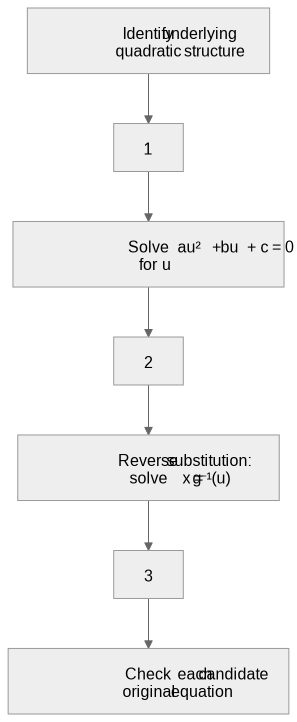
1Box 1
2Box 2
3Box 3
There is more to this lesson
The full lesson goes on to check your understanding and help you earn the marks. Create a free account to carry on, with your progress saved.
A week of Premium from your first lesson · Then the free plan continues · No card, no charge
Test your understanding of Algebra and Functions (AS Unit 1: Pure Mathematics A): Solution of quadratic equations in a function of the unknown.
Active recall beats re-reading. Take an instant quiz now to test what you’ve learned and lock it into long-term memory.
A week of Premium from your first lesson · Then the free plan continues · No card, no charge