WJEC · A-Level · Mathematics
Course version: 603/1977/X · Version from Sept 2017
Pure Mathematics A): Interpret algebraic solutions of equations graphically.
Full specification wording
Algebra and Functions (AS Unit 1: Pure Mathematics A): Interpret algebraic solutions of equations graphically.
Algebraic solutions correspond geometrically to the coordinates of intersection points between curves in the Cartesian plane.
- Point 14 of 17
- 4 key terms
Study notes
From the teaching notes for this specification point.
The idea
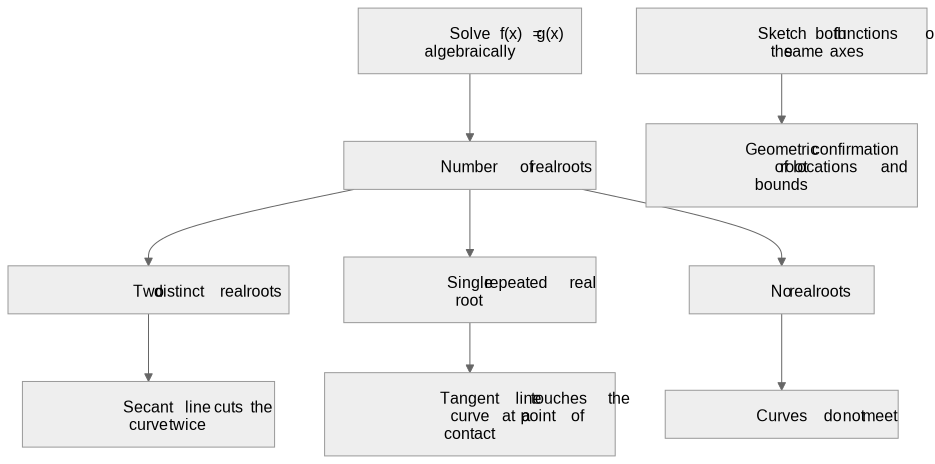
Algebraic solutions correspond geometrically to the coordinates of intersection points between curves in the Cartesian plane. Solving f(x) = 0 determines the x-intercepts where the graph of y = f(x) meets the horizontal axis y = 0. Solving simultaneous equations f(x) = g(x) algebraically finds the x-coordinates where the two curves y = f(x) and y = g(x) intersect. The number of real algebraic roots reveals the number of intersection points: two distinct real roots indicate a secant line cutting the curve twice; a single repeated real root indicates a tangent line touching the curve at a point of contact; and no real roots indicates that the curves do not meet. A sketch provides immediate geometric confirmation of root locations and bounds.
What earns the marks
- Equating functions f(x) = g(x) to set up the intersection equation.
- Interpreting the number of real roots as the number of graphical intersection points.
- Explaining tangential contact as corresponding to a repeated root with discriminant zero.
Common mistakes and how to put them right
Confusing the x-coordinates of intersection points with the full coordinate pairs (x, y).
Failing to connect a repeated root algebraically with a tangent touching the curve geometrically.
Exam tips
- Use the discriminant of the combined equation f(x) − g(x) = 0 to prove lines are tangents.
- Sketch both functions on the same axes to confirm the number and approximate locations of roots.
Try the lesson
The start of the Algebra and Functions (AS Unit 1: Pure Mathematics A): Interpret algebraic solutions of equations graphically. lesson, made from teaching notes for this specification point.
Have a go first
The graph of y = x² − 4 is drawn. The equation x² − 4 = 0 has two solutions. What do these solutions represent on the graph?
Listen
Algebraic solutions correspond geometrically to the coordinates of intersection points between curves in the Cartesian plane. Solving f(x) = 0 determines the x-intercepts where the graph of y = f(x) meets the horizontal axis y = 0. Solving simultaneous equations f(x) = g(x) algebraically finds the x-coordinates where the two curves y = f(x) and y = g(x) intersect. The number of real algebraic roots reveals the number of intersection points: two distinct real roots indicate a secant line cutting the curve twice; a single repeated real root indicates a tangent line touching the curve at a point of contact; and no real roots indicates that the curves do not meet. A sketch provides immediate geometric confirmation of root locations and bounds. A strong answer earns marks for these points. equating functions f(x) = g(x) to set up the intersection equation. interpreting the number of real roots as the number of graphical intersection points. explaining tangential contact as corresponding to a repeated root with discriminant zero. Exam tip: Use the discriminant of the combined equation f(x) − g(x) = 0 to prove lines are tangents.
See it
Key words
Say what each word means before you turn the card.
graphical intersections
Try answering aloud or in your head before turning the card.
root interpretation
Try answering aloud or in your head before turning the card.
tangents and secants
Try answering aloud or in your head before turning the card.
discriminant and intersections
Try answering aloud or in your head before turning the card.
See every definition
- graphical intersections
- Algebraic solutions correspond geometrically to the coordinates of intersection points between curves in the Cartesian plane.
- root interpretation
- The number of real algebraic roots reveals the number of intersection points between the curves.
- tangents and secants
- A secant line cuts the curve twice, while a tangent line touches the curve at a point of contact.
- discriminant and intersections
- A repeated root with discriminant zero corresponds to tangential contact, and no real roots indicates that the curves do not meet.
Label the diagram
Some boxes have lost their names. Pick the right name for each number.
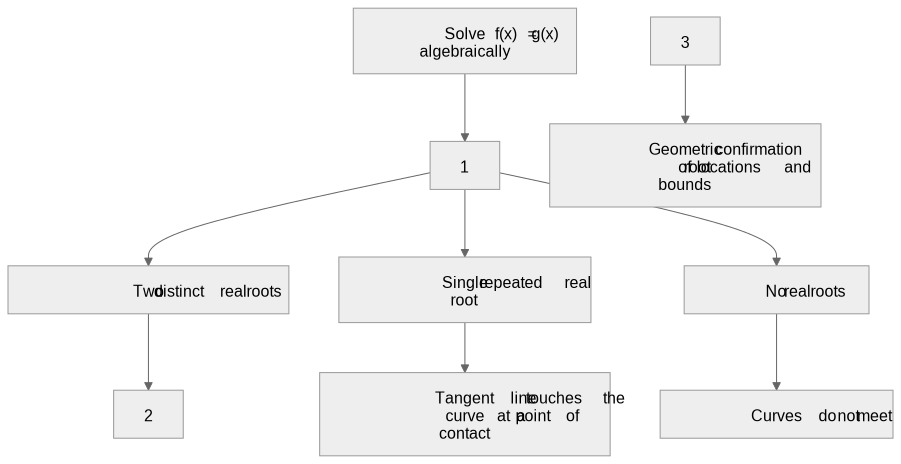
1Box 1
2Box 2
3Box 3
There is more to this lesson
The full lesson goes on to check your understanding and help you earn the marks. Create a free account to carry on, with your progress saved.
A week of Premium from your first lesson · Then the free plan continues · No card, no charge
Test your understanding of Algebra and Functions (AS Unit 1: Pure Mathematics A): Interpret algebraic solutions of equations graphically.
Active recall beats re-reading. Take an instant quiz now to test what you’ve learned and lock it into long-term memory.
A week of Premium from your first lesson · Then the free plan continues · No card, no charge