WJEC · A-Level · Mathematics
Course version: 603/1977/X · Version from Sept 2017
Pure Mathematics A): Use intersection points of graphs of curves to solve…
Full specification wording
Algebra and Functions (AS Unit 1: Pure Mathematics A): Use intersection points of graphs of curves to solve equations.
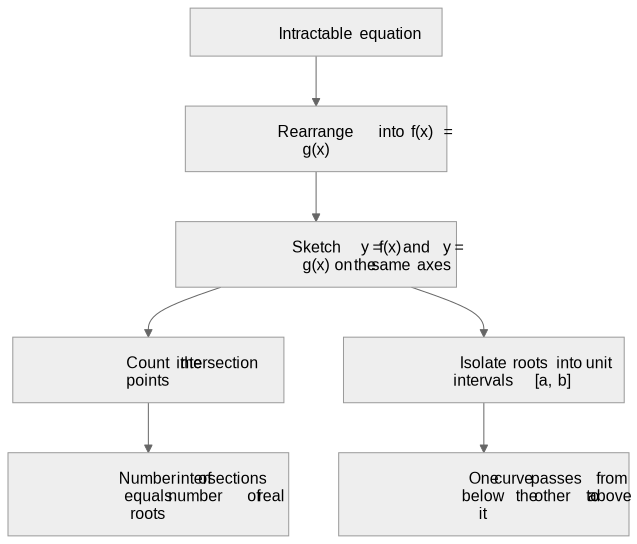
Rearranging an intractable equation into the form f(x) = g(x) allows its roots to be estimated or analysed via the intersection of two well-understood curves, y = f(x) and y = g(x).
- Point 15 of 17
- 4 key terms
Study notes
From the teaching notes for this specification point.
The idea
Rearranging an intractable equation into the form f(x) = g(x) allows its roots to be estimated or analysed via the intersection of two well-understood curves, y = f(x) and y = g(x). For example, finding the number of real roots of x³ − 3x − 1 = 0 can be achieved by sketching the cubic y = x³ and the straight line y = 3x + 1, or by graphing y = x³ − 3x and y = 1. The number of intersection points equals the number of real roots of the original equation. Furthermore, graphing helps isolate roots into unit intervals [a, b] where one curve passes from below the other to above it. In examination questions, candidates are frequently instructed to sketch a specified line and curve on the same axes to deduce the number of solutions.
What earns the marks
- Rearranging the given equation into two distinct functions f(x) and g(x).
- Sketching both curves accurately on a single set of coordinate axes.
- Deducing the exact number of real solutions from the number of visible intersections.
Common mistakes and how to put them right
Sketching curves on separate axes, making it impossible to see where they intersect.
Misinterpreting asymptotes and missing an intersection point in extreme quadrants.
Exam tips
- Choose a rearrangement where both individual curves are standard graphs you know how to sketch.
- State clearly: 'The number of intersections equals the number of real roots'.
Try the lesson
The start of the Algebra and Functions (AS Unit 1: Pure Mathematics A): Use intersection points of graphs of curves to solve equations. lesson, made from teaching notes for this specification point.
Have a go first
The curve y = x² and the line y = x + 2 are drawn on the same axes. Their intersection points have x-coordinates that solve which equation?
Listen
Rearranging an intractable equation into the form f(x) = g(x) allows its roots to be estimated or analysed via the intersection of two well-understood curves, y = f(x) and y = g(x). For example, finding the number of real roots of x³ − 3x − 1 = 0 can be achieved by sketching the cubic y = x³ and the straight line y = 3x + 1, or by graphing y = x³ − 3x and y = 1. The number of intersection points equals the number of real roots of the original equation. Furthermore, graphing helps isolate roots into unit intervals [a, b] where one curve passes from below the other to above it. In examination questions, candidates are frequently instructed to sketch a specified line and curve on the same axes to deduce the number of solutions. A strong answer earns marks for these points. rearranging the given equation into two distinct functions f(x) and g(x). sketching both curves accurately on a single set of coordinate axes. deducing the exact number of real solutions from the number of visible intersections. Exam tip: Choose a rearrangement where both individual curves are standard graphs you know how to sketch.
See it
Key words
Say what each word means before you turn the card.
curve intersections
Try answering aloud or in your head before turning the card.
graphical solutions
Try answering aloud or in your head before turning the card.
number of roots
Try answering aloud or in your head before turning the card.
curve rearrangement
Try answering aloud or in your head before turning the card.
See every definition
- curve intersections
- Points where two curves meet on a single set of coordinate axes, allowing equations to be solved.
- graphical solutions
- Estimating or analysing roots by sketching two well-understood curves and locating where they meet.
- number of roots
- The count of real roots of the original equation, which equals the number of intersection points.
- curve rearrangement
- Rewriting an intractable equation into the form f(x) = g(x) so its roots can be estimated or analysed.
Label the diagram
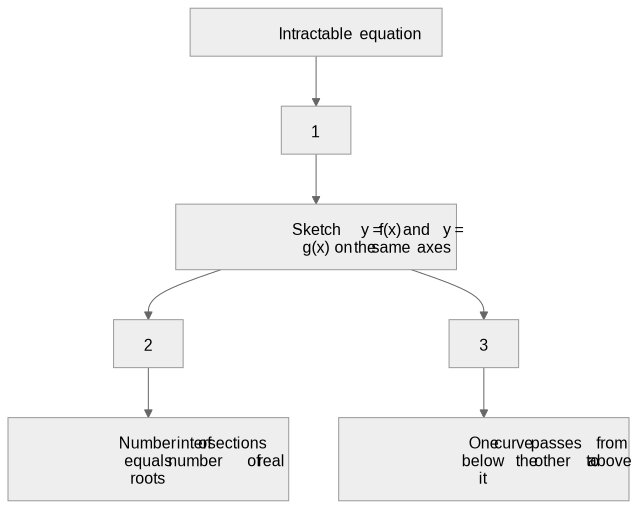
Some boxes have lost their names. Pick the right name for each number.
1Box 1
2Box 2
3Box 3
There is more to this lesson
The full lesson goes on to check your understanding and help you earn the marks. Create a free account to carry on, with your progress saved.
A week of Premium from your first lesson · Then the free plan continues · No card, no charge
Test your understanding of Algebra and Functions (AS Unit 1: Pure Mathematics A): Use intersection points of graphs of curves to solve equations.
Active recall beats re-reading. Take an instant quiz now to test what you’ve learned and lock it into long-term memory.
A week of Premium from your first lesson · Then the free plan continues · No card, no charge