WJEC · A-Level · Mathematics
Course version: 603/1977/X · Version from Sept 2017
Pure Mathematics A): Manipulate polynomials algebraically
Full specification wording
Algebra and Functions (AS Unit 1: Pure Mathematics A): Manipulate polynomials algebraically, including expanding brackets and collecting like terms, factorisation and simple algebraic division; use of the Factor Theorem.
Polynomial manipulation underpins curve analysis and equation solving.
- Point 11 of 17
- 2 key terms
Study notes
From the teaching notes for this specification point.
The idea
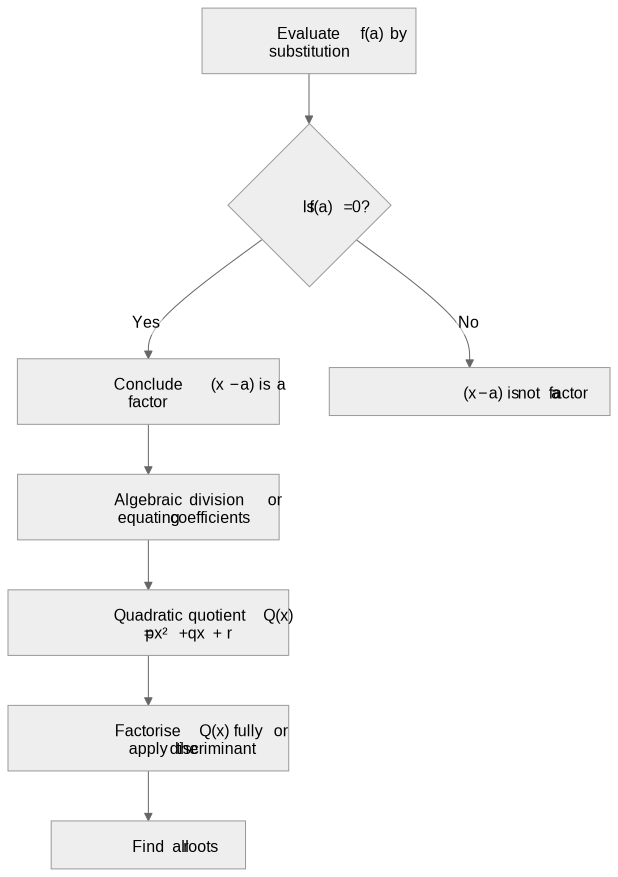
Polynomial manipulation underpins curve analysis and equation solving. Expanding brackets requires applying the distributive law across all terms, followed by collecting like terms in descending powers of x. The Factor Theorem states that a polynomial f(x) has a linear factor (x − a) if and only if f(a) = 0; more generally, (bx − a) is a factor if and only if f(a/b) = 0. Once a root is identified by evaluating integer factors of the constant term, algebraic long division or synthetic equating of coefficients factorises f(x) into (x − a)Q(x), where Q(x) is a polynomial of degree n − 1. For a cubic polynomial, this yields a quadratic quotient Q(x) = px² + qx + r, which can then be factorised further to find all roots or analyse the discriminant.
What earns the marks
- Evaluating f(a) showing substitution and concluding that f(a) = 0 proves (x − a) is a factor.
- Performing algebraic division or equating coefficients to find the quadratic quotient.
- Factorising the quadratic quotient fully into linear factors or applying the discriminant.
Common mistakes and how to put them right
Substituting the wrong sign into the polynomial, evaluating f(−a) instead of f(a) when testing (x − a).
Omitting a concluding statement such as 'since f(2) = 0, (x − 2) is a factor'.
Exam tips
- Show the substitution of the test value explicitly before stating that the result equals zero.
- Check your algebraic long division quotient by expanding (x − a)Q(x) to ensure it recovers f(x).
Try the lesson
The start of the Algebra and Functions (AS Unit 1: Pure Mathematics A): Manipulate polynomials algebraically, including expanding brackets and collecting like terms, factorisation and simple algebraic division; use of the Factor Theorem. lesson, made from teaching notes for this specification point.
Have a go first
Expand and simplify (x + 3)(x² − 2x + 5).
Listen
Polynomial manipulation underpins curve analysis and equation solving. Expanding brackets requires applying the distributive law across all terms, followed by collecting like terms in descending powers of x. The Factor Theorem states that a polynomial f(x) has a linear factor (x − a) if and only if f(a) = 0; more generally, (bx − a) is a factor if and only if f(a/b) = 0. Once a root is identified by evaluating integer factors of the constant term, algebraic long division or synthetic equating of coefficients factorises f(x) into (x − a)Q(x), where Q(x) is a polynomial of degree n − 1. For a cubic polynomial, this yields a quadratic quotient Q(x) = px² + qx + r, which can then be factorised further to find all roots or analyse the discriminant. A strong answer earns marks for these points. evaluating f(a) showing substitution and concluding that f(a) = 0 proves (x − a) is a factor. performing algebraic division or equating coefficients to find the quadratic quotient. factorising the quadratic quotient fully into linear factors or applying the discriminant. Exam tip: Show the substitution of the test value explicitly before stating that the result equals zero.
See it
Key words
Say what each word means before you turn the card.
Factor Theorem
Try answering aloud or in your head before turning the card.
algebraic division
Try answering aloud or in your head before turning the card.
See every definition
- Factor Theorem
- A polynomial f(x) has a linear factor (x − a) if and only if f(a) = 0; more generally, (bx − a) is a factor if and only if f(a/b) = 0.
- algebraic division
- Algebraic long division or synthetic equating of coefficients factorises f(x) into (x − a)Q(x), where Q(x) is a polynomial of degree n − 1.
There is more to this lesson
The full lesson goes on to check your understanding and help you earn the marks. Create a free account to carry on, with your progress saved.
A week of Premium from your first lesson · Then the free plan continues · No card, no charge
Test your understanding of Algebra and Functions (AS Unit 1: Pure Mathematics A): Manipulate polynomials algebraically, including expanding brackets and collecting like terms, factorisation and simple algebraic division; use of the Factor Theorem.
Active recall beats re-reading. Take an instant quiz now to test what you’ve learned and lock it into long-term memory.
A week of Premium from your first lesson · Then the free plan continues · No card, no charge