WJEC · A-Level · Mathematics
Course version: 603/1977/X · Version from Sept 2017
Pure Mathematics A): Understand and use graphs of functions
Full specification wording
Algebra and Functions (AS Unit 1: Pure Mathematics A): Understand and use graphs of functions; sketch curves defined by simple equations, including polynomials.
Sketching polynomial curves requires identifying global end behavior, axis intercepts, and turning points.
- Point 12 of 17
- 4 key terms
Study notes
From the teaching notes for this specification point.
The idea
Sketching polynomial curves requires identifying global end behavior, axis intercepts, and turning points. The degree n and the sign of the leading coefficient dictate asymptotic behavior: for an odd degree cubic with positive leading coefficient, y → −∞ as x → −∞ and y → +∞ as x → +∞; an even degree quartic with positive leading coefficient has y → +∞ as x → ±∞. Axis intercepts are found by setting x = 0 for the y-intercept (0, f(0)) and factorising f(x) = 0 for x-intercepts. A simple linear factor (x − a) means the curve crosses the x-axis at (a, 0); a repeated squared factor (x − b)² means the curve touches the x-axis tangentially without crossing; and a repeated cubic factor (x − c)³ produces a stationary point of inflection.
What earns the marks
- Correctly identifying global end behavior based on degree and leading coefficient.
- Finding all x-intercepts and y-intercept with correct coordinates labelled.
- Demonstrating correct behavior at repeated roots (touching the axis for squared factors).
Common mistakes and how to put them right
Crossing the x-axis at a repeated root (x − b)² instead of touching and turning.
Drawing cubic graphs that curl backwards or have incorrect asymptotic end behavior.
Exam tips
- Identify the nature of each root: a single root crosses the axis; a squared root touches the axis.
- Always label both axis intercepts with their exact coordinates on your sketch.
Try the lesson
The start of the Algebra and Functions (AS Unit 1: Pure Mathematics A): Understand and use graphs of functions; sketch curves defined by simple equations, including polynomials. lesson, made from teaching notes for this specification point.
Have a go first
The curve y = x² − 4x + 3 crosses the y-axis at which point?
Listen
Sketching polynomial curves requires identifying global end behavior, axis intercepts, and turning points. The degree n and the sign of the leading coefficient dictate asymptotic behavior: for an odd degree cubic with positive leading coefficient, y → −∞ as x → −∞ and y → +∞ as x → +∞; an even degree quartic with positive leading coefficient has y → +∞ as x → ±∞. Axis intercepts are found by setting x = 0 for the y-intercept (0, f(0)) and factorising f(x) = 0 for x-intercepts. A simple linear factor (x − a) means the curve crosses the x-axis at (a, 0); a repeated squared factor (x − b)² means the curve touches the x-axis tangentially without crossing; and a repeated cubic factor (x − c)³ produces a stationary point of inflection. A strong answer earns marks for these points. correctly identifying global end behavior based on degree and leading coefficient. finding all x-intercepts and y-intercept with correct coordinates labelled. demonstrating correct behavior at repeated roots (touching the axis for squared factors). Exam tip: Identify the nature of each root: a single root crosses the axis; a squared root touches the axis.
See it
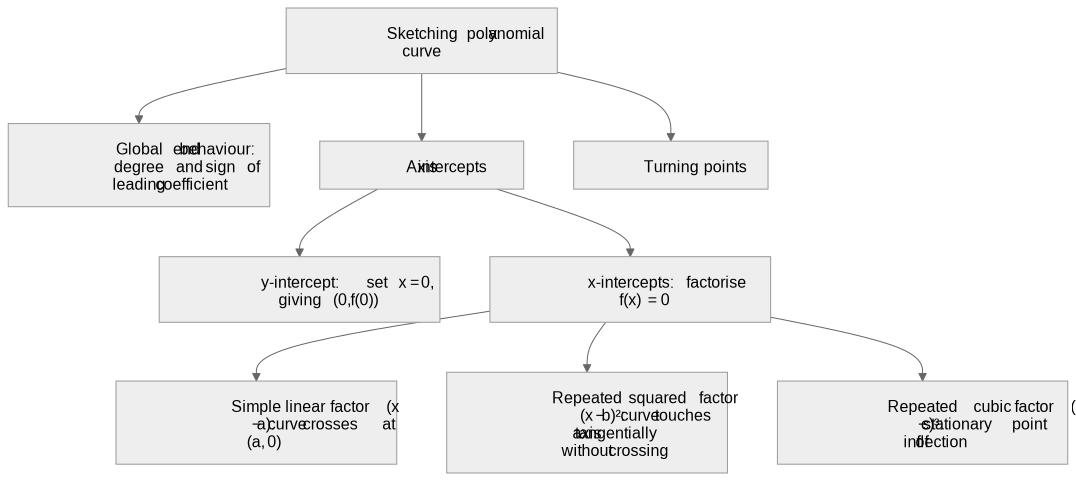
Key words
Say what each word means before you turn the card.
end behavior
Try answering aloud or in your head before turning the card.
repeated roots
Try answering aloud or in your head before turning the card.
curve sketching
Try answering aloud or in your head before turning the card.
polynomial curves
Try answering aloud or in your head before turning the card.
See every definition
- end behavior
- The degree n and the sign of the leading coefficient dictate this asymptotic behavior of the curve.
- repeated roots
- A repeated squared factor means the curve touches the x-axis tangentially without crossing, and a repeated cubic factor produces a stationary point of inflection.
- curve sketching
- Requires identifying global end behavior, axis intercepts, and turning points.
- polynomial curves
- Curves defined by simple equations, including polynomials, whose graphs are understood and sketched.
Label the diagram
Some boxes have lost their names. Pick the right name for each number.
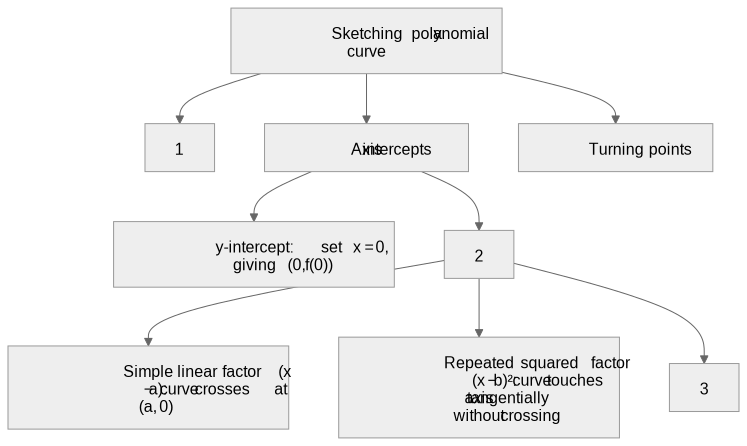
1Box 1
2Box 2
3Box 3
There is more to this lesson
The full lesson goes on to check your understanding and help you earn the marks. Create a free account to carry on, with your progress saved.
A week of Premium from your first lesson · Then the free plan continues · No card, no charge
Test your understanding of Algebra and Functions (AS Unit 1: Pure Mathematics A): Understand and use graphs of functions; sketch curves defined by simple equations, including polynomials.
Active recall beats re-reading. Take an instant quiz now to test what you’ve learned and lock it into long-term memory.
A week of Premium from your first lesson · Then the free plan continues · No card, no charge