WJEC · A-Level · Mathematics
Course version: 603/1977/X · Version from Sept 2017
Pure Mathematics A): Solve simultaneous equations in two variables by…
Full specification wording
Algebra and Functions (AS Unit 1: Pure Mathematics A): Solve simultaneous equations in two variables by elimination and by substitution, including one linear and one quadratic equation.
Solving simultaneous systems determines the coordinates where curves and lines intersect.
- Point 7 of 17
Study notes
From the teaching notes for this specification point.
The idea
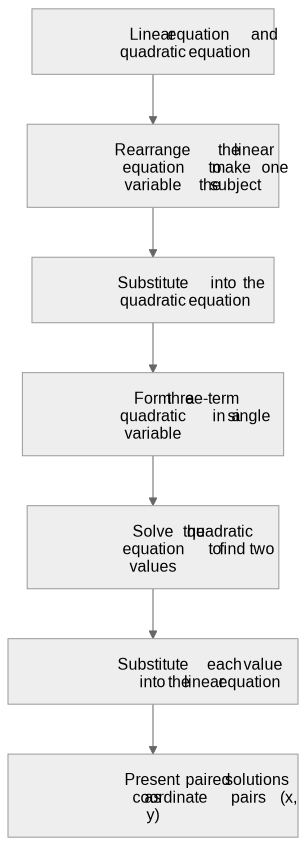
Solving simultaneous systems determines the coordinates where curves and lines intersect. When both equations are linear, elimination by equating coefficients or substitution yields a unique solution. When solving a linear equation alongside a quadratic equation (such as y = mx + c and x² + y² = r², or a curve y = ax² + bx + c), substitution is essential. Rearrange the linear equation to isolate one variable, such as y = mx + c, and substitute into the quadratic equation to obtain a single quadratic in x. Solving this quadratic yields the x-coordinates of the intersection points. Each x-value must then be substituted back into the linear equation to find the corresponding y-value, ensuring solutions are paired correctly as coordinate pairs (x, y).
What earns the marks
- Rearranging the linear equation to make one variable the subject.
- Substituting into the quadratic equation to form a three-term quadratic in a single variable.
- Solving the quadratic equation to find two values for the chosen variable.
- Finding the corresponding values of the second variable and presenting correctly paired solutions.
Common mistakes and how to put them right
Substituting back into the quadratic equation instead of the linear equation, creating spurious paired values.
Making algebraic errors when squaring binomials during the substitution step.
Exam tips
- Substitute values into the linear equation to find the corresponding second coordinates quickly and safely.
- Present your final answer clearly as paired coordinates (x₁, y₁) and (x₂, y₂).
Try the lesson
The start of the Algebra and Functions (AS Unit 1: Pure Mathematics A): Solve simultaneous equations in two variables by elimination and by substitution, including one linear and one quadratic equation. lesson, made from teaching notes for this specification point.
Have a go first
Solve the simultaneous equations y = x − 2 and x² + y² = 10.
Listen
Solving simultaneous systems determines the coordinates where curves and lines intersect. When both equations are linear, elimination by equating coefficients or substitution yields a unique solution. When solving a linear equation alongside a quadratic equation (such as y = mx + c and x² + y² = r², or a curve y = ax² + bx + c), substitution is essential. Rearrange the linear equation to isolate one variable, such as y = mx + c, and substitute into the quadratic equation to obtain a single quadratic in x. Solving this quadratic yields the x-coordinates of the intersection points. Each x-value must then be substituted back into the linear equation to find the corresponding y-value, ensuring solutions are paired correctly as coordinate pairs (x, y). A strong answer earns marks for these points. rearranging the linear equation to make one variable the subject. substituting into the quadratic equation to form a three-term quadratic in a single variable. solving the quadratic equation to find two values for the chosen variable. finding the corresponding values of the second variable and presenting correctly paired solutions. Exam tip: Substitute values into the linear equation to find the corresponding second coordinates quickly and safely.
See it
Put it in order
Put these steps in the order they happen.
- 1. Present paired solutions as coordinate pairs (x, y)
- 2. Substitute each value into the linear equation
- 3. Substitute into the quadratic equation
- 4. Solve the quadratic equation to find two values
- 5. Linear equation and quadratic equation
- 6. Rearrange the linear equation to make one variable the subject
- 7. Form a three-term quadratic in a single variable
Label the diagram
Some boxes have lost their names. Pick the right name for each number.
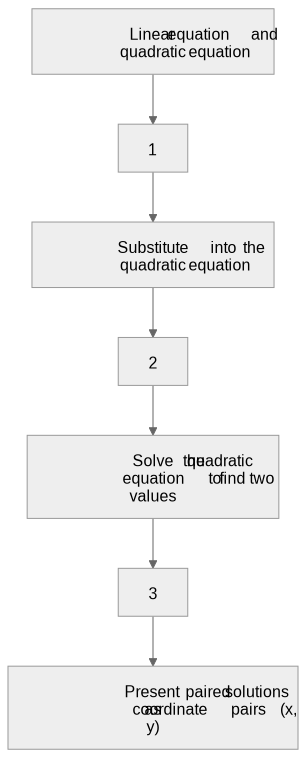
1Box 1
2Box 2
3Box 3
There is more to this lesson
The full lesson goes on to check your understanding and help you earn the marks. Create a free account to carry on, with your progress saved.
A week of Premium from your first lesson · Then the free plan continues · No card, no charge
Test your understanding of Algebra and Functions (AS Unit 1: Pure Mathematics A): Solve simultaneous equations in two variables by elimination and by substitution, including one linear and one quadratic equation.
Active recall beats re-reading. Take an instant quiz now to test what you’ve learned and lock it into long-term memory.
A week of Premium from your first lesson · Then the free plan continues · No card, no charge