WJEC · A-Level · Mathematics
Course version: 603/1977/X · Version from Sept 2017
Pure Mathematics A): Understand and use the laws of indices for all…
Full specification wording
Algebra and Functions (AS Unit 1: Pure Mathematics A): Understand and use the laws of indices for all rational exponents.
Indices govern powers and roots through three core laws for a common base a > 0: multiplication adds indices, aᵖ × aᵠ = a^(p+q); division subtracts them, aᵖ ÷ aᵠ = a^(p−q); and a power of a power…
- Point 1 of 17
- 2 key terms
Study notes
From the teaching notes for this specification point.
The idea
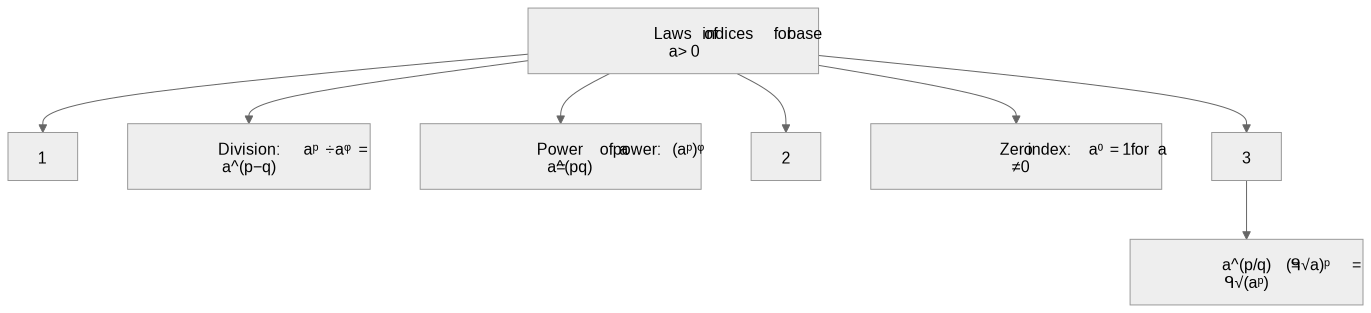
Indices govern powers and roots through three core laws for a common base a > 0: multiplication adds indices, aᵖ × aᵠ = a^(p+q); division subtracts them, aᵖ ÷ aᵠ = a^(p−q); and a power of a power multiplies them, (aᵖ)ᵠ = a^(pq). Negative indices give reciprocals, a⁻ᵖ = 1/aᵖ, and a⁰ = 1 for a ≠ 0. Fractional indices link to radicals: a^(1/q) = ᑫ√a, so a^(p/q) = (ᑫ√a)ᵖ = ᑫ√(aᵖ); for example 8^(2/3) = (³√8)² = 4. Simplifying algebraic expressions such as (2x^(1/2) + 3x^(−1/2))² requires systematic expansion, adding powers of x term by term. Surds may be converted to fractional exponents to simplify manipulation, but this is a convenience, not a prerequisite: surds can also be differentiated or integrated directly.
What earns the marks
- Converting surds and reciprocals into index form with fractional or negative exponents, e.g. √x = x^(1/2) and 1/x³ = x⁻³.
- Applying index laws correctly when multiplying or dividing powers of the same base, adding or subtracting indices rather than multiplying them.
- Evaluating numerical rational powers by taking the root first, e.g. 27^(2/3) = (³√27)² = 9, and checking the sign where the base is negative.
- Expanding brackets involving fractional powers, such as (2x^(1/2) + 3x^(−1/2))², and collecting like terms by adding indices accurately.
- Simplifying compound expressions by combining several laws in sequence, e.g. (4x⁶)^(1/2) ÷ x² = 2x.
Common mistakes and how to put them right
Multiplying powers instead of adding them when multiplying terms with the same base, e.g. writing x² × x³ = x⁶.
Put it right: The correct result is x⁵.
Confusing a negative power with a negative coefficient, e.g. writing x⁻² = −x².
Put it right: The correct meaning is x⁻² = 1/x².
Misinterpreting fractional powers, e.g. treating 8^(1/3) as 8/3.
Put it right: The correct value is ³√8 = 2.
Applying a power to only part of a product, e.g. writing (2x)³ = 2x³.
Put it right: The correct expansion is 8x³.
Exam tips
- Rewrite all roots and reciprocals in index notation before simplifying or differentiating; this makes the laws of indices directly applicable and reduces sign errors.
- Check each step against the three core laws, and remember a⁰ = 1 (not 0) for any a ≠ 0.
Try the lesson
The start of the Algebra and Functions (AS Unit 1: Pure Mathematics A): Understand and use the laws of indices for all rational exponents. lesson, made from teaching notes for this specification point.
Have a go first
Simplify 2³ × 2⁴, giving your answer as a single power of 2.
Listen
Indices govern powers and roots through three core laws for a common base a > 0: multiplication adds indices, aᵖ × aᵠ = a^(p+q); division subtracts them, aᵖ ÷ aᵠ = a^(p−q); and a power of a power multiplies them, (aᵖ)ᵠ = a^(pq). Negative indices give reciprocals, a⁻ᵖ = 1/aᵖ, and a⁰ = 1 for a ≠ 0. Fractional indices link to radicals: a^(1/q) = ᑫ√a, so a^(p/q) = (ᑫ√a)ᵖ = ᑫ√(aᵖ); for example 8^(2/3) = (³√8)² = 4. Simplifying algebraic expressions such as (2x^(1/2) + 3x^(−1/2))² requires systematic expansion, adding powers of x term by term. Surds may be converted to fractional exponents to simplify manipulation, but this is a convenience, not a prerequisite: surds can also be differentiated or integrated directly. A strong answer earns marks for these points. Converting surds and reciprocals into index form with fractional or negative exponents, e.g. √x = x^(1/2) and 1/x³ = x⁻³. Applying index laws correctly when multiplying or dividing powers of the same base, adding or subtracting indices rather than multiplying them. Evaluating numerical rational powers by taking the root first, e.g. 27^(2/3) = (³√27)² = 9, and checking the sign where the base is negative. Expanding brackets involving fractional powers, such as (2x^(1/2) + 3x^(−1/2))², and collecting like terms by adding indices accurately. Exam tip: Rewrite all roots and reciprocals in index notation before simplifying or differentiating; this makes the laws of indices directly applicable and reduces sign errors.
See it

Key words
Say what each word means before you turn the card.
laws of indices
Try answering aloud or in your head before turning the card.
fractional exponents
Try answering aloud or in your head before turning the card.
See every definition
- laws of indices
- For a common base a > 0, multiplication adds indices, division subtracts them, and a power of a power multiplies them.
- fractional exponents
- Fractional indices link to radicals, since a^(1/q) = ᑫ√a, so a^(p/q) = (ᑫ√a)ᵖ = ᑫ√(aᵖ).
Label the diagram
Some boxes have lost their names. Pick the right name for each number.
1Box 1
2Box 2
3Box 3
There is more to this lesson
The full lesson goes on to check your understanding and help you earn the marks. Create a free account to carry on, with your progress saved.
A week of Premium from your first lesson · Then the free plan continues · No card, no charge
Test your understanding of Algebra and Functions (AS Unit 1: Pure Mathematics A): Understand and use the laws of indices for all rational exponents.
Active recall beats re-reading. Take an instant quiz now to test what you’ve learned and lock it into long-term memory.
A week of Premium from your first lesson · Then the free plan continues · No card, no charge