WJEC · A-Level · Mathematics
Course version: 603/1977/X · Version from Sept 2017
Pure Mathematics A): Use and manipulate surds
Full specification wording
Algebra and Functions (AS Unit 1: Pure Mathematics A): Use and manipulate surds, including rationalising the denominator.
A surd is an irrational root of an integer.
- Point 2 of 17
- 4 key terms
Study notes
From the teaching notes for this specification point.
The idea
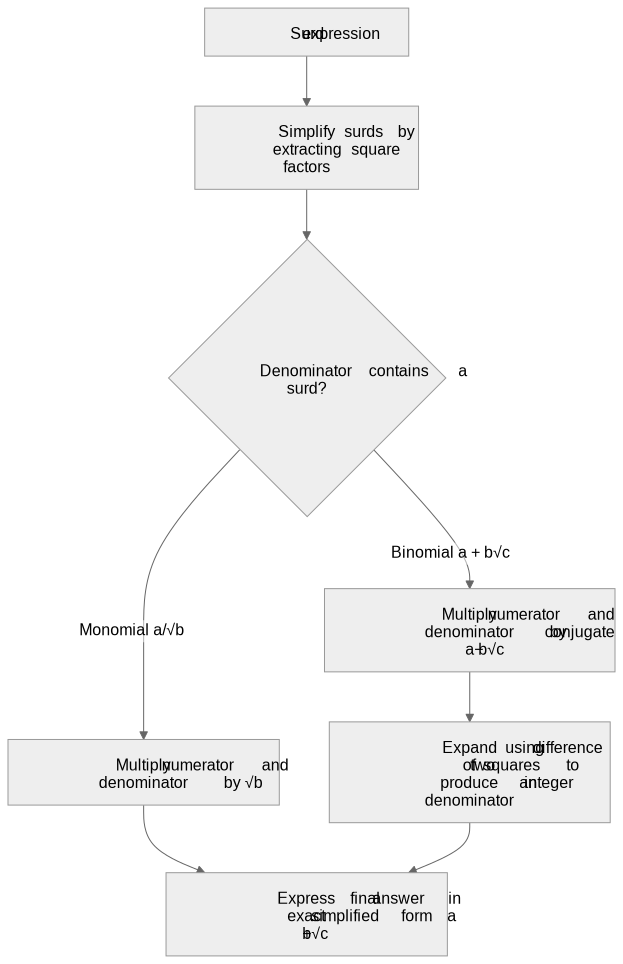
A surd is an irrational root of an integer. Surd arithmetic relies on multiplicative properties √(ab) = √a × √b and √(a/b) = √a / √b, whereas roots do not distribute over addition: √(a + b) ≠ √a + √b. Simplifying surds extracts the largest square factor, such as √72 = √(36 × 2) = 6√2. Rationalising a denominator eliminates radicals to express values in standard form. For a monomial denominator a/√b, multiply numerator and denominator by √b. For a binomial denominator containing surds, such as a + b√c, multiply by its conjugate a − b√c using the difference of two squares: (a + b√c)(a − b√c) = a² − b²c, which produces a purely rational integer denominator.
What earns the marks
- Simplifying individual surds by extracting square factors.
- Multiplying numerator and denominator by the correct conjugate expression.
- Expanding brackets using the difference of two squares to produce an integer denominator.
- Expressing the final answer in exact simplified form a + b√c.
Common mistakes and how to put them right
Assuming the square root distributes over addition, such as writing √(9 + 16) = 3 + 4 = 7.
Multiplying only the denominator by the conjugate and forgetting to multiply the numerator.
Making sign errors when expanding (a + b√c)(a − b√c).
Exam tips
- Always check if the denominator can be simplified before multiplying by its conjugate.
- Keep answers in exact simplified surd form unless decimal approximations are explicitly asked for.
Try the lesson
The start of the Algebra and Functions (AS Unit 1: Pure Mathematics A): Use and manipulate surds, including rationalising the denominator. lesson, made from teaching notes for this specification point.
Have a go first
Write √50 in the form k√2, where k is an integer.
Listen
A surd is an irrational root of an integer. Surd arithmetic relies on multiplicative properties √(ab) = √a × √b and √(a/b) = √a / √b, whereas roots do not distribute over addition: √(a + b) ≠ √a + √b. Simplifying surds extracts the largest square factor, such as √72 = √(36 × 2) = 6√2. Rationalising a denominator eliminates radicals to express values in standard form. For a monomial denominator a/√b, multiply numerator and denominator by √b. For a binomial denominator containing surds, such as a + b√c, multiply by its conjugate a − b√c using the difference of two squares: (a + b√c)(a − b√c) = a² − b²c, which produces a purely rational integer denominator. A strong answer earns marks for these points. simplifying individual surds by extracting square factors. multiplying numerator and denominator by the correct conjugate expression. expanding brackets using the difference of two squares to produce an integer denominator. expressing the final answer in exact simplified form a + b√c. Exam tip: Always check if the denominator can be simplified before multiplying by its conjugate.
See it
Key words
Say what each word means before you turn the card.
surds
Try answering aloud or in your head before turning the card.
rationalising the denominator
Try answering aloud or in your head before turning the card.
conjugate pairs
Try answering aloud or in your head before turning the card.
difference of squares
Try answering aloud or in your head before turning the card.
See every definition
- surds
- An irrational root of an integer.
- rationalising the denominator
- Eliminating radicals to express values in standard form.
- conjugate pairs
- For a binomial denominator containing surds, such as a + b√c, the expression a − b√c used to multiply it.
- difference of squares
- Expanding (a + b√c)(a − b√c) = a² − b²c, which produces a purely rational integer denominator.
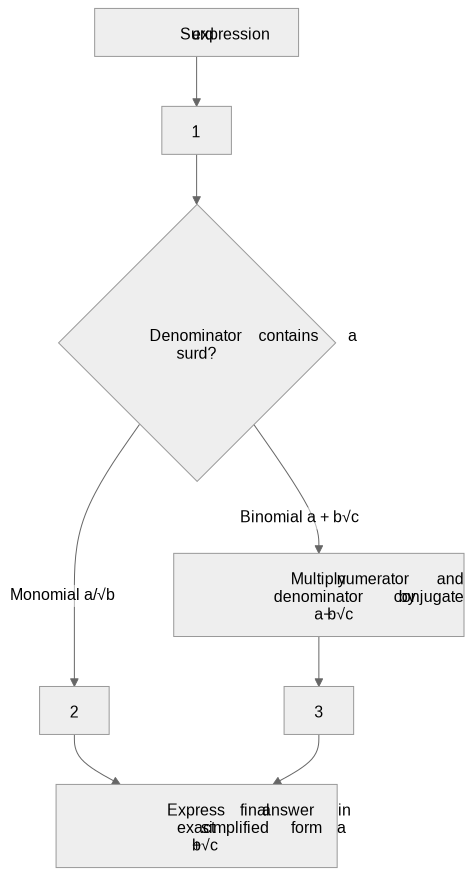
Label the diagram
Some boxes have lost their names. Pick the right name for each number.
1Box 1
2Box 2
3Box 3
There is more to this lesson
The full lesson goes on to check your understanding and help you earn the marks. Create a free account to carry on, with your progress saved.
A week of Premium from your first lesson · Then the free plan continues · No card, no charge
Test your understanding of Algebra and Functions (AS Unit 1: Pure Mathematics A): Use and manipulate surds, including rationalising the denominator.
Active recall beats re-reading. Take an instant quiz now to test what you’ve learned and lock it into long-term memory.
A week of Premium from your first lesson · Then the free plan continues · No card, no charge