OCR · GCSE · Music
Ensemble Skills
OCR GCSE Music Component 02 — Ensemble Skills requires candidates to perform as part of a live ensemble for a minimum of one minute, demonstrating a distinct, undoubled part that showcases technical control, accurate pitch and rhythm, and genuine musical interaction with at least one other live performer. Assessed entirely under AO1 (Performing) and worth up to 27 marks, this component rewards candidates who actively listen, respond, and adapt their playing in real time — making it as much about musical empathy as technical ability. Mastering ensemble awareness is the single most important factor separating Band 2 from Band 3 performances.
- 9 min read
- 4 worked examples
- 4 practice questions
- 8 key terms
Study Notes
Overview

OCR GCSE Music Component 02 — Ensemble Skills is one of two performance components that together form the practical heart of the qualification. Whereas Component 01 assesses solo performance, Component 02 specifically tests a candidate's ability to perform with others — to listen, respond, and contribute meaningfully to a shared musical experience. All 27 marks are awarded under Assessment Objective 1 (AO1): Performing, meaning the examiner's entire focus is on the quality of the live performance itself.
This guide covers everything you need to know: the rules of the component, how marks are awarded, the skills examiners look for, and the practical strategies that separate top-band candidates from the rest.

Key Knowledge & Theory
Core Concepts
The ensemble performance must meet several non-negotiable requirements before any marks can be awarded. Understanding these rules is the first step to a successful submission.
Minimum Duration: The performance must last at least one minute. In practice, most successful candidates perform pieces of two to four minutes, which provides substantially more opportunity to demonstrate ensemble awareness, dynamic shaping, and technical control over time.
Live Performer Requirement: At least one other performer must be present and performing live. A pre-recorded backing track, a Spotify accompaniment, or a karaoke track does not satisfy this requirement. The ensemble must consist of real musicians performing in real time.
Distinct, Undoubled Part: The candidate's part must be musically independent — it must not be doubled (played simultaneously note-for-note) by any other performer in the ensemble. If the piano plays the same melody as the candidate's instrument, the ensemble requirement is not met, regardless of how well the candidate plays.
Difficulty Level — Standard 3 or Above: OCR uses a graded difficulty scale. To access the higher mark bands (Band 3: 19–27 marks), the candidate's part must be at Standard 3 or above. Standard 3 broadly corresponds to approximately Grade 3 of a recognised graded examination (e.g., ABRSM, Trinity, Rockschool). Performing a part that is too simple — even with perfect accuracy — caps the maximum achievable mark.
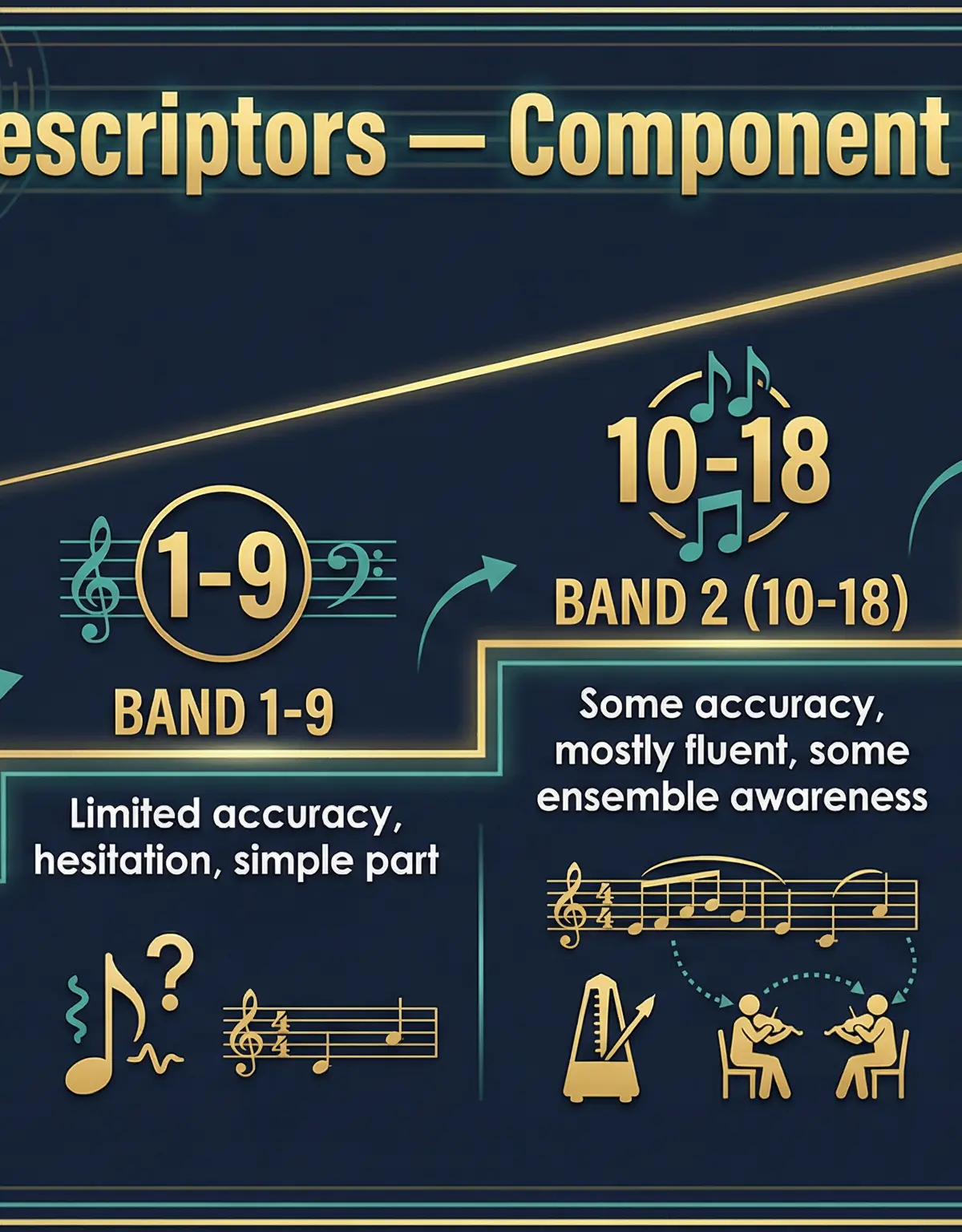
Mark Band Descriptors
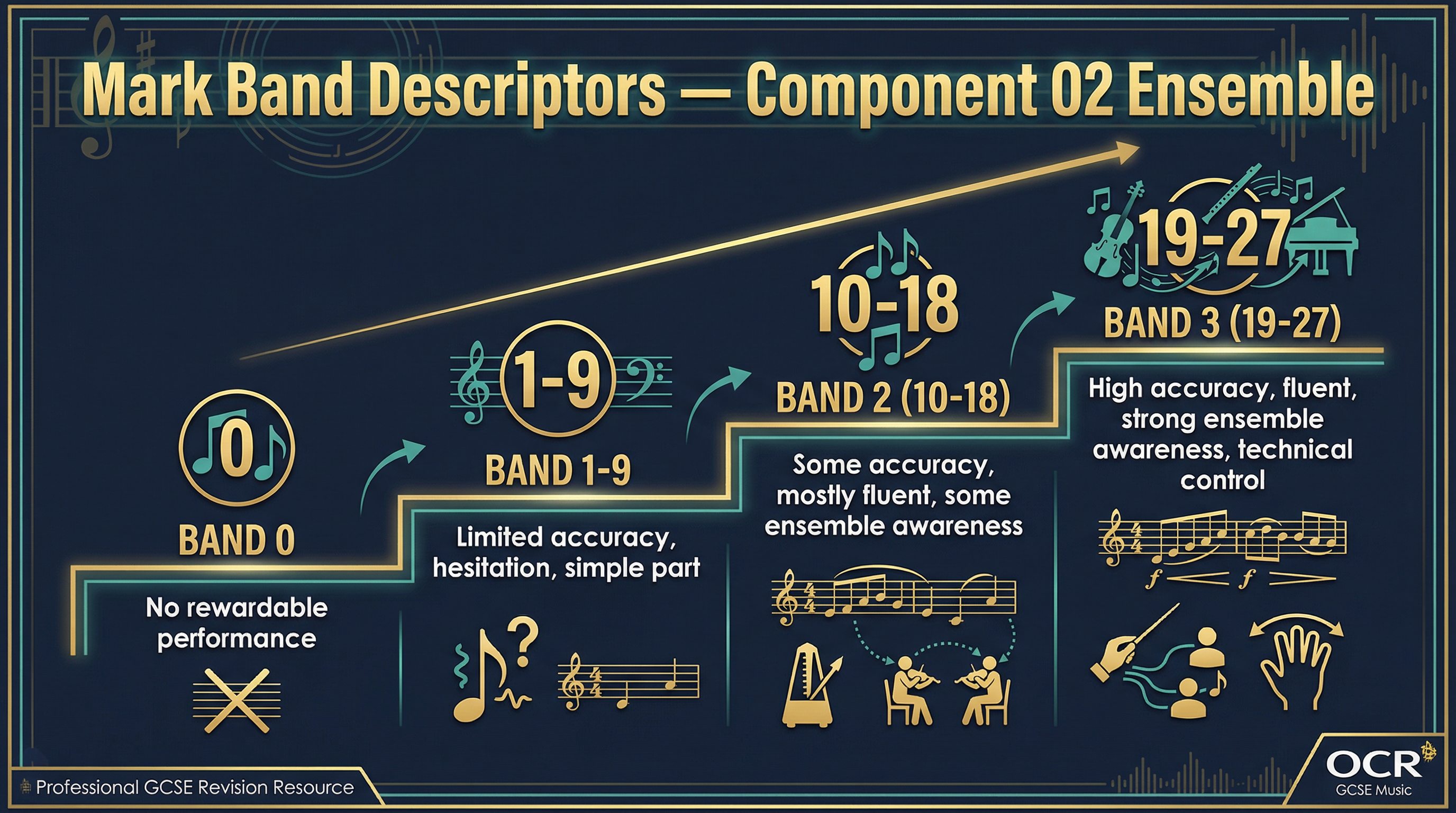
The following table summarises the four mark bands used by OCR examiners when assessing Component 02:
| Mark Band | Marks | Pitch & Rhythm | Fluency | Ensemble Awareness | Difficulty |
|---|---|---|---|---|---|
| Band 0 | 0 | No rewardable performance | — | — | — |
| Band 1 | 1–9 | Limited accuracy; frequent errors | Frequent hesitation or restarting | Little or no awareness | Below Standard 3 |
| Band 2 | 10–18 | Some accuracy; occasional errors | Mostly fluent; minor breaks | Some awareness; occasional adjustment | Standard 3 |
| Band 3 | 19–27 | High accuracy; very few errors | Fluent throughout; no restarting | Strong, active adjustment of balance, timing, dynamics | Standard 3 or above |
The Five Pillars of Ensemble Awareness
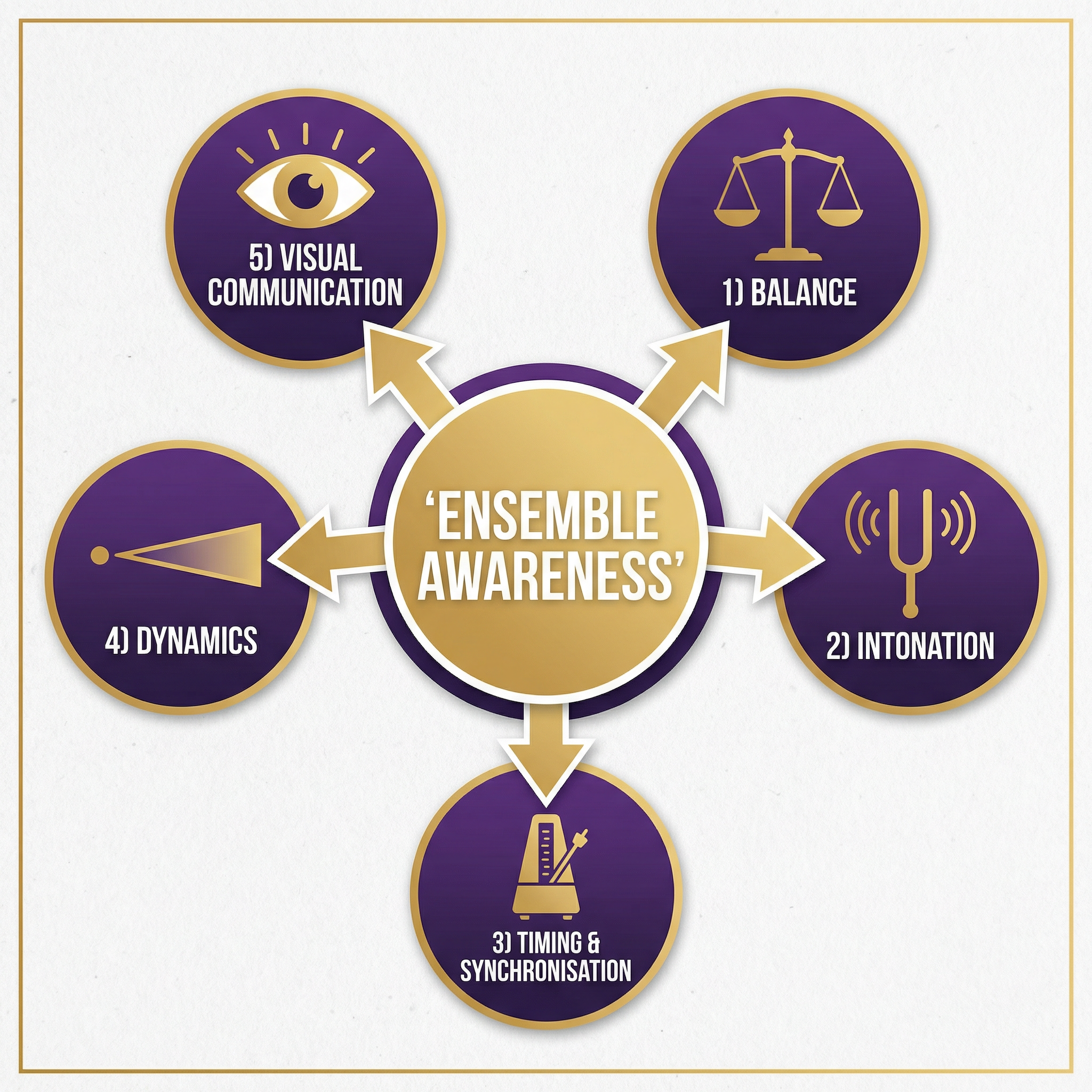
Ensemble awareness is the defining criterion that separates Band 2 from Band 3 performances. It is not simply a matter of playing together — it requires active, responsive musicianship across five interconnected dimensions.
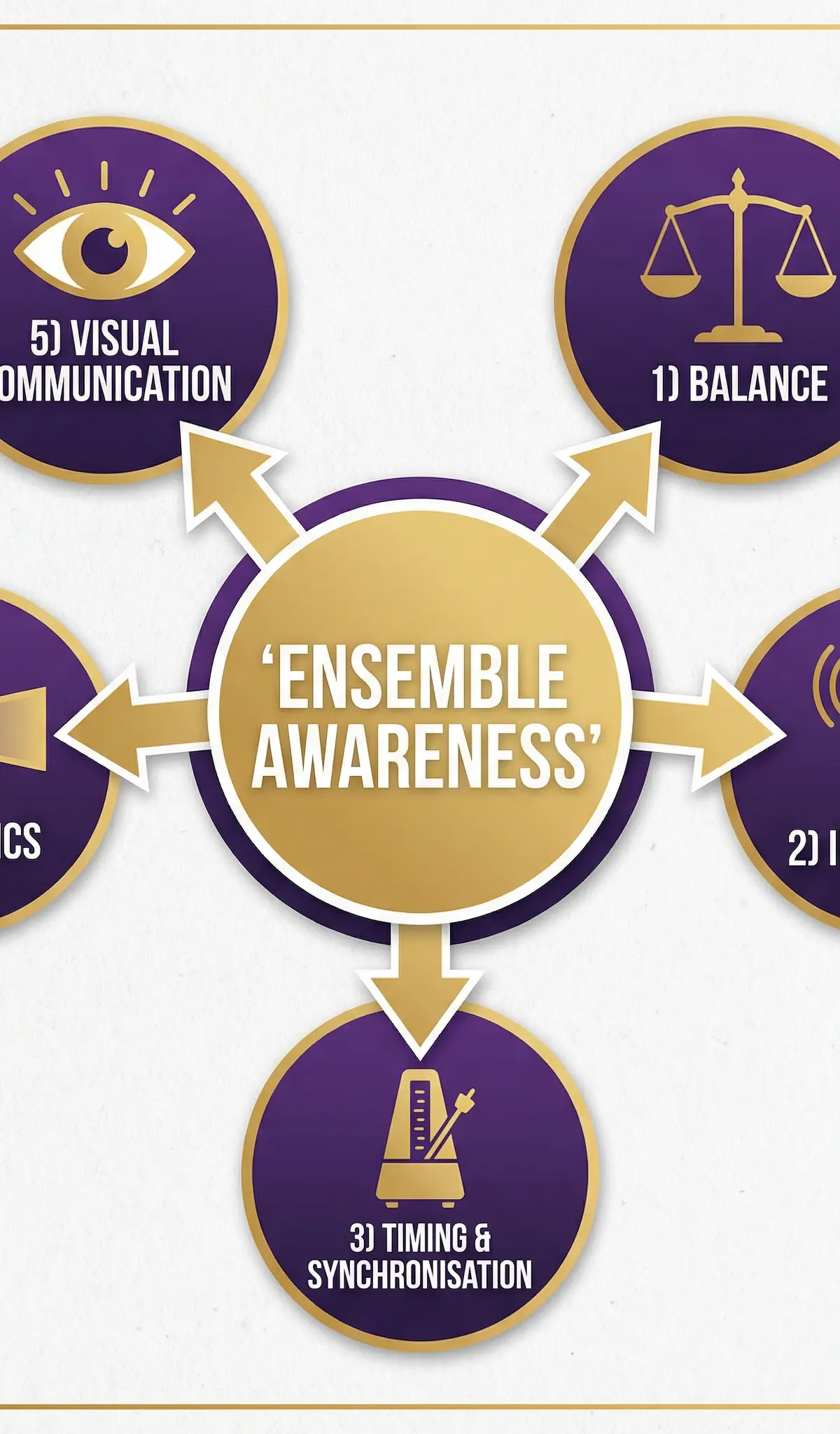
1. Balance: The candidate's part must be audible against the other performers. Examiners can only credit what they can hear. If the recording balance is poor — for example, a piano accompaniment overwhelming a solo violin — the examiner cannot assess the candidate's contribution.
2. Intonation: Pitch accuracy must be maintained not just in isolation, but relative to the ensemble. A candidate who plays in tune with themselves but drifts against the piano or other instruments will lose marks in this area. This is particularly critical for singers, string players, and wind players.
3. Timing and Synchronisation: The ensemble must start, stop, and navigate tempo changes together. Tight synchronisation — especially at phrase endings, fermatas, and key structural moments — demonstrates genuine musical communication.
4. Dynamics: Top-band candidates shape the music together, getting louder and softer as a unified ensemble rather than as individuals. Dynamic contrast that is coordinated across all performers demonstrates a high level of musical understanding.
5. Visual Communication: Professional musicians use eye contact, nods, and physical gestures to communicate in real time. Candidates who use visual cues to signal entries, tempo changes, and endings demonstrate the kind of collaborative musicianship that examiners reward.
Practical Skills
Techniques & Processes
Choosing the Right Repertoire: Repertoire selection is one of the most consequential decisions a candidate makes. The piece must: (a) be at Standard 3 or above in difficulty; (b) give the candidate a musically independent part; and (c) provide sufficient length and variety to demonstrate ensemble awareness across different musical contexts (e.g., louder and quieter passages, different tempos or moods).
Suitable ensemble formats include: duets (instrument + piano, two instruments, voice + instrument), trios, small chamber groups, jazz combos, rock/pop bands, and choral or vocal ensembles. The key is that each performer has a distinct musical role.
Rehearsal Strategy: Effective rehearsal is not simply running through the piece repeatedly. Candidates should practise specific ensemble skills deliberately:
- Listening rehearsals: Play through the piece focusing exclusively on listening to the other performer(s), not on your own part.
- Balance checks: Adjust your dynamic level until you can hear both yourself and the other performer(s) clearly.
- Cueing practice: Practise giving and receiving visual cues at key moments (starts, stops, tempo changes).
- Error recovery: Deliberately introduce small errors in rehearsal and practise recovering without stopping.
Recording Preparation: The final recording is what the examiner marks. Candidates should:
- Set up the recording equipment and test the balance before the final take.
- Listen back to a test recording and check that the candidate's part is clearly audible.
- Ensure the recording captures the full performance from start to finish without interruption.
- Perform in a quiet, acoustically suitable space to avoid background noise.
Materials & Equipment
The recording does not need to be made in a professional studio. A smartphone or tablet recording is acceptable, provided the audio quality is sufficient for the examiner to assess the performance. Key considerations include:
- Microphone placement: Position the recording device so that all performers are captured at a similar volume level.
- Room acoustics: Avoid very reverberant spaces (e.g., tiled rooms) that can blur pitch and rhythm clarity.
- Instrument condition: Ensure instruments are in good working order, in tune, and appropriate for the repertoire.
Portfolio / Coursework Guidance
Assessment Criteria
Component 02 is assessed entirely under AO1 (Performing). There is no written annotation, portfolio, or coursework submission required alongside the performance recording. The examiner assesses the recording directly against the mark band descriptors. However, candidates and teachers should ensure that:
- The centre authentication form is completed and signed.
- The recording is submitted in the correct format and by the OCR deadline.
- The difficulty level of the piece is accurately declared on the submission form.
Building a Strong Submission
While there is no portfolio for this component, candidates can strengthen their submission by:
- Selecting repertoire that clearly demonstrates Standard 3 difficulty or above.
- Ensuring the recording clearly captures the candidate's distinct contribution.
- Performing a piece that has sufficient musical variety to showcase dynamic range, tempo control, and ensemble responsiveness.
- Rehearsing sufficiently that the performance is fluent and confident — not just technically accurate.
Exam Component
Written Exam Knowledge
While Component 02 itself is a performance submission, candidates should be aware that the OCR GCSE Music written examination (Component 03) includes questions on performance practice, musical elements, and the relationship between performers and their musical context. Understanding the vocabulary of ensemble performance — texture, balance, intonation, dynamics, synchronisation — is directly relevant to written exam answers.
Practical Exam Preparation
The timeline for Component 02 is managed by the school or centre. Candidates typically:
- Select repertoire (ideally at least six months before the submission deadline).
- Rehearse with their ensemble partner(s) over an extended period.
- Record a final performance at a time agreed with their teacher.
- Submit the recording via the centre by the OCR deadline (typically in the spring term of Year 11).
Candidates are permitted to submit one recording per component. There is no opportunity to re-record after submission, so preparation and rehearsal quality are critical.
Visual Resources
2 diagrams and illustrations
Interactive Diagrams
2 interactive diagrams to visualise key concepts
Conceptual Flow Outline
Component 02 Ensemble Performance — Preparation Flowchart
Conceptual Flow Outline
AO1 Assessment Criteria — Component 02 Ensemble Skills
Worked Examples
4 worked examples — open one to explore the question and available guidance.
Practice Questions
Test your understanding — click to reveal model answers
Identify TWO requirements that a candidate's ensemble performance must meet to satisfy the OCR Component 02 specification.
Hint: Think about the rules regarding who must be present and what the candidate's part must be like.
Explain what is meant by 'balance' in the context of ensemble performance, and describe how a candidate could demonstrate good balance in their Component 02 recording.
Hint: Balance relates to volume levels. Think about both the performance itself and the recording process.
A candidate performs a guitar and bass guitar duet for their ensemble submission. The performance is fluent and accurate, but the examiner notes that the candidate does not adjust their dynamics in response to the bass player, and there is no visual communication between the two performers. Which mark band is this performance most likely to fall into, and why? Justify your answer with reference to the OCR mark scheme.
Hint: Look at the mark band descriptors carefully. What does Band 3 require that this performance is missing?
Evaluate the following repertoire choice for a Component 02 ensemble submission: a candidate who plays flute at Grade 5 standard chooses to perform a simple melody-and-chords duet with piano, where the flute plays a slow, stepwise melody at approximately Grade 2 difficulty, and the piano plays block chords as accompaniment. To what extent is this a suitable choice? Justify your answer fully.
Hint: Consider difficulty level, the undoubled part requirement, and the opportunity to demonstrate ensemble awareness. Think about both strengths and weaknesses of this choice.