AQA · A-Level · Physical Education
Course version: 7582 · Version from Sept 2016
Energy systems: Altitude training.
Altitude training means living or training at high altitude, where the partial pressure of oxygen in the air is lower than at sea level, so less oxygen diffuses into the blood.
Checked against the AQA 7582 specification (opens in a new tab) on .
- Point 23 of 26
- 4 key terms
Study notes
From the checked teaching notes for this specification point.
The idea
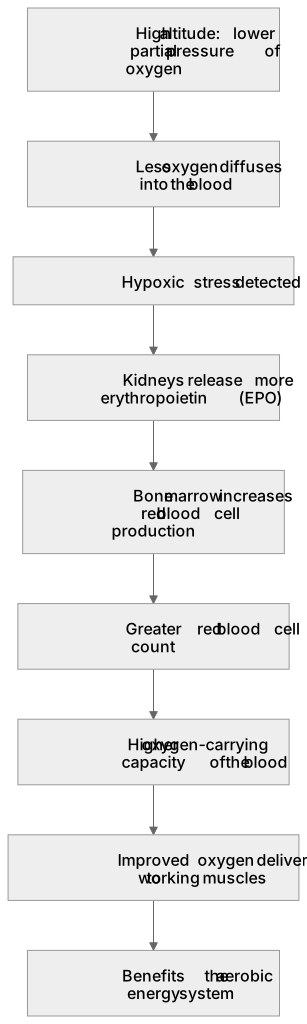
Altitude training means living or training at high altitude, where the partial pressure of oxygen in the air is lower than at sea level, so less oxygen diffuses into the blood. The body responds to this hypoxic stress by increasing production of erythropoietin (EPO) from the kidneys, which stimulates red blood cell production in bone marrow. More red blood cells raise the oxygen-carrying capacity of the blood, improving aerobic performance when the athlete returns to sea level. A common method is live high, train low: the athlete lives at altitude to gain the blood adaptation but performs high-intensity training near sea level so intensity and technique are not compromised. Altitude training is relevant to the aerobic energy system because improved oxygen delivery supports aerobic respiration.
What earns the marks
- Altitude training involves exposure to high altitude, where the partial pressure of oxygen is lower than at sea level.
- Reduced oxygen availability creates hypoxic stress that the body detects.
- The kidneys release more erythropoietin (EPO) in response to hypoxia.
- EPO stimulates the bone marrow to increase red blood cell production.
- A greater red blood cell count raises the oxygen-carrying capacity of the blood.
- Improved oxygen transport benefits the aerobic energy system and endurance performance.
- Live high, train low allows blood adaptations while maintaining high-intensity training near sea level.
Common mistakes and how to put them right
Thinking altitude air contains less oxygen overall.
Put it right: The percentage of oxygen is similar, but the partial pressure of oxygen is lower, so less oxygen diffuses into the blood.
Believing altitude training directly increases muscle strength.
Put it right: The main adaptation is increased red blood cell production and oxygen transport, which supports aerobic performance.
Assuming athletes should perform all training at altitude.
Put it right: Living high but training low preserves training intensity and technique while still gaining blood adaptations.
Confusing EPO with a training method.
Put it right: EPO is the hormone released by the kidneys that stimulates red blood cell production.
Exam tips
- Link each adaptation to the aerobic energy system by explaining how more oxygen reaches the working muscles.
- Use the term partial pressure of oxygen rather than saying there is less oxygen in the air.
- Describe the live high, train low method to show understanding of how altitude training is applied in practice.
Try the lesson
The start of the Energy systems: Altitude training. lesson, made from checked teaching notes for this specification point.
Have a go first
Which change in the blood does living and training at altitude stimulate that can later improve endurance performance at sea level?
Listen
Altitude training means living or training at high altitude, where the partial pressure of oxygen in the air is lower than at sea level, so less oxygen diffuses into the blood. The body responds to this hypoxic stress by increasing production of erythropoietin (EPO) from the kidneys, which stimulates red blood cell production in bone marrow. More red blood cells raise the oxygen-carrying capacity of the blood, improving aerobic performance when the athlete returns to sea level. A common method is live high, train low: the athlete lives at altitude to gain the blood adaptation but performs high-intensity training near sea level so intensity and technique are not compromised. Altitude training is relevant to the aerobic energy system because improved oxygen delivery supports aerobic respiration. A strong answer earns marks for these points. Altitude training involves exposure to high altitude, where the partial pressure of oxygen is lower than at sea level. Reduced oxygen availability creates hypoxic stress that the body detects. The kidneys release more erythropoietin (EPO) in response to hypoxia. EPO stimulates the bone marrow to increase red blood cell production. Exam tip: Link each adaptation to the aerobic energy system by explaining how more oxygen reaches the working muscles.
See it
Key words
Say what each word means before you turn the card.
Hypoxic stress at altitude
Try answering aloud or in your head before turning the card.
Erythropoietin and red blood cell production
Try answering aloud or in your head before turning the card.
Oxygen-carrying capacity of the blood
Try answering aloud or in your head before turning the card.
Aerobic energy system and endurance performance
Try answering aloud or in your head before turning the card.
See every definition
- Hypoxic stress at altitude
- Living or training at high altitude, where the partial pressure of oxygen in the air is lower than at sea level, so less oxygen diffuses into the blood.
- Erythropoietin and red blood cell production
- The kidneys release more erythropoietin (EPO) in response to hypoxia, which stimulates red blood cell production in bone marrow.
- Oxygen-carrying capacity of the blood
- More red blood cells raise the oxygen-carrying capacity of the blood, improving aerobic performance when the athlete returns to sea level.
- Aerobic energy system and endurance performance
- Improved oxygen delivery supports aerobic respiration, so altitude training is relevant to the aerobic energy system and benefits endurance performance.
Label the diagram
Some boxes have lost their names. Pick the right name for each number.
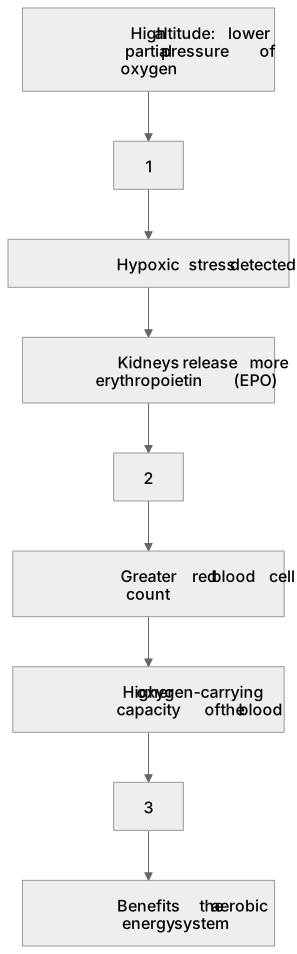
1Box 1
2Box 2
3Box 3
There is more to this lesson
The full lesson goes on to check your understanding and help you earn the marks. Create a free account to carry on, with your progress saved.
A week of Premium from your first lesson · Then the free plan continues · No card, no charge
Test your understanding of Energy systems: Altitude training.
Active recall beats re-reading. Take an instant quiz now to test what you’ve learned and lock it into long-term memory.
A week of Premium from your first lesson · Then the free plan continues · No card, no charge