AQA · A-Level · Physical Education
Course version: 7582 · Version from Sept 2016
Energy systems: High Intensity Interval Training (HIIT).
High Intensity Interval Training (HIIT) alternates short bursts of maximal or near-maximal exercise with brief recovery periods.
Checked against the AQA 7582 specification (opens in a new tab) on .
- Point 24 of 26
- 4 key terms
Study notes
From the checked teaching notes for this specification point.
The idea
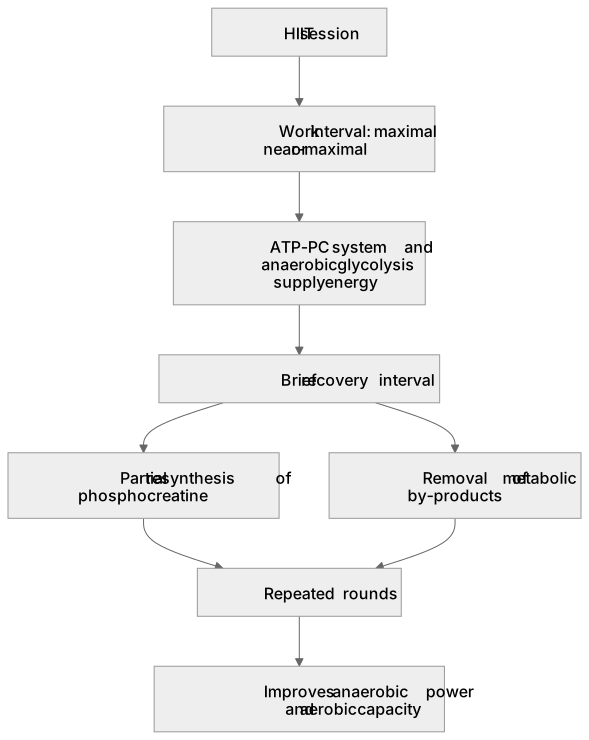
High Intensity Interval Training (HIIT) alternates short bursts of maximal or near-maximal exercise with brief recovery periods. The work intervals are intense enough to rely heavily on the ATP-PC system and anaerobic glycolysis, while the recovery intervals allow partial resynthesis of phosphocreatine and removal of metabolic by-products. A typical session might use 20 to 30 seconds of sprinting followed by 30 to 60 seconds of walking or light jogging, repeated for several rounds. HIIT improves both anaerobic power and aerobic capacity, because the intense efforts stress the anaerobic systems and the repeated nature of the session also challenges oxygen delivery. It is time-efficient compared with continuous steady-state training.
What earns the marks
- HIIT alternates short periods of high-intensity work with brief recovery periods.
- Work intervals are performed at maximal or near-maximal intensity.
- The ATP-PC system and anaerobic glycolysis supply much of the energy during work intervals.
- Recovery intervals allow partial resynthesis of phosphocreatine and removal of by-products.
- HIIT can improve both anaerobic power and aerobic capacity.
- HIIT is time-efficient compared with longer continuous steady-state training.
Common mistakes and how to put them right
Thinking HIIT only trains the aerobic system.
Put it right: The intense work intervals rely heavily on the ATP-PC system and anaerobic glycolysis, although aerobic capacity also improves.
Believing recovery intervals should be complete rest.
Put it right: Light active recovery helps remove by-products and maintain blood flow, though the key point is that recovery is brief.
Assuming HIIT is suitable for all athletes at all times.
Put it right: It is demanding and should be periodised, with adequate recovery to avoid overtraining.
Confusing HIIT with continuous steady-state training.
Put it right: HIIT uses repeated short intense efforts separated by recovery, not one sustained submaximal effort.
Exam tips
- Name the energy systems used during the work intervals and explain why they dominate at high intensity.
- Give a concrete example of a work-to-recovery ratio, such as 30 seconds of sprinting followed by 60 seconds of walking.
- Explain how the recovery interval supports performance in the next work interval.
Try the lesson
The start of the Energy systems: High Intensity Interval Training (HIIT). lesson, made from checked teaching notes for this specification point.
Have a go first
Which description best matches a session of High Intensity Interval Training?
Listen
High Intensity Interval Training (HIIT) alternates short bursts of maximal or near-maximal exercise with brief recovery periods. The work intervals are intense enough to rely heavily on the ATP-PC system and anaerobic glycolysis, while the recovery intervals allow partial resynthesis of phosphocreatine and removal of metabolic by-products. A typical session might use 20 to 30 seconds of sprinting followed by 30 to 60 seconds of walking or light jogging, repeated for several rounds. HIIT improves both anaerobic power and aerobic capacity, because the intense efforts stress the anaerobic systems and the repeated nature of the session also challenges oxygen delivery. It is time-efficient compared with continuous steady-state training. A strong answer earns marks for these points. HIIT alternates short periods of high-intensity work with brief recovery periods. Work intervals are performed at maximal or near-maximal intensity. The ATP-PC system and anaerobic glycolysis supply much of the energy during work intervals. Recovery intervals allow partial resynthesis of phosphocreatine and removal of by-products. Exam tip: Name the energy systems used during the work intervals and explain why they dominate at high intensity.
See it
Key words
Say what each word means before you turn the card.
Interval structure of work and recovery
Try answering aloud or in your head before turning the card.
Anaerobic energy systems at high intensity
Try answering aloud or in your head before turning the card.
Phosphocreatine resynthesis during recovery
Try answering aloud or in your head before turning the card.
Time-efficient training for aerobic and anaerobic fitness
Try answering aloud or in your head before turning the card.
See every definition
- Interval structure of work and recovery
- Alternating short bursts of maximal or near-maximal exercise with brief recovery periods.
- Anaerobic energy systems at high intensity
- The ATP-PC system and anaerobic glycolysis supply much of the energy during work intervals performed at maximal or near-maximal intensity.
- Phosphocreatine resynthesis during recovery
- Recovery intervals allow partial resynthesis of phosphocreatine and removal of metabolic by-products.
- Time-efficient training for aerobic and anaerobic fitness
- Improves both anaerobic power and aerobic capacity and is time-efficient compared with continuous steady-state training.
Label the diagram
Some boxes have lost their names. Pick the right name for each number.
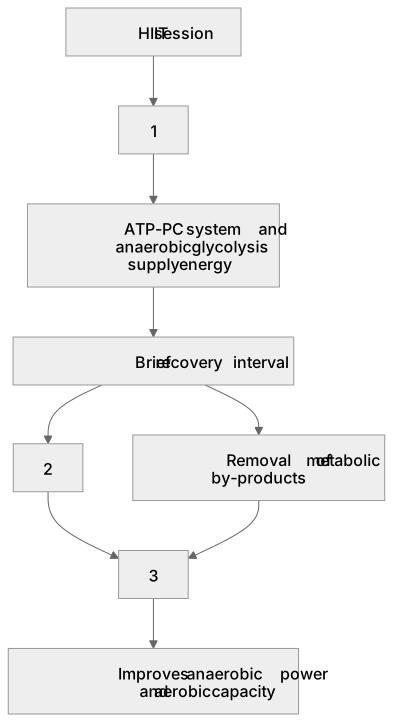
1Box 1
2Box 2
3Box 3
There is more to this lesson
The full lesson goes on to check your understanding and help you earn the marks. Create a free account to carry on, with your progress saved.
A week of Premium from your first lesson · Then the free plan continues · No card, no charge
Test your understanding of Energy systems: High Intensity Interval Training (HIIT).
Active recall beats re-reading. Take an instant quiz now to test what you’ve learned and lock it into long-term memory.
A week of Premium from your first lesson · Then the free plan continues · No card, no charge