AQA · A-Level · Physical Education
Course version: 7582 · Version from Sept 2016
General information processing model, to include:: Decision making.
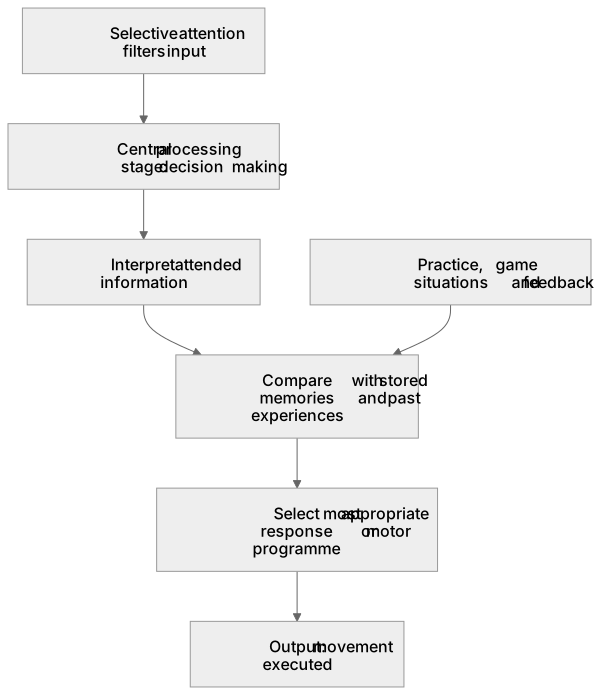
Decision making is the central processing stage of the general information processing model in which the performer interprets the attended information, compares it with stored memories and selects…
Checked against the AQA 7582 specification (opens in a new tab) on .
- Point 8 of 13
- 4 key terms
Study notes
From the checked teaching notes for this specification point.
The idea
Decision making is the central processing stage of the general information processing model in which the performer interprets the attended information, compares it with stored memories and selects an appropriate response. After selective attention has filtered the input, the brain retrieves relevant past experiences and chooses the motor programme most likely to succeed. For example, a hockey player receiving the ball on the edge of the circle decides whether to shoot, pass or dribble based on the positions of teammates and defenders. Faster and more accurate decision making develops through practice, exposure to game situations and feedback, which build a richer store of relevant memories to draw upon.
What earns the marks
- Decision making is the central processing stage of the general information processing model.
- The performer selects the most appropriate response or motor programme.
- Decision making depends on the quality of information passed from selective attention.
- Effective decision making leads to more appropriate and successful responses.
Common mistakes and how to put them right
Placing decision making at the input stage.
Put it right: It belongs to the central processing stage, after selective attention has filtered the input.
Confusing decision making with the output stage.
Put it right: The output is the actual movement executed, not the choice of response.
Believing decision making relies only on the current situation.
Put it right: Stored memories and past experiences are also retrieved and compared.
Assuming decision making cannot be improved.
Put it right: Practice, game experience and feedback develop faster and more accurate decisions.
Exam tips
- State clearly that decision making occurs in the central processing stage of the model.
- Use a specific sporting scenario to show the options considered and the response selected.
- Explain the role of memory and past experience in choosing the response.
- Link improved decision making to practice and feedback to show understanding of how it develops.
Try the lesson
The start of the General information processing model, to include:: Decision making. lesson, made from checked teaching notes for this specification point.
Have a go first
Within the general information processing model, what happens during the decision-making stage?
Listen
Decision making is the central processing stage of the general information processing model in which the performer interprets the attended information, compares it with stored memories and selects an appropriate response. After selective attention has filtered the input, the brain retrieves relevant past experiences and chooses the motor programme most likely to succeed. For example, a hockey player receiving the ball on the edge of the circle decides whether to shoot, pass or dribble based on the positions of teammates and defenders. Faster and more accurate decision making develops through practice, exposure to game situations and feedback, which build a richer store of relevant memories to draw upon. A strong answer earns marks for these points. Decision making is the central processing stage of the general information processing model. The performer selects the most appropriate response or motor programme. Decision making depends on the quality of information passed from selective attention. Effective decision making leads to more appropriate and successful responses. Exam tip: State clearly that decision making occurs in the central processing stage of the model.
See it
Key words
Say what each word means before you turn the card.
Decision making
Try answering aloud or in your head before turning the card.
Central processing and memory
Try answering aloud or in your head before turning the card.
Response selection
Try answering aloud or in your head before turning the card.
Practice and feedback
Try answering aloud or in your head before turning the card.
See every definition
- Decision making
- The central processing stage of the general information processing model in which the performer interprets the attended information, compares it with stored memories and selects an appropriate response.
- Central processing and memory
- The stage in which the brain retrieves relevant past experiences and chooses the motor programme most likely to succeed, after selective attention has filtered the input.
- Response selection
- Choosing the most appropriate response or motor programme, based on interpreting attended information and comparing it with stored memories.
- Practice and feedback
- The means through which faster and more accurate decision making develops, building a richer store of relevant memories to draw upon.
Label the diagram
Some boxes have lost their names. Pick the right name for each number.
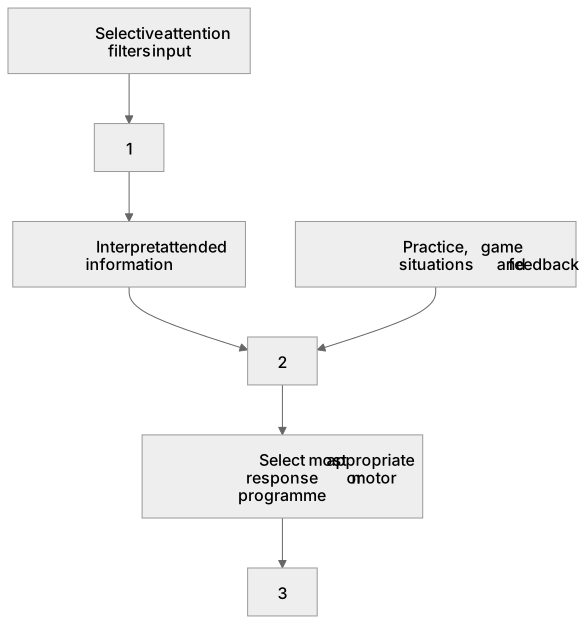
1Box 1
2Box 2
3Box 3
There is more to this lesson
The full lesson goes on to check your understanding and help you earn the marks. Create a free account to carry on, with your progress saved.
A week of Premium from your first lesson · Then the free plan continues · No card, no charge
Test your understanding of General information processing model, to include:: Decision making.
Active recall beats re-reading. Take an instant quiz now to test what you’ve learned and lock it into long-term memory.
A week of Premium from your first lesson · Then the free plan continues · No card, no charge