AQA · A-Level · Physical Education
Course version: 7582 · Version from Sept 2016
General information processing model, to include:: Selective attention.
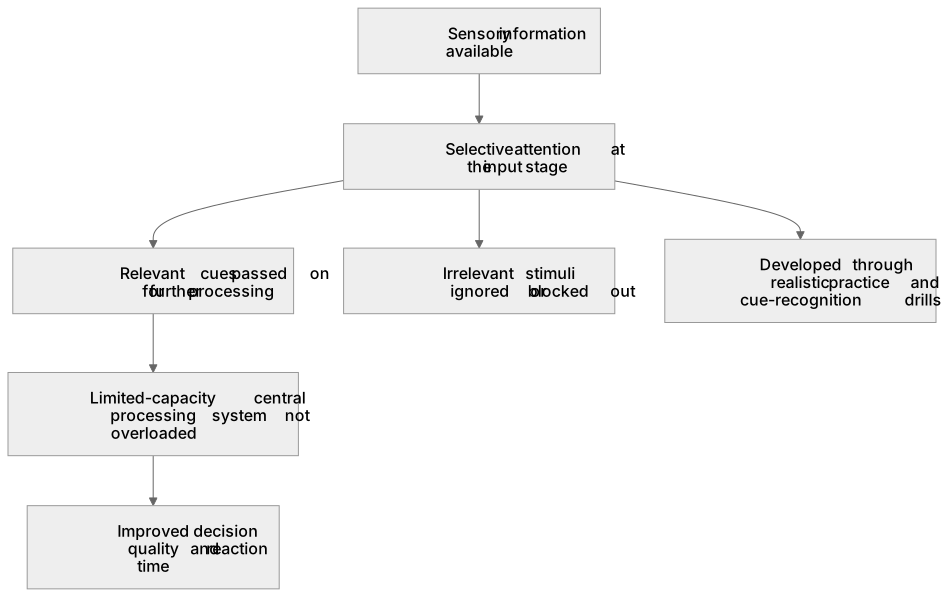
Selective attention is the process by which a performer filters the vast amount of sensory information available and attends only to the cues most relevant to the task.
Checked against the AQA 7582 specification (opens in a new tab) on .
- Point 7 of 13
- 4 key terms
Study notes
From the checked teaching notes for this specification point.
The idea
Selective attention is the process by which a performer filters the vast amount of sensory information available and attends only to the cues most relevant to the task. Within the general information processing model, it sits at the input stage: the senses detect stimuli, but selective attention decides which of those stimuli are passed on for further processing. For example, a netball centre preparing to pass scans several teammates, the ball, opponents and the umpire, yet focuses on the teammate in the best scoring position while blocking out crowd noise. Effective selective attention improves decision quality and reaction time because the limited processing capacity is not overloaded. It can be trained through practice in realistic, distracting conditions and through cue recognition drills.
What earns the marks
- Selective attention filters sensory input so only relevant cues are processed further.
- Relevant cues are prioritised while irrelevant stimuli are ignored or blocked out.
- Improved selective attention can speed up and improve the quality of decision making.
Common mistakes and how to put them right
Thinking selective attention means taking in all available information.
Put it right: It actually filters out irrelevant stimuli so only relevant cues are attended to.
Confusing selective attention with decision making.
Put it right: Selective attention operates at the input stage, whereas decision making occurs in the central processing stage.
Believing selective attention is fixed and cannot improve.
Put it right: It can be trained through practice in distracting, game-realistic conditions.
Assuming selective attention only matters in individual sports.
Put it right: It is equally important in team games where many cues compete for attention.
Exam tips
- Link selective attention explicitly to the input stage of the model so the examiner sees correct placement.
- Use a named sporting example to show which cues are attended to and which are ignored.
- Explain the consequence of selective attention for processing capacity, such as avoiding overload and speeding up response.
- Distinguish selective attention from decision making in one clear sentence to avoid confusion in multiple-choice options.
Try the lesson
The start of the General information processing model, to include:: Selective attention. lesson, made from checked teaching notes for this specification point.
Have a go first
In the general information processing model, what is the main role of selective attention?
Listen
Selective attention is the process by which a performer filters the vast amount of sensory information available and attends only to the cues most relevant to the task. Within the general information processing model, it sits at the input stage: the senses detect stimuli, but selective attention decides which of those stimuli are passed on for further processing. For example, a netball centre preparing to pass scans several teammates, the ball, opponents and the umpire, yet focuses on the teammate in the best scoring position while blocking out crowd noise. Effective selective attention improves decision quality and reaction time because the limited processing capacity is not overloaded. It can be trained through practice in realistic, distracting conditions and through cue recognition drills. A strong answer earns marks for these points. Selective attention filters sensory input so only relevant cues are processed further. Relevant cues are prioritised while irrelevant stimuli are ignored or blocked out. Improved selective attention can speed up and improve the quality of decision making. Exam tip: Link selective attention explicitly to the input stage of the model so the examiner sees correct placement.
See it
Key words
Say what each word means before you turn the card.
Selective attention
Try answering aloud or in your head before turning the card.
Input stage
Try answering aloud or in your head before turning the card.
Information overload
Try answering aloud or in your head before turning the card.
Cue recognition drills
Try answering aloud or in your head before turning the card.
See every definition
- Selective attention
- The process by which a performer filters the vast amount of sensory information available and attends only to the cues most relevant to the task.
- Input stage
- The stage of the general information processing model at which the senses detect stimuli and selective attention decides which stimuli are passed on for further processing.
- Information overload
- A state that effective selective attention prevents by ensuring the limited processing capacity is not overloaded.
- Cue recognition drills
- A method through which selective attention can be trained, alongside practice in realistic, distracting conditions.
Label the diagram
Some boxes have lost their names. Pick the right name for each number.
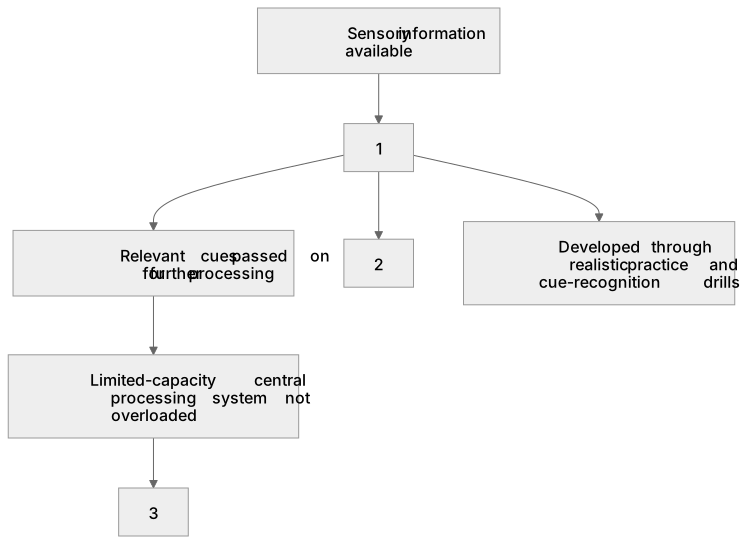
1Box 1
2Box 2
3Box 3
There is more to this lesson
The full lesson goes on to check your understanding and help you earn the marks. Create a free account to carry on, with your progress saved.
A week of Premium from your first lesson · Then the free plan continues · No card, no charge
Test your understanding of General information processing model, to include:: Selective attention.
Active recall beats re-reading. Take an instant quiz now to test what you’ve learned and lock it into long-term memory.
A week of Premium from your first lesson · Then the free plan continues · No card, no charge