AQA · A-Level · Physical Education
Course version: 7582 · Version from Sept 2016
Group dynamics: Group formation.
Group formation explains how separate individuals become a functioning team in physical activity.
Checked against the AQA 7582 specification (opens in a new tab) on .
- Point 2 of 9
- 4 key terms
Study notes
From the checked teaching notes for this specification point.
The idea
Group formation explains how separate individuals become a functioning team in physical activity. In AQA A-Level Physical Education, this is understood through Tuckman's four stages: forming, storming, norming and performing. In the forming stage, members get to know each other and rely on the coach for direction. Storming involves conflict and competition for roles as individuals establish their positions. Norming sees the group resolve conflicts, develop cohesion and agree on shared goals. Finally, in the performing stage, the team functions effectively as a unit, with players taking responsibility and working towards success. Understanding these stages helps explain why some teams gel quickly while others struggle with internal conflict.
What earns the marks
- Group formation is a dynamic process typically described by Tuckman's four stages: forming, storming, norming and performing.
- Forming involves members getting to know each other, assessing the group and relying heavily on the coach.
- Storming is characterised by conflict, rebellion against the leader and competition for roles or status.
- Norming occurs when conflicts are resolved, cohesion develops, and members agree on shared goals and expectations.
- Performing is the final stage where the team functions effectively, independently and collaboratively towards success.
Common mistakes and how to put them right
Confusing group formation with Carron's antecedents of cohesion.
Put it right: Formation refers to Tuckman's stages (forming, storming, norming, performing), while Carron's antecedents (environmental, personal, leadership, team) relate to cohesion.
Thinking a group forms instantly.
Put it right: Formation is a developing process involving distinct stages of interaction and conflict resolution.
Assuming storming is always negative.
Put it right: Storming is a necessary stage for establishing roles and resolving underlying issues before norming can occur.
Exam tips
- Link each of Tuckman's stages to a specific sporting example, such as a netball squad competing for starting positions during the storming stage.
- Use precise terminology such as forming, storming, norming and performing rather than vague phrases like getting on.
- When a question asks about formation, explain the sequential process and how a team transitions from conflict to effective performance.
Try the lesson
The start of the Group dynamics: Group formation. lesson, made from checked teaching notes for this specification point.
Have a go first
Which stage of group formation describes team-mates getting to know each other and testing out how they will work together?
Listen
Group formation explains how separate individuals become a functioning team in physical activity. In AQA A-Level Physical Education, this is understood through Tuckman's four stages: forming, storming, norming and performing. In the forming stage, members get to know each other and rely on the coach for direction. Storming involves conflict and competition for roles as individuals establish their positions. Norming sees the group resolve conflicts, develop cohesion and agree on shared goals. Finally, in the performing stage, the team functions effectively as a unit, with players taking responsibility and working towards success. Understanding these stages helps explain why some teams gel quickly while others struggle with internal conflict. A strong answer earns marks for these points. Group formation is a dynamic process typically described by Tuckman's four stages: forming, storming, norming and performing. Forming involves members getting to know each other, assessing the group and relying heavily on the coach. Storming is characterised by conflict, rebellion against the leader and competition for roles or status. Norming occurs when conflicts are resolved, cohesion develops, and members agree on shared goals and expectations. A common slip: Confusing group formation with Carron's antecedents of cohesion. Instead, formation refers to Tuckman's stages (forming, storming, norming, performing), while Carron's antecedents (environmental, personal, leadership, team) relate to cohesion. Exam tip: Link each of Tuckman's stages to a specific sporting example, such as a netball squad competing for starting positions during the storming stage.
See it
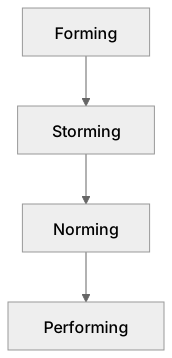
Put it in order
Put these steps in the order they happen.
- 1. Norming
- 2. Performing
- 3. Storming
- 4. Forming
Key words
Say what each word means before you turn the card.
Group formation
Try answering aloud or in your head before turning the card.
Tuckman's stages
Try answering aloud or in your head before turning the card.
Forming
Try answering aloud or in your head before turning the card.
Storming
Try answering aloud or in your head before turning the card.
See every definition
- Group formation
- A dynamic process in which separate individuals become a functioning team, typically described by Tuckman's four stages.
- Tuckman's stages
- The four stages of forming, storming, norming and performing through which a group develops.
- Forming
- The stage in which members get to know each other, assess the group and rely heavily on the coach for direction.
- Storming
- The stage characterised by conflict, rebellion against the leader and competition for roles or status.
Label the diagram
Some boxes have lost their names. Pick the right name for each number.
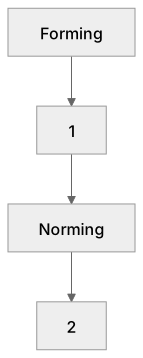
1Box 1
2Box 2
There is more to this lesson
The full lesson goes on to check your understanding and help you earn the marks. Create a free account to carry on, with your progress saved.
A week of Premium from your first lesson · Then the free plan continues · No card, no charge
Test your understanding of Group dynamics: Group formation.
Active recall beats re-reading. Take an instant quiz now to test what you’ve learned and lock it into long-term memory.
A week of Premium from your first lesson · Then the free plan continues · No card, no charge