Group Dynamics
This guide provides a comprehensive overview of Group Dynamics for AQA A-Level PE, covering key theories of group formation, cohesion, and effectiveness. It is designed to equip candidates with the theoretical knowledge and practical application skills needed to excel in exams.
Study Notes
Overview
Group Dynamics is a critical area of sport and exercise psychology that explores the nature of groups and their development. For AQA A-Level PE, understanding how a collection of individuals can become a cohesive, high-performing team is essential. This topic requires candidates to move beyond simple definitions and apply complex theoretical models to practical sporting contexts. Examiners are looking for a clear understanding of how groups form, what makes them cohesive, and why they sometimes fail to reach their potential. Mastery of this topic is demonstrated by not only describing the models of Tuckman, Carron, and Steiner, but also by critically evaluating them and applying them to specific scenarios to explain or improve team performance.
Key Knowledge & Theory
Core Concepts
The study of group dynamics rests on three foundational pillars: how groups form and develop over time, the forces that bind them together, and the factors that determine their ultimate success.
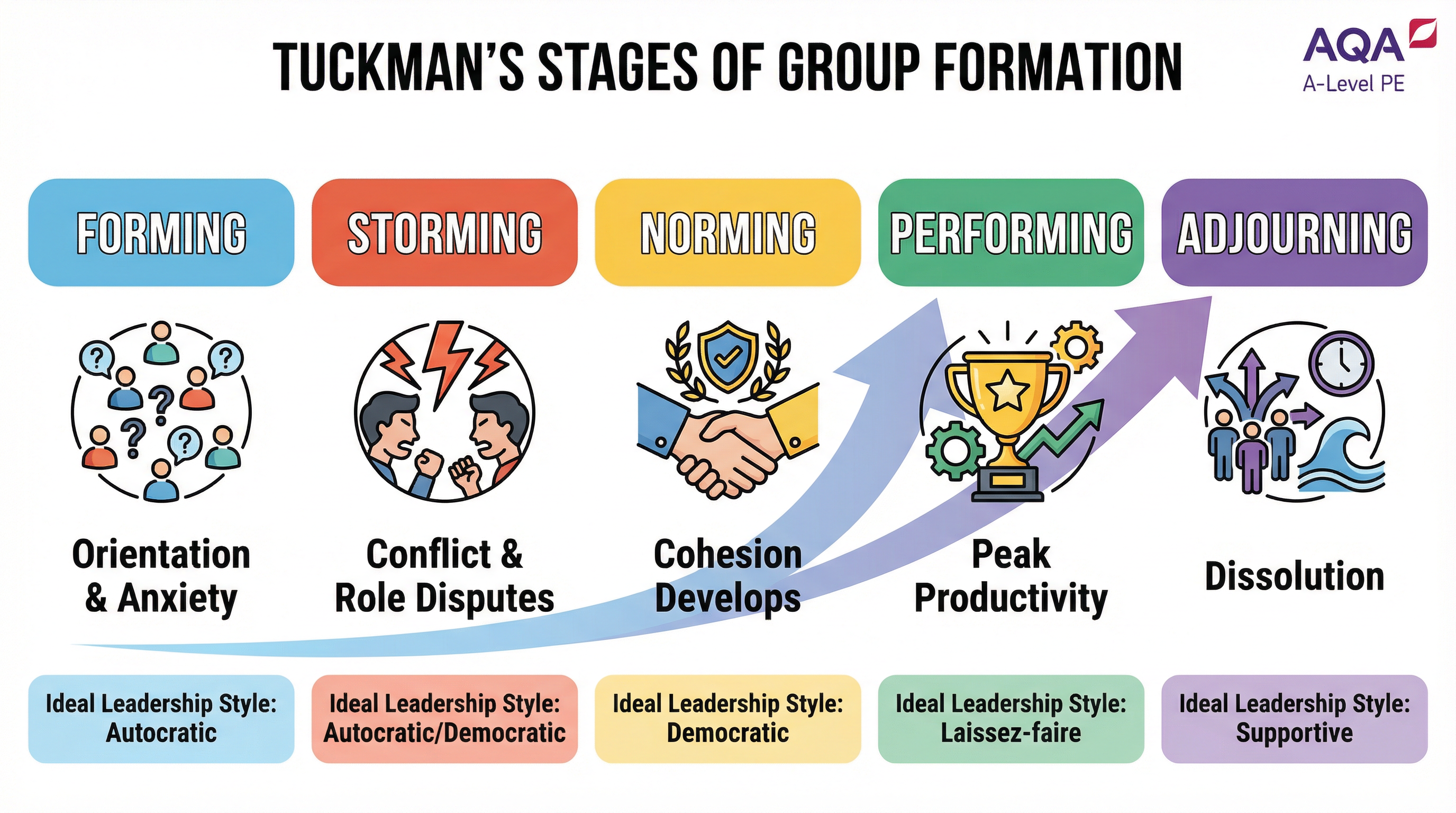
1. Group Formation (Tuckman's Model): Groups are not static; they evolve. Tuckman's model provides a framework for understanding this journey. It outlines a series of sequential stages that most groups go through. A key demand from examiners is for candidates to recognise that this progression is not always linear and that leadership styles must adapt to the group's current stage.
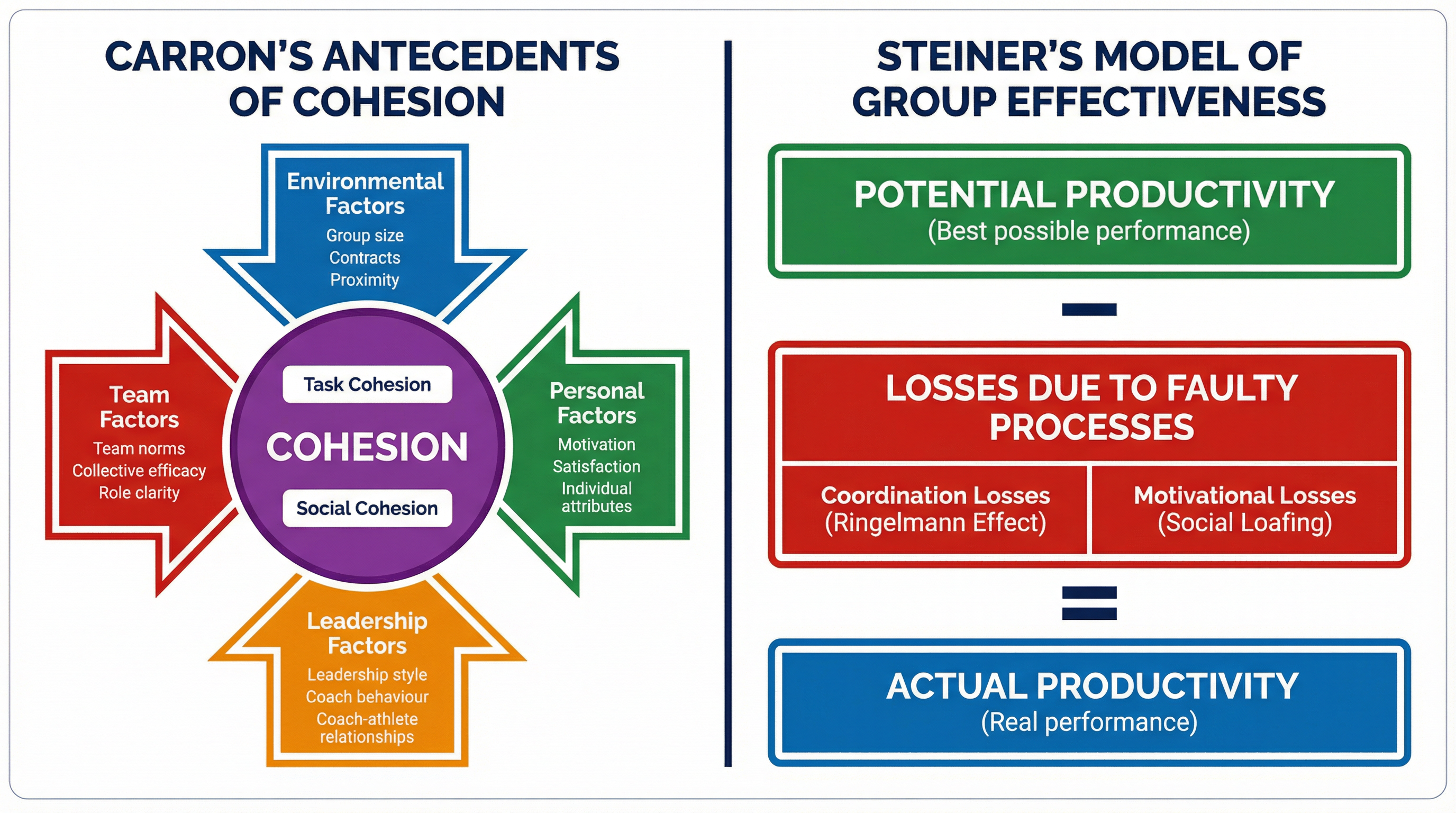
2. Cohesion (Carron's Model): Cohesion is the 'glue' that holds a team together. Carron's model is vital as it breaks down this complex concept into manageable components. It distinguishes between Task Cohesion (the group's ability to work together to achieve common goals) and Social Cohesion (the interpersonal attraction between group members). A crucial point for exam success is understanding that Task Cohesion is the primary predictor of team success in interactive sports. Carron's model also outlines the four antecedents, or factors, that influence the level of cohesion a team develops.
3. Group Effectiveness (Steiner's Model): Why do some star-studded teams fail? Steiner's model provides the answer. It presents a simple but powerful equation to explain the gap between a team's potential and its actual performance. The model highlights that a team's output is not simply the sum of its parts; it is what remains after accounting for 'faulty processes' that hinder performance.
Key Practitioners/Artists/Composers
| Name | Period/Style | Key Works | Relevance |
|---|---|---|---|
| Bruce Tuckman | 1960s-70s | "Developmental Sequence in Small Groups" (1965) | Developed the 'Forming, Storming, Norming, Performing' model of group development, later adding 'Adjourning'. His work is the foundation for understanding how teams evolve. |
| Albert Carron | 1980s-Present | "Conceptual Model of Cohesion" (1982) | A leading researcher in sport cohesion. His model, identifying antecedents and the distinction between task and social cohesion, is a cornerstone of the AQA specification. |
| Ivan Steiner | 1970s | "Group Process and Productivity" (1972) | Proposed the critical model of group effectiveness (Actual Productivity = Potential Productivity - Losses due to Faulty Processes), which is essential for analysing team performance. |
| Max Ringelmann | Early 1900s | Rope-pulling experiments (published 1913) | A French agricultural engineer whose research first identified the inverse relationship between group size and individual performance, now known as the Ringelmann Effect. |
Technical Vocabulary
- Group: Two or more persons who are interacting with one another in such a manner that each person influences and is influenced by each other person.
- Cohesion: The tendency for a group to stick together and remain united in the pursuit of its instrumental objectives and/or for the satisfaction of member affective needs.
- Task Cohesion: The degree to which group members work together to achieve common goals and objectives.
- Social Cohesion: The degree to which members of a group like each other and enjoy one another's company.
- Potential Productivity: The maximum capability of the group when cohesiveness is at its strongest.
- Actual Productivity: The level of performance a group actually achieves.
- Faulty Processes: Factors which go wrong in team performance which impede/prevent group cohesion.
- Coordination Losses: Losses that occur because the operational effectiveness of the group as a unit cannot be sustained for the full match/duration. (e.g., Ringelmann Effect).
- Motivational Losses: Losses that occur when players do not give 100% effort. (e.g., Social Loafing).
- Ringelmann Effect: The diminishing contribution of each individual as the group size increases (a coordination loss).
- Social Loafing: The tendency for individuals to lessen their effort when they are part of a group (a motivational loss).
Practical Skills
Techniques & Processes
To improve group dynamics, a coach or leader can implement several strategies. For exam purposes, it is vital to link these strategies directly to the theoretical models.
1. Clarifying Roles (Addresses Carron's 'Team Factors'):
- Process: At the start of a season (Tuckman's 'Forming' stage), hold a team meeting to explicitly define and assign roles. This includes not just playing positions but also leadership roles (captain, vice-captain) and social roles (e.g., organising social events).
- Application: A rugby coach could provide each player with a playbook detailing their specific responsibilities in set-pieces and defensive patterns. This increases role clarity and reduces coordination losses.
2. Setting Group Goals (Addresses Carron's 'Team Factors'):
- Process: Use the SMARTER principle (Specific, Measurable, Achievable, Realistic, Time-bound, Exciting, Recorded) to set goals for the team as a whole and for individual players that contribute to the team goal.
- Application: A netball team could set a collective goal of achieving a 90% centre-pass-to-goal conversion rate, with individual goals for the shooters on their accuracy. This enhances task cohesion.
3. Increasing Identifiability (Addresses Steiner's 'Motivational Losses'):
- Process: To combat social loafing, ensure individual efforts are recognised. This can be done through performance analysis statistics, public acknowledgement, or specific feedback.
- Application: In a rowing crew, a coach could use telemetry data to monitor the power output of each individual rower, making their contribution identifiable and reducing the likelihood of social loafing.
Materials & Equipment
While group dynamics is primarily a psychological topic, certain equipment can be used to facilitate team building and reduce faulty processes.
- Performance Analysis Software (e.g., Hudl, Dartfish): Used to record matches and training sessions. This allows for individual performance monitoring, which increases identifiability and can be used to provide specific feedback to clarify roles.
- Team-Building Equipment (e.g., ropes, blindfolds, problem-solving puzzles): Often used during the 'Forming' and 'Storming' stages in pre-season training to accelerate the development of communication, trust, and group norms outside of the specific sporting context.
- Communication Aids (e.g., whiteboards, two-way radios): Used by coaches to clearly communicate tactical instructions and roles, helping to minimise coordination losses during performance.
Portfolio/Coursework Guidance
While PE A-Level has a significant practical component, your understanding of Group Dynamics will primarily be assessed in the written exams. However, if you are a player-coach as part of your assessed role, your ability to manage and improve your team's dynamics could form a key part of your coursework commentary and evaluation.
Assessment Criteria
In your NEA (Non-Examined Assessment), if you are discussing your performance as a leader or coach, examiners will look for:
- Application of Theory: Explicitly referencing models like Tuckman's or Carron's to justify your coaching decisions.
- Analysis of Performance: Identifying specific instances of faulty processes (e.g., social loafing in a team drill) and explaining the steps you took to address them.
- Evaluation of Effectiveness: Critically evaluating how successful your strategies were in improving team cohesion or performance.
Building a Strong Portfolio
- Log Book/Diary: Keep a detailed record of team sessions. Note any conflicts (Storming), moments of high cohesion (Performing), or instances of faulty processes.
- Annotated Video: Film your team in action. Use annotation software to highlight examples of good coordination or, more importantly, coordination losses. Explain what is happening and link it to Steiner's model.
- Justify Your Methods: Don't just say "we did a team-building exercise." Explain why you chose that exercise, linking it to Carron's antecedents (e.g., "To improve personal factors and social cohesion, we did a problem-solving task that required high levels of communication and trust.").
Exam Component
Written Exam Knowledge
This is where the bulk of your marks for this topic will be earned. You must have a robust knowledge of all the key theories and be able to recall them accurately under exam pressure.
- Tuckman: Know the 5 stages, the characteristics of each, and the appropriate leadership style.
- Carron: Know the 4 antecedents and the difference between task and social cohesion.
- Steiner: Know the formula and be able to clearly distinguish between coordination and motivational losses, providing sporting examples for each.
Practical Exam Preparation
This topic does not directly feature in the practical exam, but a deep understanding of it will make you a more effective team player. A cohesive team communicates better, supports each other, and can overcome setbacks more effectively. Your awareness of your role within the team structure and your contribution to task cohesion will undoubtedly enhance your own and your team's performance.
Visual Resources
3 diagrams and illustrations
Interactive Diagrams
1 interactive diagram to visualise key concepts
Conceptual Flow Outline
A flowchart illustrating Steiner's Model of Group Effectiveness, showing how Potential Productivity is reduced by Faulty Processes (both Coordination and Motivational losses) to result in Actual Productivity.
Worked Examples
3 detailed examples with solutions and examiner commentary
Practice Questions
Test your understanding — click to reveal model answers
Identify the two types of faulty process outlined in Steiner's model. (2 marks)
Hint: Think about why a team might underperform. Is it a problem with teamwork or with effort?
Describe the 'Norming' stage of Tuckman's model of group development. (3 marks)
Hint: What happens after the initial conflict of the 'Storming' stage?
Using a sporting example, explain how a coach could reduce social loafing. (4 marks)
Hint: Social loafing is a motivational loss due to a lack of identifiability. How can a coach make individual effort more visible?
Critically evaluate Tuckman's model of group development. (8 marks)
Hint: Evaluate means strengths and weaknesses. Is the model always accurate? Does it apply to all types of teams?