AQA · A-Level · Physical Education
Course version: 7582 · Version from Sept 2016
Injury prevention methods: Screening.
Full specification wording
Injury prevention and the rehabilitation of injury: Injury prevention methods: Screening.
Screening is a pre-participation assessment that identifies risk factors for injury before training or competition.
Checked against the AQA 7582 specification (opens in a new tab) on .
- Point 5 of 12
- 4 key terms
Study notes
From the checked teaching notes for this specification point.
The idea
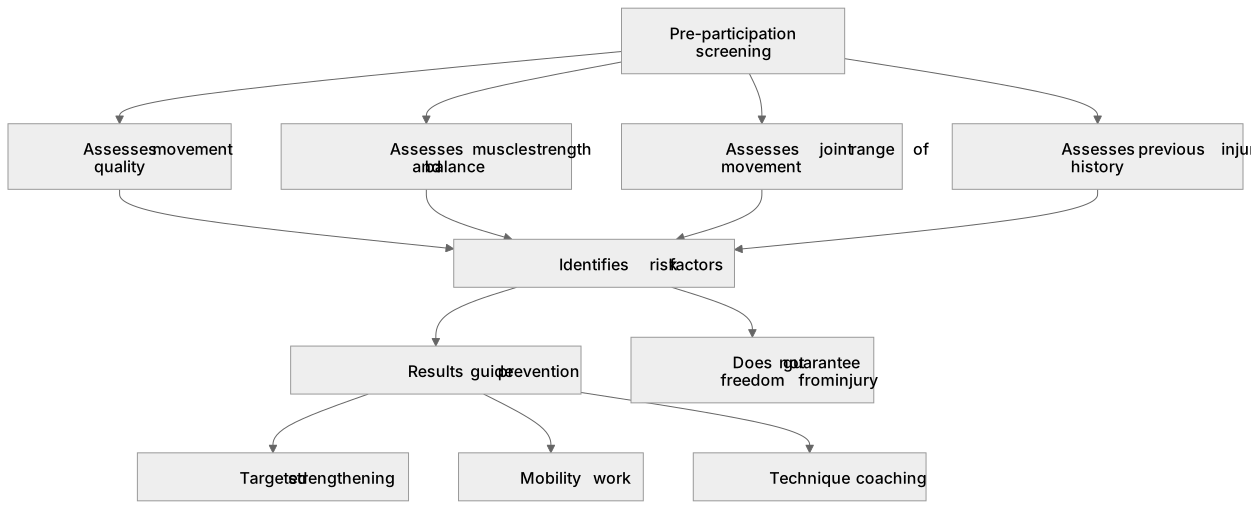
Screening is a pre-participation assessment that identifies risk factors for injury before training or competition. It typically examines movement quality, muscle strength and balance, joint range of movement, and previous injury history. For example, a screening test might reveal that one hamstring is weaker than the other, or that an athlete's landing mechanics place stress on the knee. The results guide prevention: the athlete may be given targeted strengthening, mobility work or technique coaching. Screening does not guarantee freedom from injury; it flags risk so that training can be adjusted. Understanding its purpose and limitations is essential.
What earns the marks
- Screening is a pre-participation assessment used to identify injury risk factors.
- Screening may assess movement quality, muscle strength and balance, joint range of movement, and previous injury history.
- Screening results inform prevention by guiding targeted strengthening, mobility work or technique coaching.
- Screening does not guarantee freedom from injury; it identifies risk so training can be adjusted.
- Screening is one method of injury prevention alongside warm-up, protective equipment and load management.
Common mistakes and how to put them right
Thinking screening prevents injury by itself.
Put it right by stating that screening informs prevention.
Believing screening is only for elite athletes.
Put it right by recognising its broad applicability.
Confusing screening with diagnosis.
Put it right by distinguishing the two.
Assuming a clear screening means no injury will occur.
Put it right by acknowledging its limitations.
Exam tips
- Look for the purpose of screening in the question: is it about identifying risk, guiding training, or both?
- Eliminate options that describe treatment or rehabilitation rather than pre-participation assessment.
- Remember that screening is one part of a wider prevention programme, not a standalone solution.
Try the lesson
The start of the Injury prevention and the rehabilitation of injury: Injury prevention methods: Screening. lesson, made from checked teaching notes for this specification point.
Have a go first
What is the main purpose of screening a performer before they begin a training programme?
Listen
Screening is a pre-participation assessment that identifies risk factors for injury before training or competition. It typically examines movement quality, muscle strength and balance, joint range of movement, and previous injury history. For example, a screening test might reveal that one hamstring is weaker than the other, or that an athlete's landing mechanics place stress on the knee. The results guide prevention: the athlete may be given targeted strengthening, mobility work or technique coaching. Screening does not guarantee freedom from injury; it flags risk so that training can be adjusted. Understanding its purpose and limitations is essential. A strong answer earns marks for these points. Screening is a pre-participation assessment used to identify injury risk factors. Screening may assess movement quality, muscle strength and balance, joint range of movement, and previous injury history. Screening results inform prevention by guiding targeted strengthening, mobility work or technique coaching. Screening does not guarantee freedom from injury; it identifies risk so training can be adjusted. A common slip: Thinking screening prevents injury by itself: screening identifies risk factors, and prevention follows through targeted training. Instead, stating that screening informs prevention. Exam tip: Look for the purpose of screening in the question: is it about identifying risk, guiding training, or both?
See it
Key words
Say what each word means before you turn the card.
Pre-participation assessment
Try answering aloud or in your head before turning the card.
Identification of injury risk factors
Try answering aloud or in your head before turning the card.
Informing targeted prevention strategies
Try answering aloud or in your head before turning the card.
Limitations of screening
Try answering aloud or in your head before turning the card.
See every definition
- Pre-participation assessment
- An assessment that identifies risk factors for injury before training or competition.
- Identification of injury risk factors
- Screening typically examines movement quality, muscle strength and balance, joint range of movement, and previous injury history.
- Informing targeted prevention strategies
- The results guide prevention: the athlete may be given targeted strengthening, mobility work or technique coaching.
- Limitations of screening
- Screening does not guarantee freedom from injury; it flags risk so that training can be adjusted.
Label the diagram
Some boxes have lost their names. Pick the right name for each number.
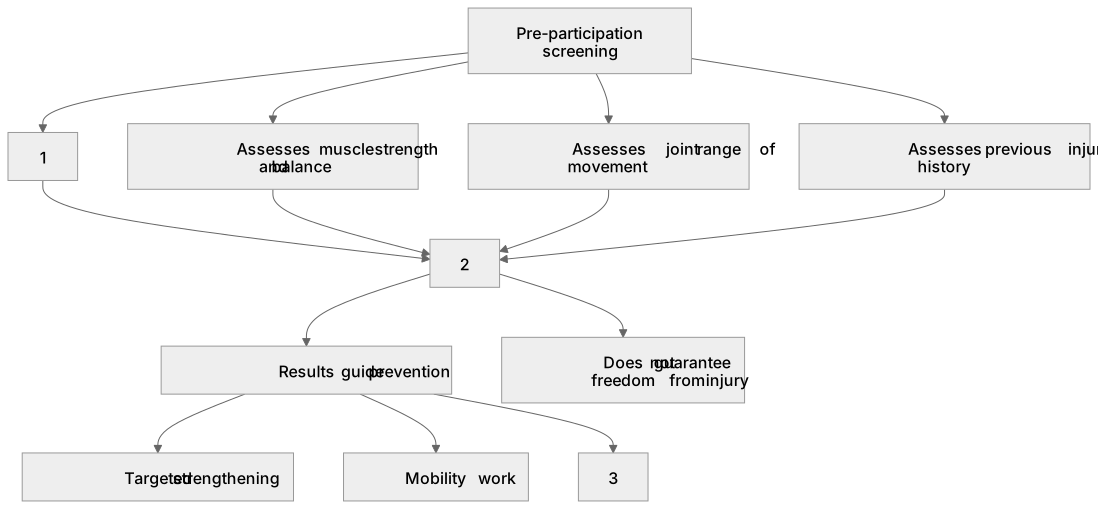
1Box 1
2Box 2
3Box 3
There is more to this lesson
The full lesson goes on to check your understanding and help you earn the marks. Create a free account to carry on, with your progress saved.
A week of Premium from your first lesson · Then the free plan continues · No card, no charge
Test your understanding of Injury prevention and the rehabilitation of injury: Injury prevention methods: Screening.
Active recall beats re-reading. Take an instant quiz now to test what you’ve learned and lock it into long-term memory.
A week of Premium from your first lesson · Then the free plan continues · No card, no charge