AQA · A-Level · Physical Education
Course version: 7582 · Version from Sept 2016
Warm up, flexibility training (active, passive, static and ballistic),…
Full specification wording
Injury prevention and the rehabilitation of injury: Warm up, flexibility training (active, passive, static and ballistic), taping and bracing.
Injury prevention includes warm up, flexibility training, taping and bracing.
Checked against the AQA 7582 specification (opens in a new tab) on .
- Point 7 of 12
- 4 key terms
Study notes
From the checked teaching notes for this specification point.
The idea
Injury prevention includes warm up, flexibility training, taping and bracing. A warm up raises muscle temperature, increases blood flow and prepares joints and muscles for activity, reducing strain risk. Flexibility training can be active, where the performer moves the joint themselves; passive, where a partner or device applies the stretch; static, holding a position still; and ballistic, using bouncing or swinging movements. Taping supports a joint or muscle, limits unwanted movement and can provide proprioceptive feedback. Bracing uses a rigid or semi-rigid device to stabilise a joint or region. These methods are used alongside safe technique and appropriate equipment.
What earns the marks
- Warm up raises muscle temperature and blood flow, preparing the body for activity.
- Active flexibility is performed by the individual moving the joint themselves.
- Passive flexibility uses an external force such as a partner or device.
- Static flexibility involves holding a stretch still, while ballistic flexibility uses bouncing or swinging movements.
- Taping and bracing support or stabilise a joint, limiting unwanted movement and providing feedback.
Common mistakes and how to put them right
Confusing active and passive flexibility.
Put it right: Active is self-produced movement, passive relies on an external force.
Thinking ballistic stretching is always safe.
Put it right: Its bouncing action can trigger the stretch reflex and increase injury risk if performed incorrectly.
Believing taping or bracing cures an injury.
Put it right: They support and protect but do not replace rehabilitation or safe technique.
Skipping warm up before flexibility work.
Put it right: A warm up prepares tissues and makes stretching safer and more effective.
Exam tips
- Learn a clear definition and example for each flexibility type so you can match them quickly in MCQs.
- Distinguish taping from bracing: taping uses adhesive tape, bracing uses a fitted device.
- When a question asks about injury prevention, link the method to how it reduces risk, not just what it is.
Try the lesson
The start of the Injury prevention and the rehabilitation of injury: Warm up, flexibility training (active, passive, static and ballistic), taping and bracing. lesson, made from checked teaching notes for this specification point.
Have a go first
A gymnast performs an active stretch to increase the flexibility of their hamstrings. Which statement describes the correct technique for this type of stretch?
Listen
Injury prevention includes warm up, flexibility training, taping and bracing. A warm up raises muscle temperature, increases blood flow and prepares joints and muscles for activity, reducing strain risk. Flexibility training can be active, where the performer moves the joint themselves; passive, where a partner or device applies the stretch; static, holding a position still; and ballistic, using bouncing or swinging movements. Taping supports a joint or muscle, limits unwanted movement and can provide proprioceptive feedback. Bracing uses a rigid or semi-rigid device to stabilise a joint or region. These methods are used alongside safe technique and appropriate equipment. A strong answer earns marks for these points. Warm up raises muscle temperature and blood flow, preparing the body for activity. Active flexibility is performed by the individual moving the joint themselves. Passive flexibility uses an external force such as a partner or device. Static flexibility involves holding a stretch still, while ballistic flexibility uses bouncing or swinging movements. Exam tip: Learn a clear definition and example for each flexibility type so you can match them quickly in MCQs.
See it

Key words
Say what each word means before you turn the card.
Warm up
Try answering aloud or in your head before turning the card.
Flexibility types
Try answering aloud or in your head before turning the card.
Taping and bracing
Try answering aloud or in your head before turning the card.
Injury prevention
Try answering aloud or in your head before turning the card.
See every definition
- Warm up
- Raises muscle temperature and blood flow, preparing the body for activity.
- Flexibility types
- Active is performed by the individual moving the joint themselves, passive uses an external force such as a partner or device, static involves holding a stretch still, and ballistic uses bouncing or swinging movements.
- Taping and bracing
- Support or stabilise a joint, limiting unwanted movement and providing feedback.
- Injury prevention
- Includes warm up, flexibility training, taping and bracing, used alongside safe technique and appropriate equipment.
Label the diagram
Some boxes have lost their names. Pick the right name for each number.
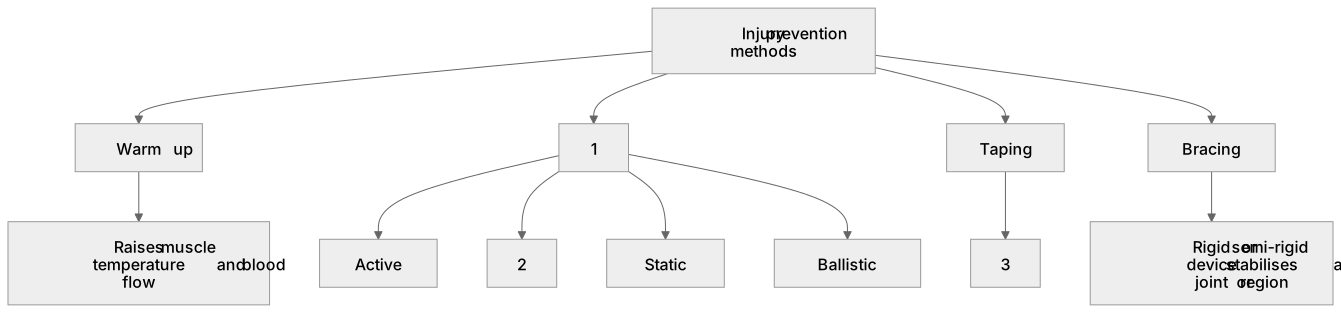
1Box 1
2Box 2
3Box 3
There is more to this lesson
The full lesson goes on to check your understanding and help you earn the marks. Create a free account to carry on, with your progress saved.
A week of Premium from your first lesson · Then the free plan continues · No card, no charge
Test your understanding of Injury prevention and the rehabilitation of injury: Warm up, flexibility training (active, passive, static and ballistic), taping and bracing.
Active recall beats re-reading. Take an instant quiz now to test what you’ve learned and lock it into long-term memory.
A week of Premium from your first lesson · Then the free plan continues · No card, no charge