AQA · GCSE · Physics
Course version: 8463 · Version from Sept 2016
The resistance of a filament lamp increases as the temperature of the…
Full specification wording
Resistors: The resistance of a filament lamp increases as the temperature of the filament increases.
A filament lamp works by getting hot: current in the thin metal filament raises its temperature until it glows.
Checked against the AQA 8463 specification (opens in a new tab) on .
- Point 5 of 13
- 4 key terms
Study notes
From the checked teaching notes for this specification point.
The idea
A filament lamp works by getting hot: current in the thin metal filament raises its temperature until it glows. That heating changes the filament itself. The metal ions in the lattice vibrate more strongly at higher temperature, so the electrons carrying the current collide with them more often and find it harder to pass, which means the resistance increases. The effect shows up clearly on a characteristic graph. Near the origin the line is almost straight, because the current is small and the filament is barely warm. As the potential difference rises the filament heats, the resistance climbs, and the current no longer rises in proportion, so the curve bends over and its gradient falls.
What earns the marks
- Stating that the resistance of the filament increases as its temperature increases.
- Explaining the cause in terms of increased vibration of the ions in the metal.
- Linking that to more frequent collisions with the electrons carrying the current.
- Describing the resulting curve as bending over with a decreasing gradient.
Common mistakes and how to put them right
Stating that the current heats the filament without saying what that does to the resistance.
Claiming resistance falls as the lamp gets hotter, confusing it with a thermistor.
Describing the graph as a straight line because it passes through the origin.
Saying electrons are destroyed or slowed by the heat rather than colliding more often with vibrating ions.
Exam tips
- Answer explain questions with a chain: more current, hotter filament, more vibration, more collisions, more resistance.
- Describe the graph shape and the physical cause together, since each usually carries its own mark.
- Keep the filament lamp and the thermistor apart in your memory, as their responses to temperature are opposite.
Try the lesson
The start of the Resistors: The resistance of a filament lamp increases as the temperature of the filament increases. lesson, made from checked teaching notes for this specification point.
Have a go first
As the temperature of a filament lamp's filament increases, what happens to its resistance?
Listen
A filament lamp works by getting hot: current in the thin metal filament raises its temperature until it glows. That heating changes the filament itself. The metal ions in the lattice vibrate more strongly at higher temperature, so the electrons carrying the current collide with them more often and find it harder to pass, which means the resistance increases. The effect shows up clearly on a characteristic graph. Near the origin the line is almost straight, because the current is small and the filament is barely warm. As the potential difference rises the filament heats, the resistance climbs, and the current no longer rises in proportion, so the curve bends over and its gradient falls. A strong answer earns marks for these points. stating that the resistance of the filament increases as its temperature increases. explaining the cause in terms of increased vibration of the ions in the metal. linking that to more frequent collisions with the electrons carrying the current. describing the resulting curve as bending over with a decreasing gradient. Exam tip: Answer explain questions with a chain: more current, hotter filament, more vibration, more collisions, more resistance.
See it
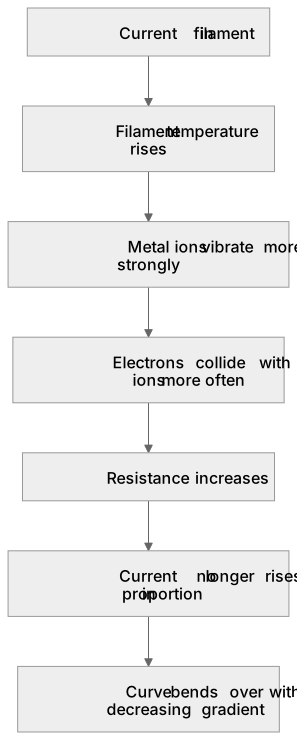
Put it in order
Put these steps in the order they happen.
- 1. Curve bends over with decreasing gradient
- 2. Current no longer rises in proportion
- 3. Metal ions vibrate more strongly
- 4. Resistance increases
- 5. Current in filament
- 6. Filament temperature rises
- 7. Electrons collide with ions more often
Key words
Say what each word means before you turn the card.
filament lamps
Try answering aloud or in your head before turning the card.
temperature and resistance
Try answering aloud or in your head before turning the card.
ion vibration and collisions
Try answering aloud or in your head before turning the card.
decreasing gradient
Try answering aloud or in your head before turning the card.
See every definition
- filament lamps
- A lamp in which current in the thin metal filament raises its temperature until it glows.
- temperature and resistance
- The resistance of a filament increases as the temperature of the filament increases.
- ion vibration and collisions
- The metal ions in the lattice vibrate more strongly at higher temperature, so the electrons carrying the current collide with them more often and find it harder to pass.
- decreasing gradient
- As the potential difference rises the filament heats, the resistance climbs, and the current no longer rises in proportion, so the curve bends over and its gradient falls.
Label the diagram
Some boxes have lost their names. Pick the right name for each number.
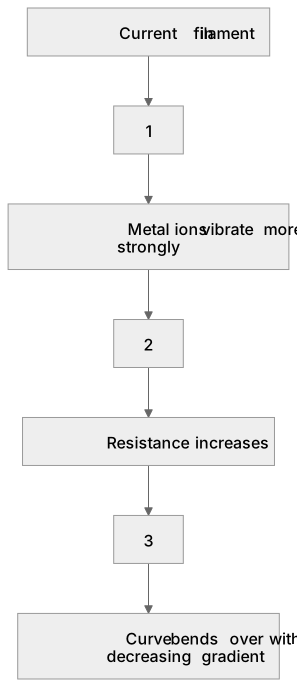
1Box 1
2Box 2
3Box 3
There is more to this lesson
The full lesson goes on to check your understanding and help you earn the marks. Create a free account to carry on, with your progress saved.
A week of Premium from your first lesson · Then the free plan continues · No card, no charge
Test your understanding of Resistors: The resistance of a filament lamp increases as the temperature of the filament increases.
Active recall beats re-reading. Take an instant quiz now to test what you’ve learned and lock it into long-term memory.
A week of Premium from your first lesson · Then the free plan continues · No card, no charge