OCR · A-Level · Physics
Course version: H556 · Version from Sept 2015
Dynamics: (f) one- and two-dimensional motion under constant force.
Motion under constant force involves constant acceleration, described by the equations of motion (suvat): v = u + at, s = ut + ½at², v² = u² + 2as, s = ½(u + v)t.
Checked against the OCR H556 specification (opens in a new tab) on .
- Point 6 of 10
- 4 key terms
Study notes
From the checked teaching notes for this specification point.
The idea
Motion under constant force involves constant acceleration, described by the equations of motion (suvat): v = u + at, s = ut + ½at², v² = u² + 2as, s = ½(u + v)t. In one dimension, motion is along a straight line; in two dimensions, motion can be split into independent perpendicular components, often horizontal and vertical. For projectile motion, horizontal acceleration is zero (constant velocity) and vertical acceleration is g downwards. For example, a ball thrown horizontally: horizontal distance x = uₓt, vertical drop y = ½gt². In MCQs, you may calculate a quantity using suvat, resolve vectors, or identify independence of components. Always define a positive direction and use consistent signs.
What earns the marks
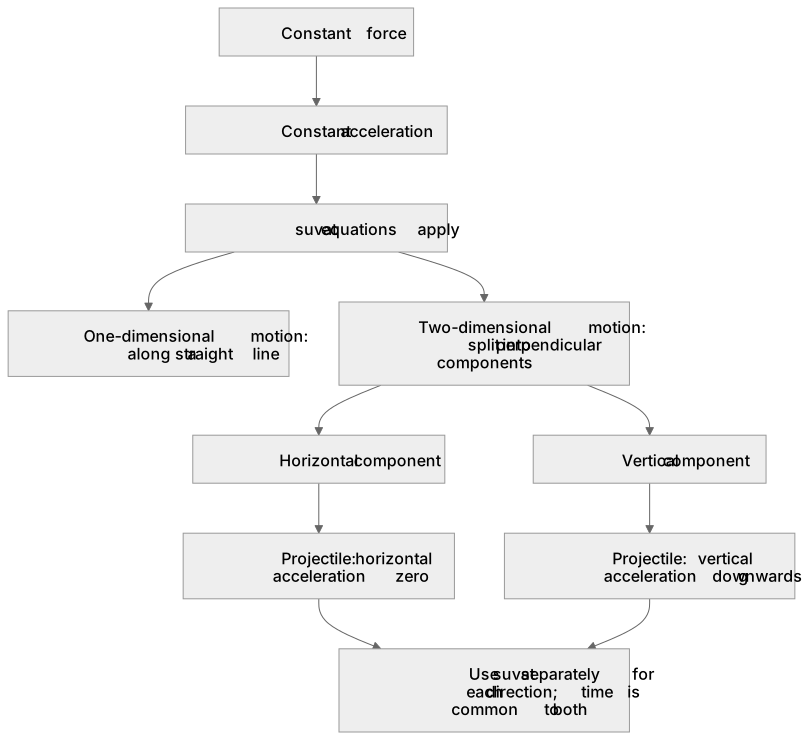
- Constant force produces constant acceleration, so the suvat equations apply.
- In one dimension, motion is along a straight line; use suvat with consistent signs.
- In two dimensions, resolve motion into perpendicular components that are independent.
- For projectile motion, horizontal acceleration is zero and vertical acceleration is g downwards.
- Use suvat separately for each direction; time is common to both.
- Define a positive direction and apply signs consistently.
Common mistakes and how to put them right
Using suvat equations when acceleration is not constant.
Put it right by checking that the force is constant before applying them.
Mixing up horizontal and vertical components in projectile motion.
Put it right by treating them separately with their own suvat calculations.
Forgetting that vertical acceleration is g downwards and taking it as positive when upward is positive.
Put it right by assigning signs consistently.
Assuming horizontal velocity changes in projectile motion.
Put it right by recognising horizontal acceleration is zero (ignoring air resistance).
Exam tips
- List the suvat variables you know and the one you need before choosing an equation.
- For two-dimensional motion, draw a diagram and resolve initial velocity into components.
- Use the same time t for horizontal and vertical parts of projectile motion.
Try the lesson
The start of the Dynamics: (f) one- and two-dimensional motion under constant force. lesson, made from checked teaching notes for this specification point.
Listen
Motion under constant force involves constant acceleration, described by the equations of motion (suvat): v = u + at, s = ut + ½at², v² = u² + 2as, s = ½(u + v)t. In one dimension, motion is along a straight line; in two dimensions, motion can be split into independent perpendicular components, often horizontal and vertical. For projectile motion, horizontal acceleration is zero (constant velocity) and vertical acceleration is g downwards. For example, a ball thrown horizontally: horizontal distance x = uₓt, vertical drop y = ½gt². In MCQs, you may calculate a quantity using suvat, resolve vectors, or identify independence of components. Always define a positive direction and use consistent signs. A strong answer earns marks for these points. Constant force produces constant acceleration, so the suvat equations apply. In one dimension, motion is along a straight line; use suvat with consistent signs. In two dimensions, resolve motion into perpendicular components that are independent. For projectile motion, horizontal acceleration is zero and vertical acceleration is g downwards. A common slip: Using suvat equations when acceleration is not constant. Instead, checking that the force is constant before applying them. Exam tip: List the suvat variables you know and the one you need before choosing an equation.
See it
Key words
Say what each word means before you turn the card.
Constant acceleration
Try answering aloud or in your head before turning the card.
Equations of motion
Try answering aloud or in your head before turning the card.
Projectile motion
Try answering aloud or in your head before turning the card.
Vector resolution
Try answering aloud or in your head before turning the card.
See every definition
- Constant acceleration
- Constant force produces constant acceleration, so the suvat equations apply.
- Equations of motion
- The suvat equations describe motion under constant force: v = u + at, s = ut + ½at², v² = u² + 2as, s = ½(u + v)t.
- Projectile motion
- Horizontal acceleration is zero (constant velocity) and vertical acceleration is g downwards.
- Vector resolution
- In two dimensions, motion can be split into independent perpendicular components, often horizontal and vertical.
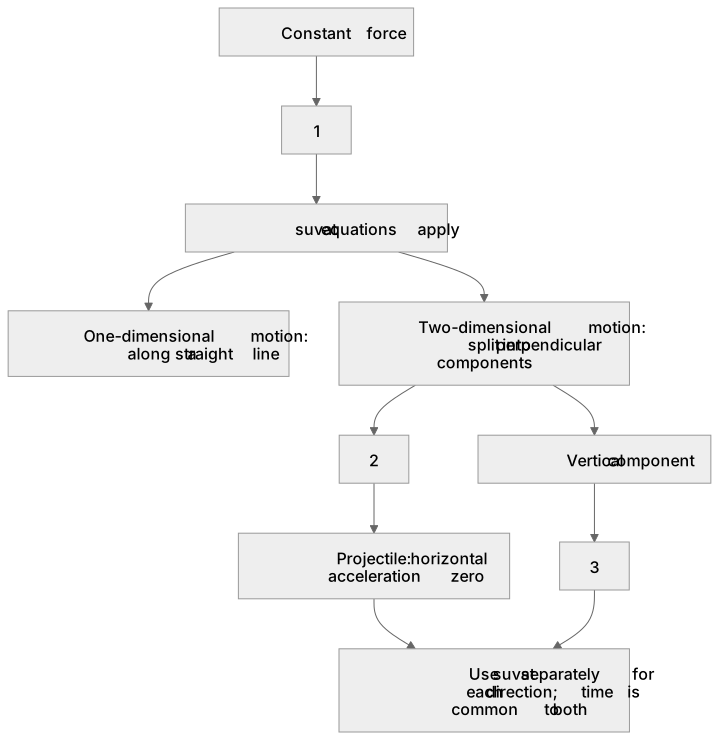
Label the diagram
Some boxes have lost their names. Pick the right name for each number.
1Box 1
2Box 2
3Box 3
There is more to this lesson
The full lesson goes on to check your understanding and help you earn the marks. Create a free account to carry on, with your progress saved.
A week of Premium from your first lesson · Then the free plan continues · No card, no charge
Test your understanding of Dynamics: (f) one- and two-dimensional motion under constant force.
Active recall beats re-reading. Take an instant quiz now to test what you’ve learned and lock it into long-term memory.
A week of Premium from your first lesson · Then the free plan continues · No card, no charge