OCR · GCSE · Physics
Course version: J249 · Version from Sept 2018
Physics on the move: explain the dangers caused by large decelerations
A large deceleration means velocity changes quickly, so the rate of change of velocity is high.
Checked against the OCR J249 specification (opens in a new tab) on .
- Point 6 of 8
- 4 key terms
Study notes
From the checked teaching notes for this specification point.
The idea
A large deceleration means velocity changes quickly, so the rate of change of velocity is high. Since force equals mass times acceleration (F = m × a), a large deceleration requires a large resultant force on whatever is being slowed. In a vehicle, that force acts through the seat belt, airbag or crumple zone on the occupants. A large deceleration over a short time gives a large force, which can cause injury such as whiplash, internal damage or fractures, and can throw loose objects forward. Spreading the same change in velocity over a longer time reduces the deceleration and therefore the force, which is why crumple zones, seat belts and airbags are designed to extend the stopping time. Learners should link the size of the deceleration to the size of the force and then to the risk of harm.
What earns the marks
- States that a large deceleration means a large rate of change of velocity.
- Links a large deceleration to a large resultant force using F = m × a.
- Explains that a large force acting on a passenger can cause injury.
- Identifies that extending the time of deceleration reduces the force and the danger.
Common mistakes and how to put them right
Confuses deceleration with speed.
Put it right: Keep the distinction between speed, velocity and rate of change of velocity.
Assumes a large deceleration produces a small force.
Put it right: Apply F = m × a so a larger deceleration gives a larger force.
Ignores the role of time.
Put it right: Explain that spreading the change over a longer time lowers the deceleration and the force.
Exam tips
- Name the equation F = m × a and say what each symbol means before applying it.
- Use a road example such as a car braking hard or hitting a barrier to make the link between deceleration and force concrete.
- When asked about safety features, explain how each one increases the time taken to stop.
Try the lesson
The start of the Physics on the move: explain the dangers caused by large decelerations lesson, made from checked teaching notes for this specification point.
Have a go first
How does a seat belt help protect a passenger during a sudden stop?
Listen
A large deceleration means velocity changes quickly, so the rate of change of velocity is high. Since force equals mass times acceleration (F = m × a), a large deceleration requires a large resultant force on whatever is being slowed. In a vehicle, that force acts through the seat belt, airbag or crumple zone on the occupants. A large deceleration over a short time gives a large force, which can cause injury such as whiplash, internal damage or fractures, and can throw loose objects forward. Spreading the same change in velocity over a longer time reduces the deceleration and therefore the force, which is why crumple zones, seat belts and airbags are designed to extend the stopping time. Learners should link the size of the deceleration to the size of the force and then to the risk of harm. A strong answer earns marks for these points. States that a large deceleration means a large rate of change of velocity. Links a large deceleration to a large resultant force using F = m × a. Explains that a large force acting on a passenger can cause injury. Identifies that extending the time of deceleration reduces the force and the danger. Exam tip: Name the equation F = m × a and say what each symbol means before applying it.
See it
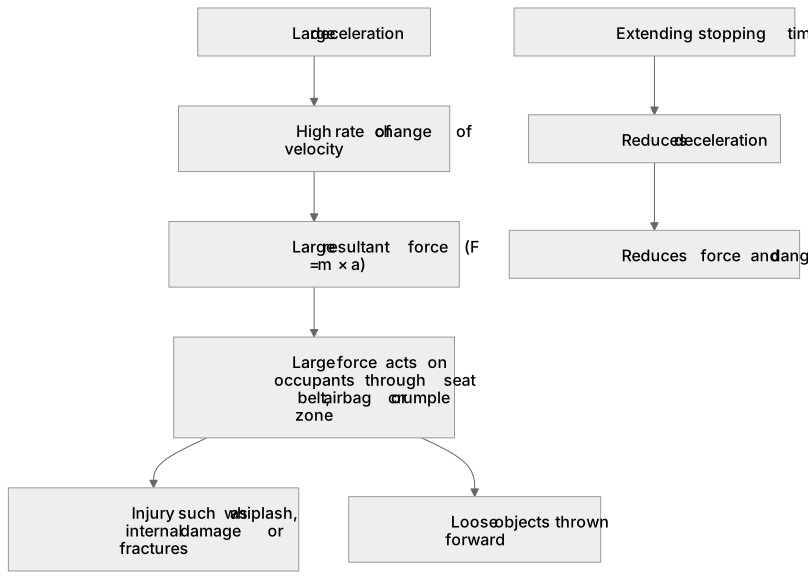
Key words
Say what each word means before you turn the card.
Rate of change of velocity
Try answering aloud or in your head before turning the card.
Resultant force
Try answering aloud or in your head before turning the card.
Passenger safety and injury
Try answering aloud or in your head before turning the card.
Vehicle safety features
Try answering aloud or in your head before turning the card.
See every definition
- Rate of change of velocity
- A large deceleration means velocity changes quickly, so this is high.
- Resultant force
- A large deceleration requires a large one of these on whatever is being slowed, since force equals mass times acceleration.
- Passenger safety and injury
- A large force acting on a passenger can cause injury such as whiplash, internal damage or fractures.
- Vehicle safety features
- Crumple zones, seat belts and airbags are designed to extend the stopping time, spreading the same change in velocity over a longer time to reduce the force.
Label the diagram
Some boxes have lost their names. Pick the right name for each number.
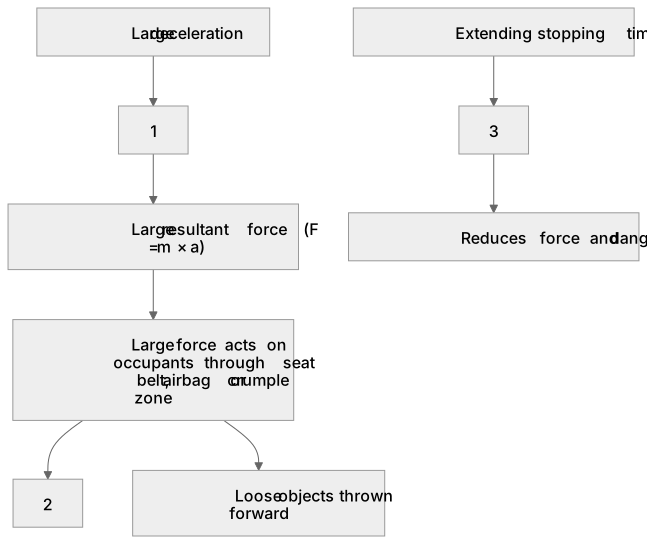
1Box 1
2Box 2
3Box 3
There is more to this lesson
The full lesson goes on to check your understanding and help you earn the marks. Create a free account to carry on, with your progress saved.
A week of Premium from your first lesson · Then the free plan continues · No card, no charge
Test your understanding of Physics on the move: explain the dangers caused by large decelerations
Active recall beats re-reading. Take an instant quiz now to test what you’ve learned and lock it into long-term memory.
A week of Premium from your first lesson · Then the free plan continues · No card, no charge