OCR · GCSE · Physics
Course version: J249 · Version from Sept 2018
Describe a simple model of the Earth’s atmosphere and of atmospheric…
Full specification wording
Pressure: describe a simple model of the Earth’s atmosphere and of atmospheric pressure (to include: an assumption of uniform density; knowledge of layers is not expected) (content found only in the physics separate science qualification)
This separate-science item asks you to describe a simple model, not to name atmospheric layers.
Checked against the OCR J249 specification (opens in a new tab) on .
- Point 8 of 12
- 3 key terms
Study notes
From the checked teaching notes for this specification point.
The idea
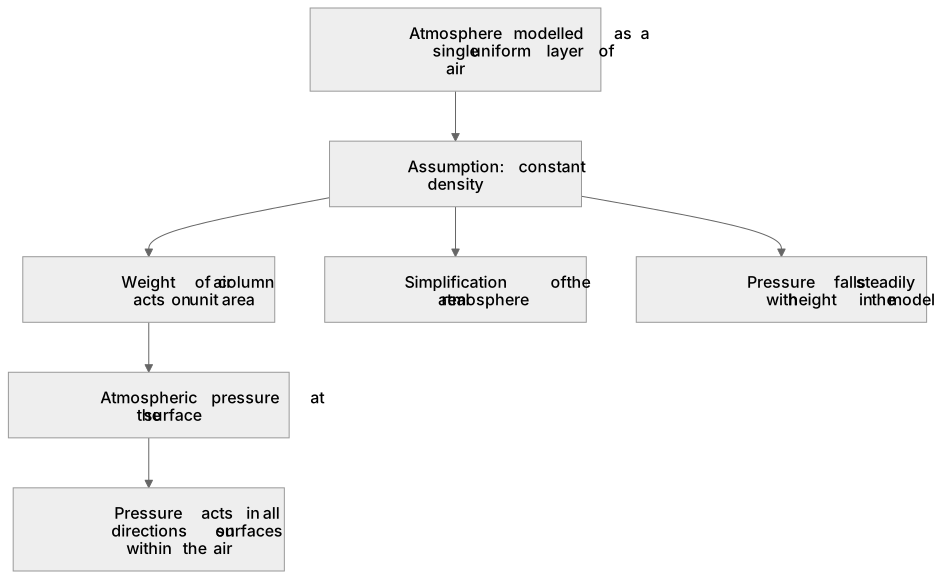
This separate-science item asks you to describe a simple model, not to name atmospheric layers. In the model, treat the atmosphere as a single uniform layer of air of constant density sitting on the Earth's surface, rather than as a stack of named regions. Atmospheric pressure at the surface is then explained as the weight of this air column pressing down on each unit of area, giving a pressure that acts in all directions on any surface within the air. Because density is assumed uniform, the pressure falls steadily with height in the model, which is a simplification of the real gradual thinning of air. Use the model to predict that pressure decreases as you rise, and recognise that the uniform-density assumption is what makes the simple calculation possible.
What earns the marks
- States that the model treats the atmosphere as a uniform layer of air of constant density above the Earth's surface.
- Explains atmospheric pressure as the weight of the air column acting on unit area of a surface.
- Recognises that the uniform-density assumption is a simplification of the real atmosphere.
- Describes pressure as acting in all directions on surfaces within the air.
- Predicts that pressure decreases with height in the uniform-density model.
Common mistakes and how to put them right
Names individual atmospheric layers as the required answer.
Put it right: Describe instead a single uniform-density layer, since knowledge of layers is not expected.
Claims air exerts no weight or pressure because it is a gas.
Put it right: Explain that the weight of the air column produces atmospheric pressure.
Treats the uniform-density assumption as exactly true of the real atmosphere.
Put it right: Identify it as a simplifying assumption of the model.
Exam tips
- Read the question for the word 'model' and describe the simplified uniform-density picture rather than real atmospheric structure.
- Link pressure directly to the weight of air acting on unit area to gain the explanation mark.
- State explicitly that uniform density is an assumption, showing you understand the model's limitation.
Try the lesson
The start of the Pressure: describe a simple model of the Earth’s atmosphere and of atmospheric pressure (to include: an assumption of uniform density; knowledge of layers is not expected) (content found only in the physics separate science qualification) lesson, made from checked teaching notes for this specification point.
Have a go first
In the simple uniform-density model of the Earth's atmosphere, what causes the atmospheric pressure at the Earth's surface?
Listen
This separate-science item asks you to describe a simple model, not to name atmospheric layers. In the model, treat the atmosphere as a single uniform layer of air of constant density sitting on the Earth's surface, rather than as a stack of named regions. Atmospheric pressure at the surface is then explained as the weight of this air column pressing down on each unit of area, giving a pressure that acts in all directions on any surface within the air. Because density is assumed uniform, the pressure falls steadily with height in the model, which is a simplification of the real gradual thinning of air. Use the model to predict that pressure decreases as you rise, and recognise that the uniform-density assumption is what makes the simple calculation possible. A strong answer earns marks for these points. States that the model treats the atmosphere as a uniform layer of air of constant density above the Earth's surface. Explains atmospheric pressure as the weight of the air column acting on unit area of a surface. Recognises that the uniform-density assumption is a simplification of the real atmosphere. Describes pressure as acting in all directions on surfaces within the air. Exam tip: Read the question for the word 'model' and describe the simplified uniform-density picture rather than real atmospheric structure.
See it
Key words
Say what each word means before you turn the card.
Atmospheric pressure and weight of air
Try answering aloud or in your head before turning the card.
Uniform density assumption
Try answering aloud or in your head before turning the card.
Pressure acting in all directions
Try answering aloud or in your head before turning the card.
See every definition
- Atmospheric pressure and weight of air
- The weight of the air column pressing down on each unit of area, giving a pressure that acts in all directions on any surface within the air.
- Uniform density assumption
- Treating the atmosphere as having constant density, which is a simplification of the real gradual thinning of air and makes the simple calculation possible.
- Pressure acting in all directions
- The pressure from the weight of the air column acts in all directions on any surface within the air.
Label the diagram
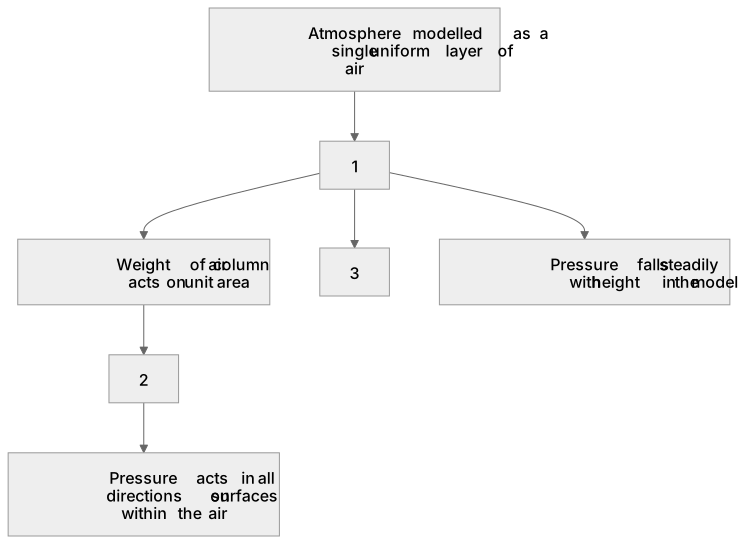
Some boxes have lost their names. Pick the right name for each number.
1Box 1
2Box 2
3Box 3
There is more to this lesson
The full lesson goes on to check your understanding and help you earn the marks. Create a free account to carry on, with your progress saved.
A week of Premium from your first lesson · Then the free plan continues · No card, no charge
Test your understanding of Pressure: describe a simple model of the Earth’s atmosphere and of atmospheric pressure (to include: an assumption of uniform density; knowledge of layers is not expected) (content found only in the physics separate science qualification)
Active recall beats re-reading. Take an instant quiz now to test what you’ve learned and lock it into long-term memory.
A week of Premium from your first lesson · Then the free plan continues · No card, no charge