OCR · GCSE · Physics
Course version: J249 · Version from Sept 2018
Explain why atmospheric pressure varies with height above the surface of…
Full specification wording
Pressure: explain why atmospheric pressure varies with height above the surface of the planet (content found only in the physics separate science qualification)
This separate-science item asks you to explain, not merely state, why atmospheric pressure changes with height.
Checked against the OCR J249 specification (opens in a new tab) on .
- Point 9 of 12
- 4 key terms
Study notes
From the checked teaching notes for this specification point.
The idea
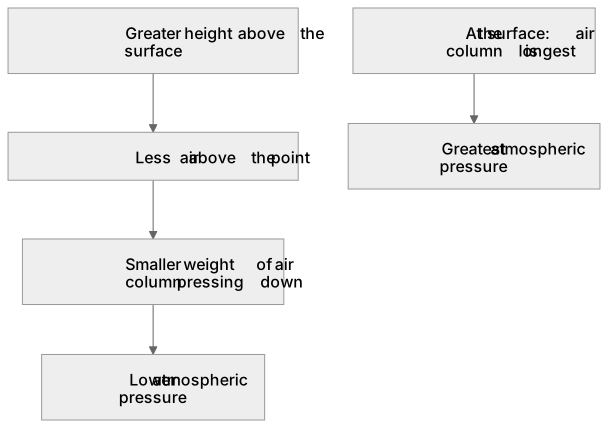
This separate-science item asks you to explain, not merely state, why atmospheric pressure changes with height. As you move higher above the surface, there is less air above you, so the weight of the air column pressing down is smaller and the atmospheric pressure is lower. Near the surface the column of air is longest, so pressure is greatest; at high altitude the column is short and pressure is reduced. The explanation must connect height to the amount (and therefore weight) of air above the point, and hence to the pressure exerted. A useful check is to compare a point at sea level with a point high on a mountain: the mountain-top point has less air above it, so the pressure there is lower.
What earns the marks
- Explains that a greater height means less air above the point.
- Links the reduced amount of air above to a smaller weight of air column.
- Concludes that atmospheric pressure is lower at greater height.
- States that pressure is greatest at the surface where the air column is longest.
Common mistakes and how to put them right
States only that pressure decreases with height without explaining the reduced weight of air above.
Put it right: Give the causal link to the air column.
Claims pressure increases with height because air is 'thinner'.
Put it right: Explain that less air above means lower pressure.
Confuses atmospheric pressure with temperature changes with altitude.
Put it right: Focus the explanation on the weight of air above the point.
Exam tips
- Use the phrase 'less air above' to show the cause of the change in pressure.
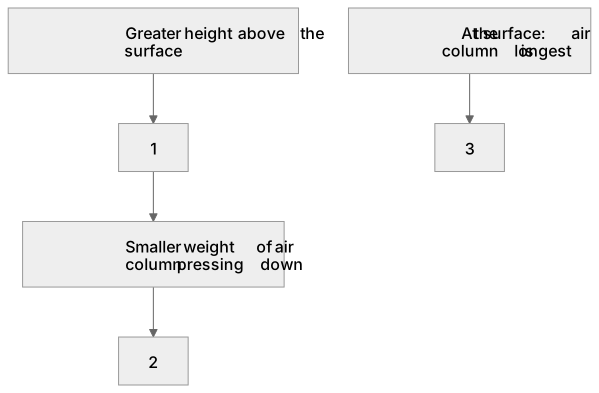
- Chain the reasoning: greater height, less air above, smaller weight, lower pressure.
- Compare two heights explicitly to make the explanation clear and complete.
Try the lesson
The start of the Pressure: explain why atmospheric pressure varies with height above the surface of the planet (content found only in the physics separate science qualification) lesson, made from checked teaching notes for this specification point.
Have a go first
Why is the atmospheric pressure lower at the top of a high mountain than at sea level?
Listen
This separate-science item asks you to explain, not merely state, why atmospheric pressure changes with height. As you move higher above the surface, there is less air above you, so the weight of the air column pressing down is smaller and the atmospheric pressure is lower. Near the surface the column of air is longest, so pressure is greatest; at high altitude the column is short and pressure is reduced. The explanation must connect height to the amount (and therefore weight) of air above the point, and hence to the pressure exerted. A useful check is to compare a point at sea level with a point high on a mountain: the mountain-top point has less air above it, so the pressure there is lower. A strong answer earns marks for these points. Explains that a greater height means less air above the point. Links the reduced amount of air above to a smaller weight of air column. Concludes that atmospheric pressure is lower at greater height. States that pressure is greatest at the surface where the air column is longest. Exam tip: Use the phrase 'less air above' to show the cause of the change in pressure.
See it
Key words
Say what each word means before you turn the card.
Atmospheric pressure and altitude
Try answering aloud or in your head before turning the card.
Weight of air column
Try answering aloud or in your head before turning the card.
Cause-and-effect explanation
Try answering aloud or in your head before turning the card.
Comparing pressures at different heights
Try answering aloud or in your head before turning the card.
See every definition
- Atmospheric pressure and altitude
- A greater height means there is less air above the point, so the atmospheric pressure is lower.
- Weight of air column
- A reduced amount of air above a point means a smaller weight of air column pressing down.
- Cause-and-effect explanation
- The reasoning chains greater height, less air above, smaller weight, and lower pressure, rather than stating only that pressure decreases.
- Comparing pressures at different heights
- A point at sea level has a longer air column and greater pressure, while a mountain-top point has less air above it and lower pressure.
Label the diagram
Some boxes have lost their names. Pick the right name for each number.
1Box 1
2Box 2
3Box 3
There is more to this lesson
The full lesson goes on to check your understanding and help you earn the marks. Create a free account to carry on, with your progress saved.
A week of Premium from your first lesson · Then the free plan continues · No card, no charge
Test your understanding of Pressure: explain why atmospheric pressure varies with height above the surface of the planet (content found only in the physics separate science qualification)
Active recall beats re-reading. Take an instant quiz now to test what you’ve learned and lock it into long-term memory.
A week of Premium from your first lesson · Then the free plan continues · No card, no charge