OCR · GCSE · Physics
Course version: J249 · Version from Sept 2018
Explain how doing work on a gas can increase its temperature (to include:…
Full specification wording
Pressure: explain how doing work on a gas can increase its temperature (to include: examples such as a bicycle pump) (content found only in the physics separate science qualification) (Higher tier only)
Doing work on a gas transfers energy to it.
Checked against the OCR J249 specification (opens in a new tab) on .
- Point 7 of 12
- 4 key terms
Study notes
From the checked teaching notes for this specification point.
The idea
Doing work on a gas transfers energy to it. When a gas is compressed quickly, for example by pushing the piston of a bicycle pump, the moving piston does work on the gas. The particles gain kinetic energy, so their average speed increases and the temperature of the gas rises. In the bicycle pump the air inside is compressed as the piston moves in, the air warms up, and the pump barrel feels warm to touch. The key idea is energy transfer by work: a force moves through a distance on the gas, energy is transferred to the particles, and the rise in average kinetic energy shows as a rise in temperature. If the compression is slow, energy can be transferred to the surroundings and the temperature rise is smaller, but the work still transfers energy to the gas.
What earns the marks
- States that doing work on the gas transfers energy to it.
- Explains that compressing the gas with a moving piston is an example of doing work on the gas.
- Links the energy transferred to an increase in the kinetic energy and average speed of the particles.
- States that the increased average kinetic energy of the particles corresponds to a higher temperature.
- Applies the idea to a bicycle pump, where compressing the air warms the air and the pump barrel.
Common mistakes and how to put them right
Says the gas particles are heated by friction alone.
Put it right: Identify the work done by the moving piston compressing the gas as the energy transfer.
Claims temperature rises because the particles are squeezed closer together without any energy transfer.
Put it right: Link the temperature rise to increased kinetic energy from work done.
Treats the bicycle pump as cooling the air.
Put it right: Describe the air warming as the piston compresses it.
Exam tips
- Name the energy transfer explicitly: work is done on the gas by the moving piston, transferring energy to the particles.
- Connect the energy transfer to particle kinetic energy and average speed before stating that temperature rises, so the causal chain is complete.
- Use the bicycle pump example to show the link between compression, warming of the air and the warm pump barrel.
Try the lesson
The start of the Pressure: explain how doing work on a gas can increase its temperature (to include: examples such as a bicycle pump) (content found only in the physics separate science qualification) (Higher tier only) lesson, made from checked teaching notes for this specification point.
Have a go first
A bicycle pump is used to inflate a tyre. The pump barrel becomes warm. Which energy transfer is mainly responsible for the temperature rise of the gas inside the pump?
Listen
Doing work on a gas transfers energy to it. When a gas is compressed quickly, for example by pushing the piston of a bicycle pump, the moving piston does work on the gas. The particles gain kinetic energy, so their average speed increases and the temperature of the gas rises. In the bicycle pump the air inside is compressed as the piston moves in, the air warms up, and the pump barrel feels warm to touch. The key idea is energy transfer by work: a force moves through a distance on the gas, energy is transferred to the particles, and the rise in average kinetic energy shows as a rise in temperature. If the compression is slow, energy can be transferred to the surroundings and the temperature rise is smaller, but the work still transfers energy to the gas. A strong answer earns marks for these points. States that doing work on the gas transfers energy to it. Explains that compressing the gas with a moving piston is an example of doing work on the gas. Links the energy transferred to an increase in the kinetic energy and average speed of the particles. States that the increased average kinetic energy of the particles corresponds to a higher temperature. Exam tip: Name the energy transfer explicitly: work is done on the gas by the moving piston, transferring energy to the particles.
See it
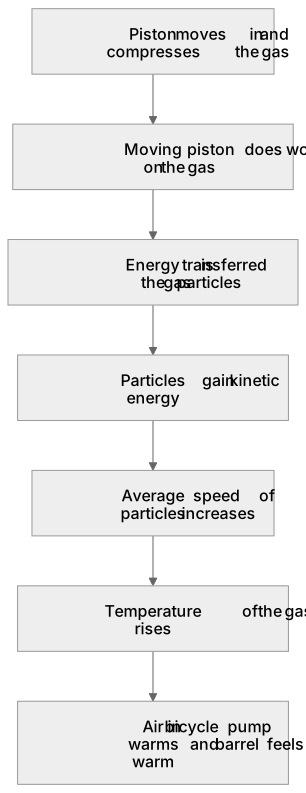
Put it in order
Put these steps in the order they happen.
- 1. Air in bicycle pump warms and barrel feels warm
- 2. Temperature of the gas rises
- 3. Energy is transferred to the gas particles
- 4. Average speed of particles increases
- 5. Piston moves in and compresses the gas
- 6. Moving piston does work on the gas
- 7. Particles gain kinetic energy
Key words
Say what each word means before you turn the card.
Work done on a gas
Try answering aloud or in your head before turning the card.
Energy transfer and particle kinetic energy
Try answering aloud or in your head before turning the card.
Temperature as a measure of average particle kinetic energy
Try answering aloud or in your head before turning the card.
Everyday example of a bicycle pump
Try answering aloud or in your head before turning the card.
See every definition
- Work done on a gas
- Doing work on a gas transfers energy to it, for example when a moving piston compresses the gas.
- Energy transfer and particle kinetic energy
- Energy transferred to the gas by work increases the kinetic energy and average speed of the particles.
- Temperature as a measure of average particle kinetic energy
- The increased average kinetic energy of the particles corresponds to a higher temperature of the gas.
- Everyday example of a bicycle pump
- Compressing the air inside as the piston moves in warms the air and the pump barrel feels warm to touch.
Label the diagram
Some boxes have lost their names. Pick the right name for each number.
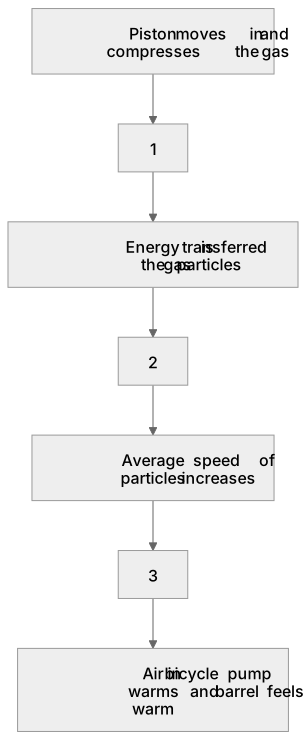
1Box 1
2Box 2
3Box 3
There is more to this lesson
The full lesson goes on to check your understanding and help you earn the marks. Create a free account to carry on, with your progress saved.
A week of Premium from your first lesson · Then the free plan continues · No card, no charge
Test your understanding of Pressure: explain how doing work on a gas can increase its temperature (to include: examples such as a bicycle pump) (content found only in the physics separate science qualification) (Higher tier only)
Active recall beats re-reading. Take an instant quiz now to test what you’ve learned and lock it into long-term memory.
A week of Premium from your first lesson · Then the free plan continues · No card, no charge