OCR · GCSE · Physics
Course version: J249 · Version from Sept 2018
Explain how increasing the volume in which a gas is contained, at constant…
Full specification wording
Pressure: explain how increasing the volume in which a gas is contained, at constant temperature can lead to a decrease in pressure (to include: behaviour regarding particle velocity and collisions) (content found only in the physics separate science qualification)
At constant temperature the gas particles keep the same average speed, so their average velocity magnitude does not change when the container is enlarged.
Checked against the OCR J249 specification (opens in a new tab) on .
- Point 6 of 12
- 2 key terms
Study notes
From the checked teaching notes for this specification point.
The idea
At constant temperature the gas particles keep the same average speed, so their average velocity magnitude does not change when the container is enlarged. What changes is the space available. In a larger volume the particles are spread more thinly, so the number of particles per unit volume falls. Each particle still travels at the same typical speed, but it now has further to go between collisions with the walls, and there are fewer particles near any given area of wall. Fewer collisions per second with each unit area of wall means a smaller force per unit area, and pressure is force per unit area, so the pressure decreases. A useful check is to imagine doubling the volume: the same particles now occupy twice the space, so roughly half as many wall collisions occur per second per unit area, and the pressure roughly halves.
What earns the marks
- States that at constant temperature the average speed of the gas particles stays the same.
- Explains that in a larger volume the particles are more spread out, so the number of particles per unit volume decreases.
- States that particles travel further between collisions with the walls in the larger volume.
- Links fewer collisions with the walls per second per unit area to a smaller force per unit area and therefore lower pressure.
- Recognises that pressure is force per unit area and applies this to the wall collisions.
Common mistakes and how to put them right
Claims that the particles slow down when the volume increases.
Put it right: Keep the average speed constant because the temperature is constant.
Says the particles themselves get smaller or expand.
Put it right: Keep the particle size fixed and change only the spacing between particles.
Confuses fewer collisions with weaker collisions.
Put it right: Keep each collision similar and reduce the number of collisions per second per unit area.
Exam tips
- Anchor the answer on the constant-temperature condition first, stating that average particle speed is unchanged, then explain the spacing and collision effects.
- Use the chain 'more spread out → fewer particles per unit volume → fewer wall collisions per second per unit area → lower force per unit area → lower pressure' to keep every link explicit.
- When a numerical factor is offered, check it against the idea that doubling volume at constant temperature roughly halves pressure, and reject options that change particle speed.
Try the lesson
The start of the Pressure: explain how increasing the volume in which a gas is contained, at constant temperature can lead to a decrease in pressure (to include: behaviour regarding particle velocity and collisions) (content found only in the physics separate science qualification) lesson, made from checked teaching notes for this specification point.
Have a go first
A sealed syringe contains a gas at constant temperature. The piston is pulled out so the gas occupies a larger volume. What happens to the average speed of the gas particles?
Listen
At constant temperature the gas particles keep the same average speed, so their average velocity magnitude does not change when the container is enlarged. What changes is the space available. In a larger volume the particles are spread more thinly, so the number of particles per unit volume falls. Each particle still travels at the same typical speed, but it now has further to go between collisions with the walls, and there are fewer particles near any given area of wall. Fewer collisions per second with each unit area of wall means a smaller force per unit area, and pressure is force per unit area, so the pressure decreases. A useful check is to imagine doubling the volume: the same particles now occupy twice the space, so roughly half as many wall collisions occur per second per unit area, and the pressure roughly halves. A strong answer earns marks for these points. States that at constant temperature the average speed of the gas particles stays the same. Explains that in a larger volume the particles are more spread out, so the number of particles per unit volume decreases. States that particles travel further between collisions with the walls in the larger volume. Links fewer collisions with the walls per second per unit area to a smaller force per unit area and therefore lower pressure. Exam tip: Anchor the answer on the constant-temperature condition first, stating that average particle speed is unchanged, then explain the spacing and collision effects.
See it
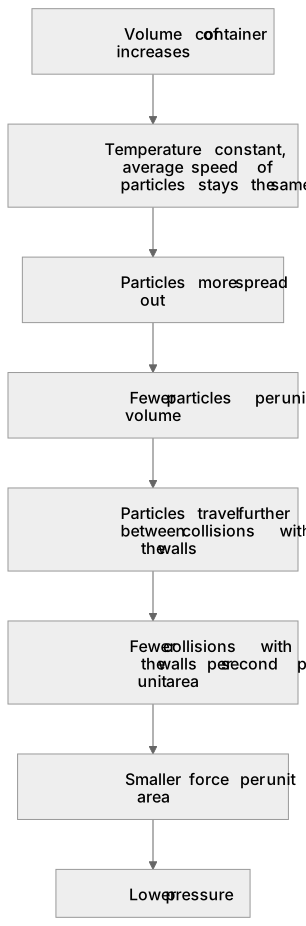
Put it in order
Put these steps in the order they happen.
- 1. Particles travel further between collisions with the walls
- 2. Lower pressure
- 3. Fewer collisions with the walls per second per unit area
- 4. Volume of container increases
- 5. Temperature constant, so average speed of particles stays the same
- 6. Smaller force per unit area
- 7. Particles more spread out
- 8. Fewer particles per unit volume
Key words
Say what each word means before you turn the card.
Constant temperature and constant average particle speed
Try answering aloud or in your head before turning the card.
Particle spacing and number density
Try answering aloud or in your head before turning the card.
See every definition
- Constant temperature and constant average particle speed
- At constant temperature the average speed of the gas particles stays the same, so the particles do not slow down when the volume increases.
- Particle spacing and number density
- In a larger volume the particles are spread more thinly, so the number of particles per unit volume falls.
Label the diagram
Some boxes have lost their names. Pick the right name for each number.
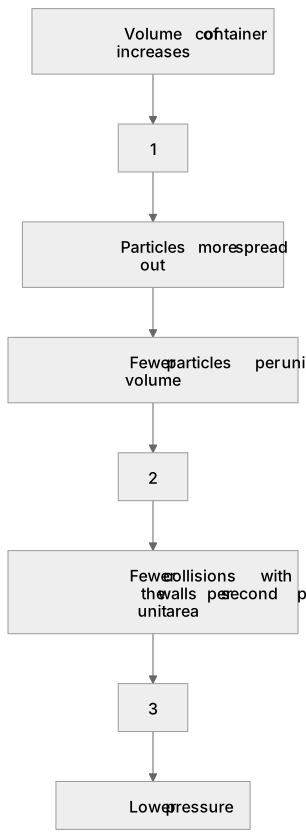
1Box 1
2Box 2
3Box 3
There is more to this lesson
The full lesson goes on to check your understanding and help you earn the marks. Create a free account to carry on, with your progress saved.
A week of Premium from your first lesson · Then the free plan continues · No card, no charge
Test your understanding of Pressure: explain how increasing the volume in which a gas is contained, at constant temperature can lead to a decrease in pressure (to include: behaviour regarding particle velocity and collisions) (content found only in the physics separate science qualification)
Active recall beats re-reading. Take an instant quiz now to test what you’ve learned and lock it into long-term memory.
A week of Premium from your first lesson · Then the free plan continues · No card, no charge