OCR · GCSE · Physics
Course version: J249 · Version from Sept 2018
Recall that atomic nuclei are composed of both protons and neutrons, that…
Full specification wording
Radioactive emissions: recall that atomic nuclei are composed of both protons and neutrons, that the nucleus of each element has a characteristic positive charge
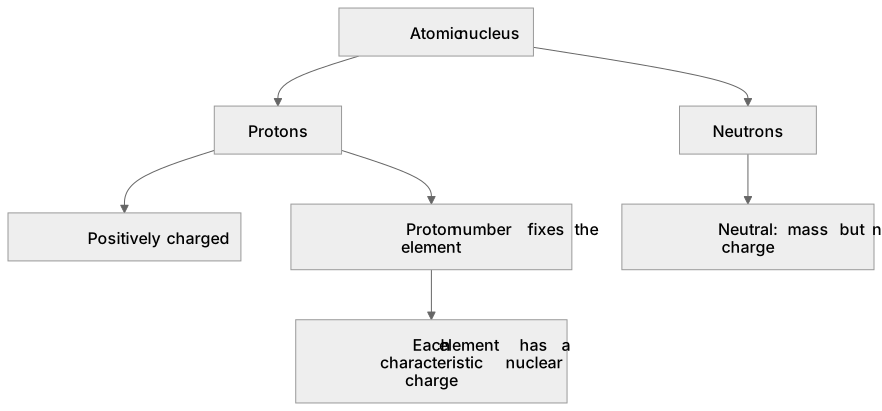
Every atomic nucleus contains two kinds of nucleon: positively charged protons and neutral neutrons.
- Point 1 of 12
- 4 key terms
Study notes
From the checked teaching notes for this specification point.
The idea
Every atomic nucleus contains two kinds of nucleon: positively charged protons and neutral neutrons. The proton number fixes which element the atom is, so each element has a characteristic nuclear charge: hydrogen nuclei carry charge 1⁺ from a single proton, helium nuclei carry 2⁺ from two protons, and so on. Neutrons add mass but no charge, so changing the neutron count leaves the nuclear charge unchanged. A useful method is to read a nuclide symbol such as ²³⁸₉₂U as 92 protons and 146 neutrons, then state the charge as 92⁺. In a multiple-choice question, eliminate any option that gives the nucleus a negative charge, that places electrons inside the nucleus, or that claims all nuclei have the same charge.
What earns the marks
- Identifies protons and neutrons as the particles that make up an atomic nucleus.
- States that the nucleus carries a positive charge because of its protons.
- Links the number of protons to the characteristic charge of each element's nucleus.
- Rejects options that place electrons inside the nucleus or give the nucleus a negative charge.
Common mistakes and how to put them right
Places electrons inside the nucleus.
Put it right: Keep electrons in the shells around the nucleus and count only protons and neutrons as nucleons.
Claims every nucleus has the same charge.
Put it right: Link the charge to the proton number, which differs between elements.
Treats neutrons as charged.
Put it right: Note that neutrons are neutral and contribute mass but no charge.
Exam tips
- Count protons first, then state the nuclear charge as that number with a superscript plus sign.
- Cross out any option mentioning electrons in the nucleus before comparing the rest.
Try the lesson
The start of the Radioactive emissions: recall that atomic nuclei are composed of both protons and neutrons, that the nucleus of each element has a characteristic positive charge lesson, made from checked teaching notes for this specification point.
Have a go first
What is the electric charge of a neutron?
Listen
Every atomic nucleus contains two kinds of nucleon: positively charged protons and neutral neutrons. The proton number fixes which element the atom is, so each element has a characteristic nuclear charge: hydrogen nuclei carry charge 1⁺ from a single proton, helium nuclei carry 2⁺ from two protons, and so on. Neutrons add mass but no charge, so changing the neutron count leaves the nuclear charge unchanged. A useful method is to read a nuclide symbol such as ²³⁸₉₂U as 92 protons and 146 neutrons, then state the charge as 92⁺. In a multiple-choice question, eliminate any option that gives the nucleus a negative charge, that places electrons inside the nucleus, or that claims all nuclei have the same charge. A strong answer earns marks for these points. Identifies protons and neutrons as the particles that make up an atomic nucleus. States that the nucleus carries a positive charge because of its protons. Links the number of protons to the characteristic charge of each element's nucleus. Rejects options that place electrons inside the nucleus or give the nucleus a negative charge. Exam tip: Count protons first, then state the nuclear charge as that number with a superscript plus sign.
See it
Key words
Say what each word means before you turn the card.
Nuclear composition
Try answering aloud or in your head before turning the card.
Proton number and element identity
Try answering aloud or in your head before turning the card.
Nuclear charge
Try answering aloud or in your head before turning the card.
Neutrons and mass
Try answering aloud or in your head before turning the card.
See every definition
- Nuclear composition
- Atomic nuclei are composed of both protons and neutrons, which are the particles that make up an atomic nucleus.
- Proton number and element identity
- The number of protons fixes which element the atom is, so the nucleus of each element has a characteristic positive charge.
- Nuclear charge
- The nucleus carries a positive charge because of its protons, and neutrons add mass but no charge.
- Neutrons and mass
- Neutrons are neutral and contribute mass but no charge, so changing the neutron count leaves the nuclear charge unchanged.
Label the diagram
Some boxes have lost their names. Pick the right name for each number.
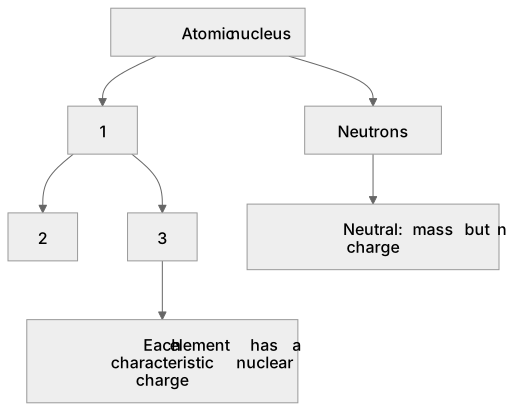
1Box 1
2Box 2
3Box 3
There is more to this lesson
The full lesson goes on to check your understanding and help you earn the marks. Create a free account to carry on, with your progress saved.
A week of Premium from your first lesson · Then the free plan continues · No card, no charge
Test your understanding of Radioactive emissions: recall that atomic nuclei are composed of both protons and neutrons, that the nucleus of each element has a characteristic positive charge
Active recall beats re-reading. Take an instant quiz now to test what you’ve learned and lock it into long-term memory.
A week of Premium from your first lesson · Then the free plan continues · No card, no charge