OCR · GCSE · Physics
Course version: J249 · Version from Sept 2018
Recall that atoms of the same elements can differ in nuclear mass by…
Full specification wording
Radioactive emissions: recall that atoms of the same elements can differ in nuclear mass by having different numbers of neutrons
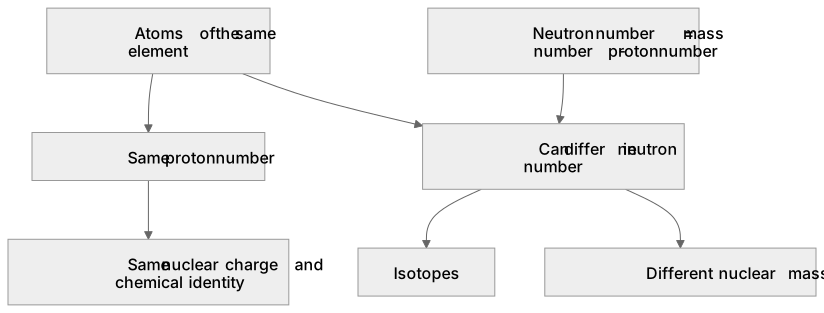
Atoms of one element always share the same proton number, but they need not share the same neutron number.
Checked against the OCR J249 specification (opens in a new tab) on .
- Point 2 of 12
- 4 key terms
Study notes
From the checked teaching notes for this specification point.
The idea
Atoms of one element always share the same proton number, but they need not share the same neutron number. Variants of an element with different neutron counts are isotopes, and because neutrons carry mass, isotopes differ in nuclear mass while keeping the same nuclear charge and chemical identity. For example, chlorine-35 has 17 protons and 18 neutrons, while chlorine-37 has 17 protons and 20 neutrons; both are chlorine, but the second is heavier. A reliable method is to subtract the proton number from the mass number to find the neutron count, then compare two atoms of the same element. In a multiple-choice question, accept an option that keeps the proton number fixed and varies the neutron number, and reject options that change the element or move electrons.
What earns the marks
- States that atoms of the same element can have different numbers of neutrons.
- Links a difference in neutron number to a difference in nuclear mass.
- Keeps the proton number the same when comparing two atoms of one element.
- Rejects options that change the element's identity or alter electron numbers to explain the mass difference.
Common mistakes and how to put them right
Assumes atoms of one element must have identical mass.
Put it right: Allow different neutron counts and therefore different nuclear masses.
Changes the proton number to explain a mass difference.
Put it right: Keep protons fixed and vary neutrons instead.
Confuses neutron number with electron number.
Put it right: Derive neutrons by subtracting the proton number from the mass number.
Exam tips
- Use mass number minus proton number to find neutrons before judging each option.
- Check that the proton number stays the same in any pair described as the same element.
- Rule out options that mention electrons, since the statement concerns nuclear mass.
Try the lesson
The start of the Radioactive emissions: recall that atoms of the same elements can differ in nuclear mass by having different numbers of neutrons lesson, made from checked teaching notes for this specification point.
Have a go first
Two atoms are of the same element but have different nuclear masses. What must differ between them?
Listen
Atoms of one element always share the same proton number, but they need not share the same neutron number. Variants of an element with different neutron counts are isotopes, and because neutrons carry mass, isotopes differ in nuclear mass while keeping the same nuclear charge and chemical identity. For example, chlorine-35 has 17 protons and 18 neutrons, while chlorine-37 has 17 protons and 20 neutrons; both are chlorine, but the second is heavier. A reliable method is to subtract the proton number from the mass number to find the neutron count, then compare two atoms of the same element. In a multiple-choice question, accept an option that keeps the proton number fixed and varies the neutron number, and reject options that change the element or move electrons. A strong answer earns marks for these points. States that atoms of the same element can have different numbers of neutrons. Links a difference in neutron number to a difference in nuclear mass. Keeps the proton number the same when comparing two atoms of one element. Rejects options that change the element's identity or alter electron numbers to explain the mass difference. Exam tip: Use mass number minus proton number to find neutrons before judging each option.
See it
Key words
Say what each word means before you turn the card.
Isotopes
Try answering aloud or in your head before turning the card.
Neutron number
Try answering aloud or in your head before turning the card.
Nuclear mass
Try answering aloud or in your head before turning the card.
Proton number and element identity
Try answering aloud or in your head before turning the card.
See every definition
- Isotopes
- Variants of an element with different neutron counts, while atoms of one element always share the same proton number.
- Neutron number
- Found by subtracting the proton number from the mass number, and can differ between atoms of the same element.
- Nuclear mass
- Differs between atoms of the same element because neutrons carry mass, while the proton number stays the same.
- Proton number and element identity
- Atoms of one element always share the same proton number, so keeping it fixed preserves the element's identity.
Label the diagram
Some boxes have lost their names. Pick the right name for each number.
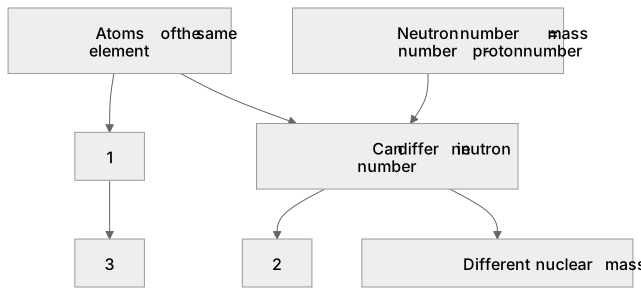
1Box 1
2Box 2
3Box 3
There is more to this lesson
The full lesson goes on to check your understanding and help you earn the marks. Create a free account to carry on, with your progress saved.
A week of Premium from your first lesson · Then the free plan continues · No card, no charge
Test your understanding of Radioactive emissions: recall that atoms of the same elements can differ in nuclear mass by having different numbers of neutrons
Active recall beats re-reading. Take an instant quiz now to test what you’ve learned and lock it into long-term memory.
A week of Premium from your first lesson · Then the free plan continues · No card, no charge