OCR · GCSE · Physics
Course version: J249 · Version from Sept 2018
Recall that some nuclei are unstable and may emit alpha particles, beta…
Full specification wording
Radioactive emissions: recall that some nuclei are unstable and may emit alpha particles, beta particles, or neutrons, and electromagnetic radiation as gamma rays
Many nuclei are stable, but some have too much energy or an unsuitable balance of protons and neutrons and are unstable.
Checked against the OCR J249 specification (opens in a new tab) on .
- Point 4 of 12
- 3 key terms
Study notes
From the checked teaching notes for this specification point.
The idea
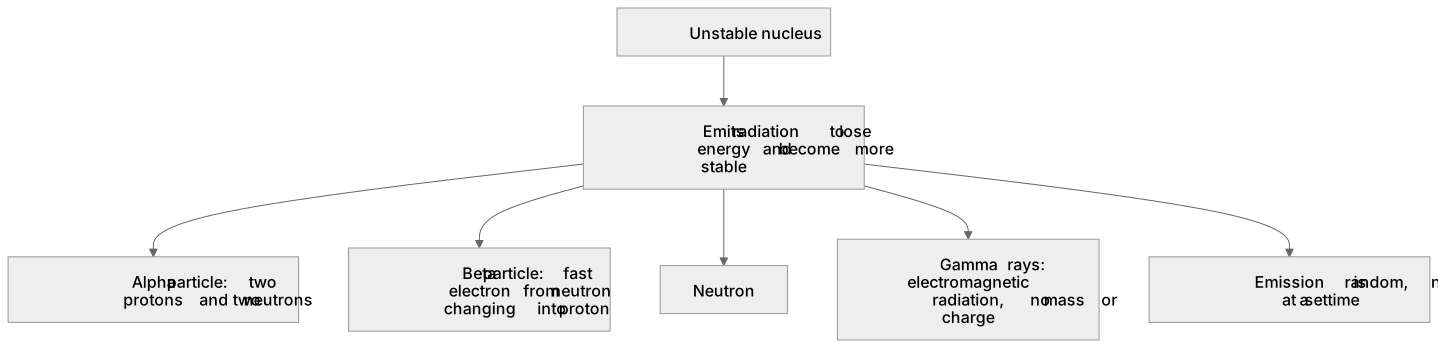
Many nuclei are stable, but some have too much energy or an unsuitable balance of protons and neutrons and are unstable. An unstable nucleus can lose energy by emitting radiation, and this happens randomly rather than at a set time. The emissions named are an alpha particle (two protons and two neutrons, a helium nucleus), a beta particle (a fast electron produced when a neutron changes into a proton), a neutron, and gamma rays, which are electromagnetic radiation of very short wavelength and carry no mass or charge. Emitting an alpha particle lowers the mass number by 4 and the atomic number by 2; beta emission leaves the mass number unchanged and raises the atomic number by 1; gamma emission changes neither. A single nucleus may emit one or more of these, and the type emitted depends on the nucleus, not on temperature or chemical form.
What earns the marks
- States that unstable nuclei emit radiation in order to become more stable.
- Names alpha particles, beta particles, neutrons and gamma rays as possible emissions from unstable nuclei.
- Describes an alpha particle as two protons and two neutrons, equivalent to a helium nucleus.
- Describes a beta particle as a fast electron released when a neutron changes into a proton.
- Identifies gamma rays as electromagnetic radiation with no mass and no charge.
- Explains that emission is random and cannot be predicted for an individual nucleus.
Common mistakes and how to put them right
Describes gamma rays as particles with mass.
Put it right: Recognise them as electromagnetic radiation carrying no mass or charge.
Claims beta particles are protons.
Put it right: Identify them as fast electrons produced when a neutron becomes a proton.
Says the type of emission depends on temperature or chemical compound.
Put it right: Link it instead to the stability of the nucleus.
Treats alpha emission as leaving mass number unchanged.
Put it right: Account for the loss of two protons and two neutrons.
Exam tips
- Match each emission to its charge and mass before choosing an answer.
- Use the change in proton number to decide which emission has occurred.
- Reject options that make emission predictable for a single nucleus, since decay is random.
Try the lesson
The start of the Radioactive emissions: recall that some nuclei are unstable and may emit alpha particles, beta particles, or neutrons, and electromagnetic radiation as gamma rays lesson, made from checked teaching notes for this specification point.
Have a go first
Which type of radiation emitted by unstable nuclei is a form of electromagnetic radiation?
Listen
Many nuclei are stable, but some have too much energy or an unsuitable balance of protons and neutrons and are unstable. An unstable nucleus can lose energy by emitting radiation, and this happens randomly rather than at a set time. The emissions named are an alpha particle (two protons and two neutrons, a helium nucleus), a beta particle (a fast electron produced when a neutron changes into a proton), a neutron, and gamma rays, which are electromagnetic radiation of very short wavelength and carry no mass or charge. Emitting an alpha particle lowers the mass number by 4 and the atomic number by 2; beta emission leaves the mass number unchanged and raises the atomic number by 1; gamma emission changes neither. A single nucleus may emit one or more of these, and the type emitted depends on the nucleus, not on temperature or chemical form. A strong answer earns marks for these points. States that unstable nuclei emit radiation in order to become more stable. Names alpha particles, beta particles, neutrons and gamma rays as possible emissions from unstable nuclei. Describes an alpha particle as two protons and two neutrons, equivalent to a helium nucleus. Describes a beta particle as a fast electron released when a neutron changes into a proton. Exam tip: Match each emission to its charge and mass before choosing an answer.
See it
Key words
Say what each word means before you turn the card.
Nuclear instability
Try answering aloud or in your head before turning the card.
Alpha, beta, neutron and gamma emission
Try answering aloud or in your head before turning the card.
Random nature of decay
Try answering aloud or in your head before turning the card.
See every definition
- Nuclear instability
- Some nuclei have too much energy or an unsuitable balance of protons and neutrons, so they are unstable and may emit radiation.
- Alpha, beta, neutron and gamma emission
- An unstable nucleus can lose energy by emitting an alpha particle, a beta particle, a neutron, or gamma rays.
- Random nature of decay
- Emission happens randomly rather than at a set time and cannot be predicted for an individual nucleus.
Label the diagram
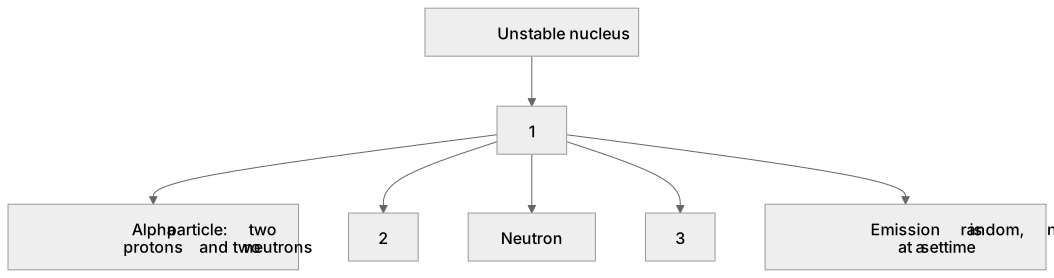
Some boxes have lost their names. Pick the right name for each number.
1Box 1
2Box 2
3Box 3
There is more to this lesson
The full lesson goes on to check your understanding and help you earn the marks. Create a free account to carry on, with your progress saved.
A week of Premium from your first lesson · Then the free plan continues · No card, no charge
Test your understanding of Radioactive emissions: recall that some nuclei are unstable and may emit alpha particles, beta particles, or neutrons, and electromagnetic radiation as gamma rays
Active recall beats re-reading. Take an instant quiz now to test what you’ve learned and lock it into long-term memory.
A week of Premium from your first lesson · Then the free plan continues · No card, no charge