OCR · GCSE · Physics
Course version: J249 · Version from Sept 2018
Relate the emission of alpha particles, beta particles, gamma radiation…
Full specification wording
Radioactive emissions: relate the emission of alpha particles, beta particles, gamma radiation and neutrons to possible changes in the mass or the charge of the nucleus, or both
An unstable nucleus can shed energy and particles, and each emission changes the nucleus in a particular way.
Checked against the OCR J249 specification (opens in a new tab) on .
- Point 5 of 12
- 4 key terms
Study notes
From the checked teaching notes for this specification point.
The idea
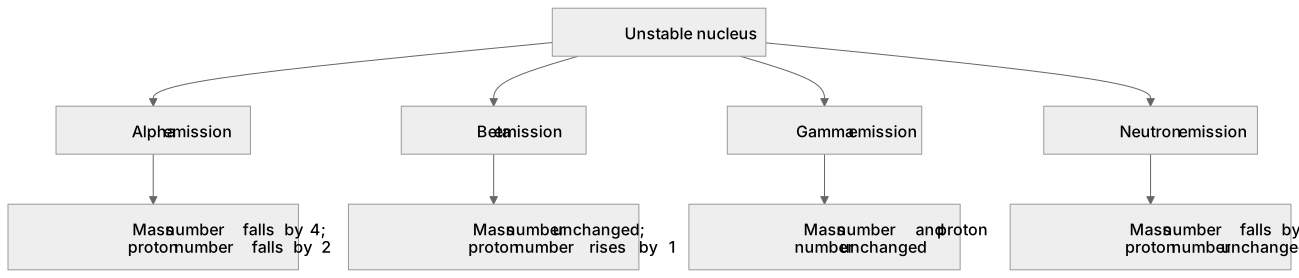
An unstable nucleus can shed energy and particles, and each emission changes the nucleus in a particular way. An alpha particle is a helium nucleus, 2 protons and 2 neutrons, so emitting one lowers the mass number by 4 and the proton (atomic) number by 2, reducing both mass and positive charge. A beta particle is a fast electron created when a neutron changes into a proton, so the mass number stays the same while the proton number rises by 1, increasing the positive charge. Gamma radiation is a high-energy electromagnetic wave with no mass and no charge, so it changes neither mass number nor proton number; it usually accompanies alpha or beta emission as the nucleus loses surplus energy. A neutron emission removes one neutron, lowering the mass number by 1 while the proton number is unchanged, so charge stays the same. Track mass number and proton number separately to predict the change.
What earns the marks
- States that alpha emission reduces the mass number by 4 and the proton number by 2, lowering both mass and positive charge.
- States that beta emission leaves the mass number unchanged and raises the proton number by 1, increasing positive charge.
- States that gamma emission changes neither the mass number nor the proton number, so mass and charge are unchanged.
- States that neutron emission lowers the mass number by 1 while the proton number and charge stay the same.
- Distinguishes the change in mass number from the change in proton number for each type of emission.
Common mistakes and how to put them right
Claims that beta emission lowers the mass number.
Put it right by noting that a neutron becomes a proton, so the total number of nucleons is unchanged.
Treats gamma radiation as carrying away charge or mass.
Put it right by stating that gamma is electromagnetic radiation with zero mass and zero charge.
Assumes neutron emission changes the charge of the nucleus.
Put it right by stating that only the neutron count, and so the mass number, falls.
Confuses the proton-number change for alpha and beta emission.
Put it right by linking alpha to a fall of 2 and beta to a rise of 1 in proton number.
Exam tips
- Write the mass number and proton number before and after each emission so the change is visible.
- Remember the alpha particle as a helium nucleus with 2 protons and 2 neutrons when working out the change.
- Check each option in a multiple-choice question against both mass number and proton number, not just one.
- Recall that gamma often accompanies alpha or beta decay but by itself alters neither number.
Try the lesson
The start of the Radioactive emissions: relate the emission of alpha particles, beta particles, gamma radiation and neutrons to possible changes in the mass or the charge of the nucleus, or both lesson, made from checked teaching notes for this specification point.
Have a go first
A nucleus emits a single neutron. What happens to its mass number and its atomic number?
Listen
An unstable nucleus can shed energy and particles, and each emission changes the nucleus in a particular way. An alpha particle is a helium nucleus, 2 protons and 2 neutrons, so emitting one lowers the mass number by 4 and the proton (atomic) number by 2, reducing both mass and positive charge. A beta particle is a fast electron created when a neutron changes into a proton, so the mass number stays the same while the proton number rises by 1, increasing the positive charge. Gamma radiation is a high-energy electromagnetic wave with no mass and no charge, so it changes neither mass number nor proton number; it usually accompanies alpha or beta emission as the nucleus loses surplus energy. A neutron emission removes one neutron, lowering the mass number by 1 while the proton number is unchanged, so charge stays the same. Track mass number and proton number separately to predict the change. A strong answer earns marks for these points. States that alpha emission reduces the mass number by 4 and the proton number by 2, lowering both mass and positive charge. States that beta emission leaves the mass number unchanged and raises the proton number by 1, increasing positive charge. States that gamma emission changes neither the mass number nor the proton number, so mass and charge are unchanged. States that neutron emission lowers the mass number by 1 while the proton number and charge stay the same. A common slip: Claims that beta emission lowers the mass number. Instead, noting that a neutron becomes a proton, so the total number of nucleons is unchanged. Exam tip: Write the mass number and proton number before and after each emission so the change is visible.
See it
Key words
Say what each word means before you turn the card.
Alpha emission
Try answering aloud or in your head before turning the card.
Beta emission
Try answering aloud or in your head before turning the card.
Gamma radiation
Try answering aloud or in your head before turning the card.
Neutron emission
Try answering aloud or in your head before turning the card.
See every definition
- Alpha emission
- Emitting a helium nucleus of 2 protons and 2 neutrons lowers the mass number by 4 and the proton number by 2, reducing both mass and positive charge.
- Beta emission
- A fast electron created when a neutron changes into a proton leaves the mass number the same while the proton number rises by 1, increasing the positive charge.
- Gamma radiation
- A high-energy electromagnetic wave with no mass and no charge, so it changes neither mass number nor proton number.
- Neutron emission
- Removing one neutron lowers the mass number by 1 while the proton number is unchanged, so charge stays the same.
Label the diagram
Some boxes have lost their names. Pick the right name for each number.
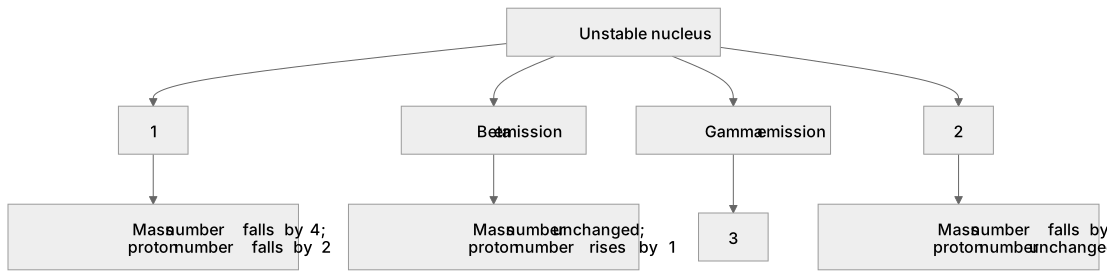
1Box 1
2Box 2
3Box 3
There is more to this lesson
The full lesson goes on to check your understanding and help you earn the marks. Create a free account to carry on, with your progress saved.
A week of Premium from your first lesson · Then the free plan continues · No card, no charge
Test your understanding of Radioactive emissions: relate the emission of alpha particles, beta particles, gamma radiation and neutrons to possible changes in the mass or the charge of the nucleus, or both
Active recall beats re-reading. Take an instant quiz now to test what you’ve learned and lock it into long-term memory.
A week of Premium from your first lesson · Then the free plan continues · No card, no charge