AQA · GCSE · Religious Studies
Course version: 8062 · Version from Sept 2018
Akhirah (life after death), human responsibility and accountability,…
Full specification wording
Beliefs and teachings: Akhirah (life after death), human responsibility and accountability, resurrection, heaven and hell.
Akhirah refers to the Islamic belief in everlasting life after death, which fundamentally shapes how Muslims live today.
Checked against the AQA 8062 specification (opens in a new tab) on .
- Point 7 of 13
- 4 key terms
Study notes
From the checked teaching notes for this specification point.
The idea
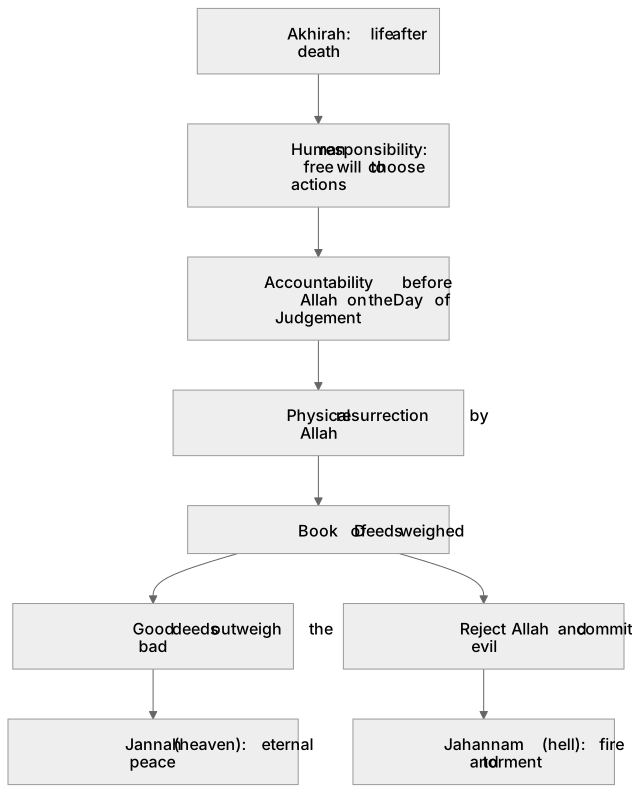
Akhirah refers to the Islamic belief in everlasting life after death, which fundamentally shapes how Muslims live today. Because life is a test, humans bear responsibility for their actions and face ultimate accountability before Allah on the Day of Judgement. On this day, physical resurrection occurs, and the Book of Deeds is weighed. Those whose good deeds outweigh the bad, demonstrating obedience to Allah, are rewarded with Jannah (heaven), described as a paradise of eternal peace. Conversely, those who reject Allah and commit evil face Jahannam (hell), a place of fire and torment. This belief encourages Muslims to follow the Five Pillars and act morally, knowing every action has eternal consequences.
What earns the marks
- Define Akhirah as the Islamic concept of life after death and a core article of faith.
- Explain that human responsibility means individuals have free will to choose their actions, leading to accountability on the Day of Judgement.
- Describe resurrection as the physical raising of the dead by Allah to face judgement.
- Contrast the eternal reward of Jannah (heaven) for the righteous with the punishment of Jahannam (hell) for the wicked.
Common mistakes and how to put them right
Confusing reincarnation with resurrection.
Put it right: Muslims believe in a single physical resurrection, not a cycle of rebirth.
Assuming Allah's predestination (Al-Qadr) removes human accountability.
Put it right: Muslims believe humans still have free will and are responsible for their choices.
Describing heaven and hell only as abstract concepts.
Put it right: Islamic teachings often describe Jannah and Jahannam as literal, physical places of reward and punishment.
Exam tips
- Use the Arabic terms Jannah and Jahannam alongside heaven and hell to demonstrate precise subject knowledge.
- Link the concept of Akhirah to daily life, explaining how the fear of accountability motivates Muslims to give Zakah or pray regularly.
- When evaluating beliefs about life after death, contrast Islamic physical resurrection with secular or alternative religious views.
Try the lesson
The start of the Beliefs and teachings: Akhirah (life after death), human responsibility and accountability, resurrection, heaven and hell. lesson, made from checked teaching notes for this specification point.
Have a go first
What is the Islamic term for life after death?
Listen
Akhirah refers to the Islamic belief in everlasting life after death, which fundamentally shapes how Muslims live today. Because life is a test, humans bear responsibility for their actions and face ultimate accountability before Allah on the Day of Judgement. On this day, physical resurrection occurs, and the Book of Deeds is weighed. Those whose good deeds outweigh the bad, demonstrating obedience to Allah, are rewarded with Jannah (heaven), described as a paradise of eternal peace. Conversely, those who reject Allah and commit evil face Jahannam (hell), a place of fire and torment. This belief encourages Muslims to follow the Five Pillars and act morally, knowing every action has eternal consequences. A strong answer earns marks for these points. Define Akhirah as the Islamic concept of life after death and a core article of faith. Explain that human responsibility means individuals have free will to choose their actions, leading to accountability on the Day of Judgement. Describe resurrection as the physical raising of the dead by Allah to face judgement. Contrast the eternal reward of Jannah (heaven) for the righteous with the punishment of Jahannam (hell) for the wicked. Exam tip: Use the Arabic terms Jannah and Jahannam alongside heaven and hell to demonstrate precise subject knowledge.
See it
Key words
Say what each word means before you turn the card.
Akhirah
Try answering aloud or in your head before turning the card.
Resurrection
Try answering aloud or in your head before turning the card.
Jannah
Try answering aloud or in your head before turning the card.
Jahannam
Try answering aloud or in your head before turning the card.
See every definition
- Akhirah
- The Islamic belief in everlasting life after death, which fundamentally shapes how Muslims live today.
- Resurrection
- The physical raising of the dead by Allah to face judgement.
- Jannah
- Heaven, described as a paradise of eternal peace, where those whose good deeds outweigh the bad are rewarded.
- Jahannam
- Hell, a place of fire and torment, faced by those who reject Allah and commit evil.
Label the diagram
Some boxes have lost their names. Pick the right name for each number.
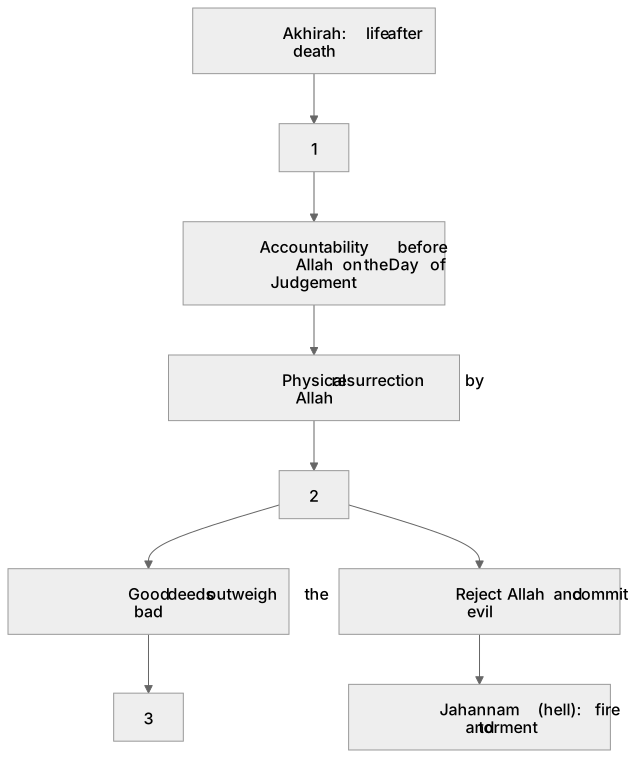
1Box 1
2Box 2
3Box 3
There is more to this lesson
The full lesson goes on to check your understanding and help you earn the marks. Create a free account to carry on, with your progress saved.
A week of Premium from your first lesson · Then the free plan continues · No card, no charge
Test your understanding of Beliefs and teachings: Akhirah (life after death), human responsibility and accountability, resurrection, heaven and hell.
Active recall beats re-reading. Take an instant quiz now to test what you’ve learned and lock it into long-term memory.
A week of Premium from your first lesson · Then the free plan continues · No card, no charge