AQA · GCSE · Religious Studies
Course version: 8062 · Version from Sept 2018
Beliefs and teachings: Key Beliefs
In Islam, key beliefs form the foundational theology (Aqidah) that underpins a Muslim's entire worldview, daily actions, and moral framework.
Checked against the AQA 8062 specification (opens in a new tab) on .
- Point 1 of 13
- 4 key terms
Study notes
From the checked teaching notes for this specification point.
The idea
In Islam, key beliefs form the foundational theology (Aqidah) that underpins a Muslim's entire worldview, daily actions, and moral framework. These core tenets are not merely theoretical; they actively dictate how adherents worship, interact with others, and understand their ultimate purpose. For example, the absolute belief in the oneness of God (Tawhid) directly influences the rejection of idolatry and the practice of daily prayer. Understanding these key beliefs is essential for grasping how faith translates into practice, providing the spiritual architecture that unites the global Muslim community (Ummah) while allowing for distinct theological interpretations across different traditions.
What earns the marks
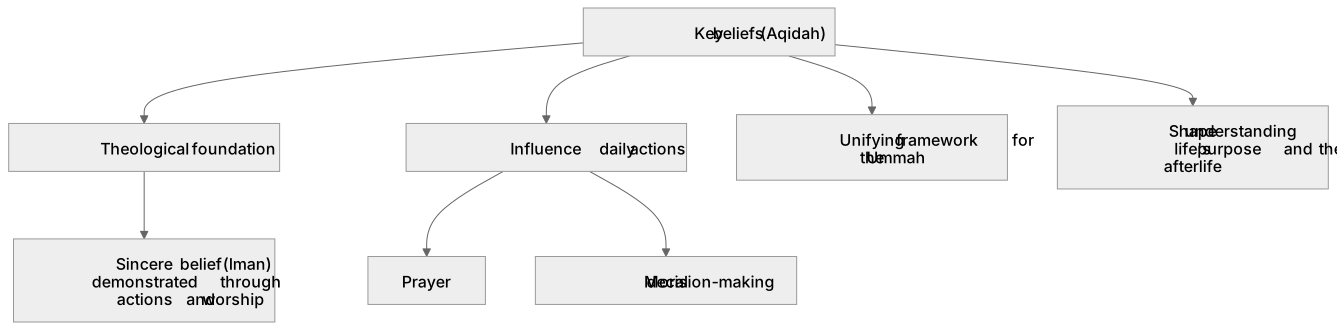
- Identify that key beliefs form the theological foundation (Aqidah) of Islamic practice.
- Explain how core beliefs influence daily actions, such as prayer and moral decision-making.
- Recognise that key beliefs provide a unifying framework for the global Muslim community (Ummah).
- Discuss how foundational beliefs shape a Muslim's understanding of life's purpose and the afterlife.
Common mistakes and how to put them right
Treating beliefs as entirely separate from actions.
Put it right: Explain that in Islam, sincere belief (Iman) must be demonstrated through physical actions and worship.
Assuming all Muslims hold identical interpretations of every belief.
Put it right: Acknowledge that while core beliefs are shared, theological nuances exist between Sunni and Shi'a traditions.
Confusing cultural practices with key theological beliefs.
Put it right: Distinguish between universal Islamic tenets derived from the Qur'an and regional cultural customs.
Exam tips
- Always link a specific key belief to a practical impact on a Muslim's daily life to demonstrate depth of understanding.
- Use Arabic terminology, such as Tawhid or Iman, to show precise subject knowledge when discussing core beliefs.
- When evaluating the importance of beliefs, contrast them with practices to show how one informs the other.
Try the lesson
The start of the Beliefs and teachings: Key Beliefs lesson, made from checked teaching notes for this specification point.
Have a go first
Which of the following represents the core summary of key beliefs in Sunni Islam?
Listen
In Islam, key beliefs form the foundational theology (Aqidah) that underpins a Muslim's entire worldview, daily actions, and moral framework. These core tenets are not merely theoretical; they actively dictate how adherents worship, interact with others, and understand their ultimate purpose. For example, the absolute belief in the oneness of God (Tawhid) directly influences the rejection of idolatry and the practice of daily prayer. Understanding these key beliefs is essential for grasping how faith translates into practice, providing the spiritual architecture that unites the global Muslim community (Ummah) while allowing for distinct theological interpretations across different traditions. A strong answer earns marks for these points. Identify that key beliefs form the theological foundation (Aqidah) of Islamic practice. Explain how core beliefs influence daily actions, such as prayer and moral decision-making. Recognise that key beliefs provide a unifying framework for the global Muslim community (Ummah). Discuss how foundational beliefs shape a Muslim's understanding of life's purpose and the afterlife. A common slip: Treating beliefs as entirely separate from actions. Instead, explain that in Islam, sincere belief (Iman) must be demonstrated through physical actions and worship. Exam tip: Always link a specific key belief to a practical impact on a Muslim's daily life to demonstrate depth of understanding.
See it
Key words
Say what each word means before you turn the card.
Theology (Aqidah)
Try answering aloud or in your head before turning the card.
Faith and Action
Try answering aloud or in your head before turning the card.
Unity of the Ummah
Try answering aloud or in your head before turning the card.
Divine Purpose
Try answering aloud or in your head before turning the card.
See every definition
- Theology (Aqidah)
- The foundational theology that underpins a Muslim's entire worldview, daily actions, and moral framework.
- Faith and Action
- Sincere belief must be demonstrated through physical actions and worship, so beliefs are not entirely separate from actions.
- Unity of the Ummah
- The spiritual architecture that unites the global Muslim community while allowing for distinct theological interpretations across different traditions.
- Divine Purpose
- The understanding of ultimate purpose that key beliefs actively dictate for adherents.
Label the diagram
Some boxes have lost their names. Pick the right name for each number.
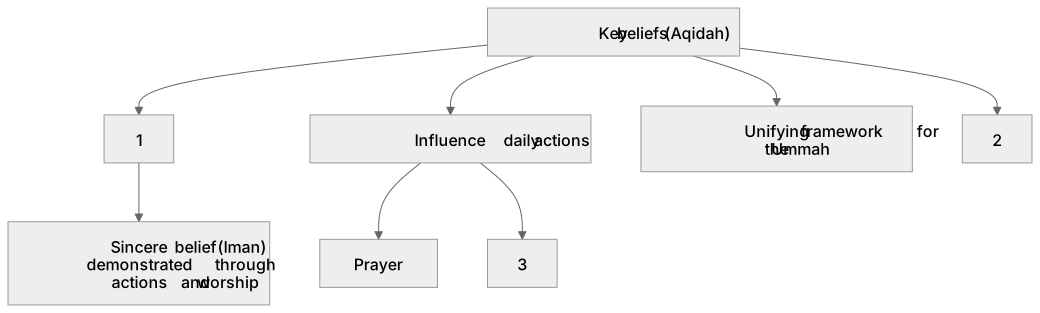
1Box 1
2Box 2
3Box 3
There is more to this lesson
The full lesson goes on to check your understanding and help you earn the marks. Create a free account to carry on, with your progress saved.
A week of Premium from your first lesson · Then the free plan continues · No card, no charge
Test your understanding of Beliefs and teachings: Key Beliefs
Active recall beats re-reading. Take an instant quiz now to test what you’ve learned and lock it into long-term memory.
A week of Premium from your first lesson · Then the free plan continues · No card, no charge