AQA · GCSE · Religious Studies
Course version: 8062 · Version from Sept 2018
Predestination and human freedom and its relationship to the Day of…
Full specification wording
Beliefs and teachings: Predestination and human freedom and its relationship to the Day of Judgement.
Al-Qadr (predestination) is the Islamic belief that Allah knows and determines everything that happens in the universe.
Checked against the AQA 8062 specification (opens in a new tab) on .
- Point 6 of 13
- 4 key terms
Study notes
From the checked teaching notes for this specification point.
The idea
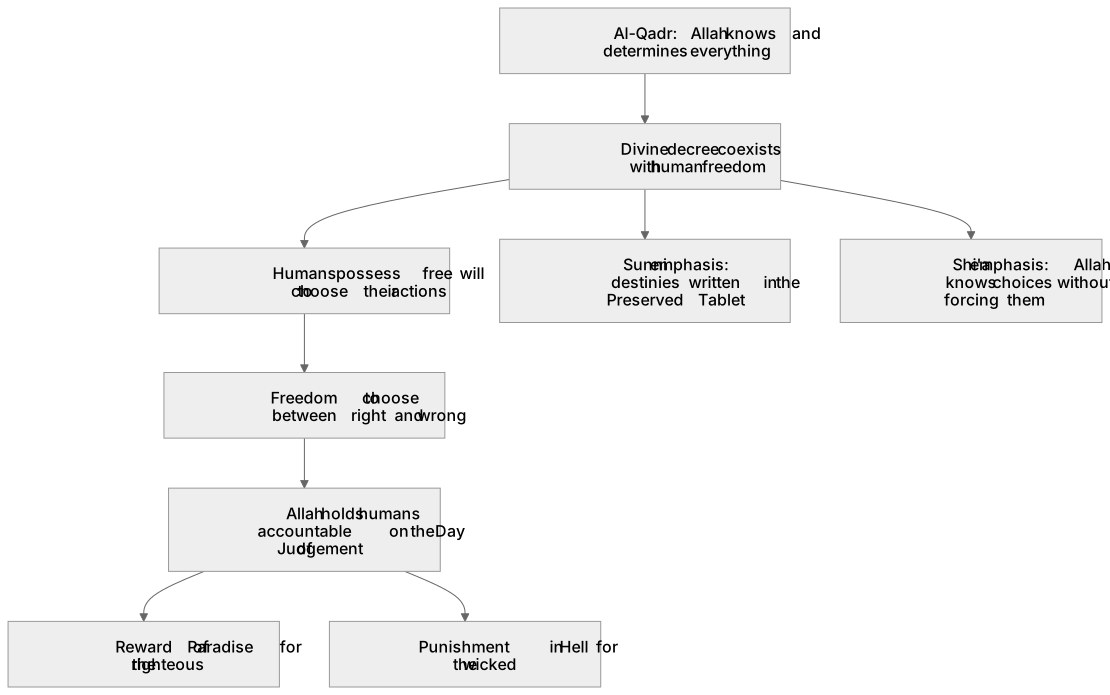
Al-Qadr (predestination) is the Islamic belief that Allah knows and determines everything that happens in the universe. However, this divine decree coexists with human freedom; humans possess free will to choose their actions. Sunni Muslims often emphasise that Allah has written all destinies in the Preserved Tablet, while Shi'a Muslims emphasise that Allah knows what humans will choose without forcing their choice. This balance is crucial for the Day of Judgement (Akhirah). Because humans have the freedom to choose between right and wrong, it is entirely just for Allah to hold them accountable, rewarding the righteous with Paradise and punishing the wicked in Hell.
What earns the marks
- Define Al-Qadr as the belief in divine predestination, where Allah is omniscient and sovereign over all events.
- Explain that despite Allah's foreknowledge, humans are granted free will to make their own moral choices.
- Articulate the relationship between free will and the Day of Judgement, noting that accountability requires the freedom to choose.
- Contrast Sunni emphasis on Allah's supreme decree with the Shi'a emphasis on human free will and divine justice (Adalat).
Common mistakes and how to put them right
Arguing that predestination means humans are robots with no choices.
Put it right: Explain that Allah's foreknowledge does not cancel out human free will; humans still make active choices.
Stating that the Day of Judgement is unfair if Allah already knows the outcome.
Put it right: Emphasise that Allah judges based on the choices humans freely make, ensuring perfect justice.
Confusing the Sunni and Shi'a perspectives on predestination.
Put it right: Sunnis focus more on the Preserved Tablet and divine decree, while Shi'as focus heavily on human agency and divine justice.
Exam tips
- Always link the concept of free will to moral accountability on the Day of Judgement to secure higher marks in evaluation questions.
- Use the term 'Al-Qadr' when discussing predestination to show strong subject vocabulary.
- Acknowledge the tension between divine foreknowledge and human freedom, explaining how Islamic theology reconciles them through Allah's omniscience.
Try the lesson
The start of the Beliefs and teachings: Predestination and human freedom and its relationship to the Day of Judgement. lesson, made from checked teaching notes for this specification point.
Have a go first
Which Islamic term refers to the belief in predestination, that God has knowledge of everything that will happen?
Listen
Al-Qadr (predestination) is the Islamic belief that Allah knows and determines everything that happens in the universe. However, this divine decree coexists with human freedom; humans possess free will to choose their actions. Sunni Muslims often emphasise that Allah has written all destinies in the Preserved Tablet, while Shi'a Muslims emphasise that Allah knows what humans will choose without forcing their choice. This balance is crucial for the Day of Judgement (Akhirah). Because humans have the freedom to choose between right and wrong, it is entirely just for Allah to hold them accountable, rewarding the righteous with Paradise and punishing the wicked in Hell. A strong answer earns marks for these points. Define Al-Qadr as the belief in divine predestination, where Allah is omniscient and sovereign over all events. Explain that despite Allah's foreknowledge, humans are granted free will to make their own moral choices. Articulate the relationship between free will and the Day of Judgement, noting that accountability requires the freedom to choose. Contrast Sunni emphasis on Allah's supreme decree with the Shi'a emphasis on human free will and divine justice (Adalat). A common slip: Arguing that predestination means humans are robots with no choices. Instead, Explain that Allah's foreknowledge does not cancel out human free will; humans still make active choices. Exam tip: Always link the concept of free will to moral accountability on the Day of Judgement to secure higher marks in evaluation questions.
See it
Key words
Say what each word means before you turn the card.
Al-Qadr (Predestination)
Try answering aloud or in your head before turning the card.
Free Will
Try answering aloud or in your head before turning the card.
Akhirah (Life after death)
Try answering aloud or in your head before turning the card.
Divine Justice
Try answering aloud or in your head before turning the card.
See every definition
- Al-Qadr (Predestination)
- The Islamic belief that Allah knows and determines everything that happens in the universe.
- Free Will
- The human freedom to choose their own actions, which coexists with divine decree.
- Akhirah (Life after death)
- The Day of Judgement, for which the balance between predestination and human freedom is crucial.
- Divine Justice
- Allah holding humans accountable because they have the freedom to choose between right and wrong, rewarding the righteous with Paradise and punishing the wicked in Hell.
Label the diagram
Some boxes have lost their names. Pick the right name for each number.
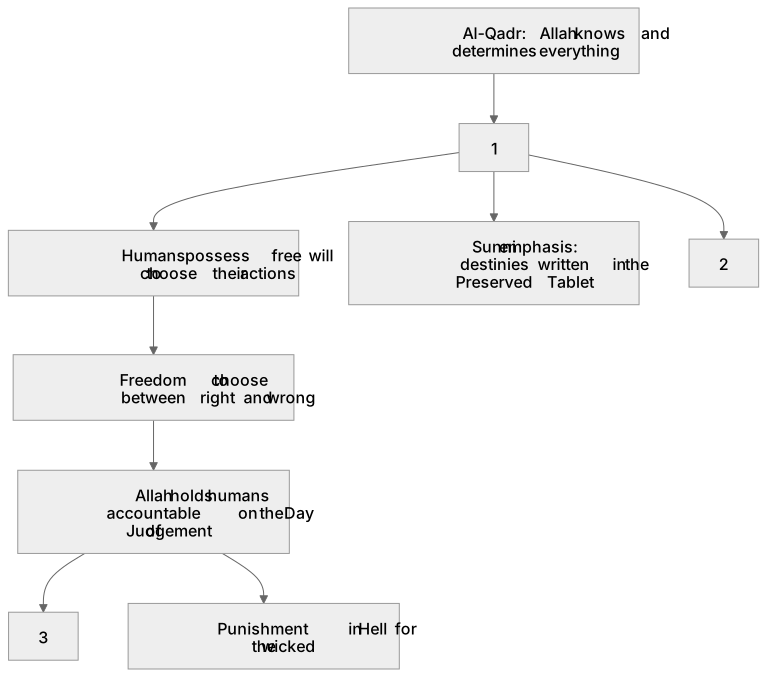
1Box 1
2Box 2
3Box 3
There is more to this lesson
The full lesson goes on to check your understanding and help you earn the marks. Create a free account to carry on, with your progress saved.
A week of Premium from your first lesson · Then the free plan continues · No card, no charge
Test your understanding of Beliefs and teachings: Predestination and human freedom and its relationship to the Day of Judgement.
Active recall beats re-reading. Take an instant quiz now to test what you’ve learned and lock it into long-term memory.
A week of Premium from your first lesson · Then the free plan continues · No card, no charge