Development — Edexcel GCSE Psychology
Verified courseTeaching note checked against the official specification.
Development explained
Development covers 4 specification points, including A.
Read the full explanation
forebrain b. midbrain c. hindbrain d.… and A. sensorimotor b. pre-operational c. concrete…. Open a point below for its explanation and revision guidance.
1.1.1 Understand early brain development, including the development of: a. forebrain b. midbrain c. hindbrain d. cerebellum e. medulla
Early brain development begins in the womb when the neural tube forms and divides into three sections: the forebrain, midbrain, and hindbrain. The forebrain develops into areas responsible for complex cognitive processes and emotions. The midbrain forms a relay station for sensory information and motor control. The hindbrain develops into structures vital for survival, specifically the cerebellum and the medulla. The cerebellum coordinates voluntary movements, balance, and motor learning, allowing a child to eventually walk. The medulla controls autonomic, involuntary functions such as breathing and heart rate. Understanding these stages highlights how foundational structures emerge to support both basic survival and higher-order thinking.
1.1.2 Understand the role of education and intelligence, including Piaget’s Theory of Cognitive Development, and the four stages of cognitive development, including strengths and weaknesses of the theory: a. sensorimotor b. pre-operational c. concrete operational d. formal operational e. schemata/schemas f. assimilation g. accommodation h. equilibrium
Piaget’s Theory explains how intelligence evolves through active learning. Children build mental frameworks called schemas. When new information fits an existing schema, assimilation occurs, maintaining equilibrium. If it does not fit, accommodation alters the schema to restore balance. Piaget proposed four stages: sensorimotor (learning through senses), pre-operational (symbolic but egocentric thought), concrete operational (logical thought about physical objects), and formal operational (abstract reasoning). While influential in education by promoting discovery learning, weaknesses include underestimating children's abilities at earlier ages and ignoring the role of social influences on cognitive development.
1.1.3 Understand the effects of learning on development using Carol Dweck’s mindset theory, including strengths and weaknesses of the theory: a. fixed mindset b. growth mindset c. ability and effort
Carol Dweck’s mindset theory explores how individuals perceive their intelligence, affecting their development. A fixed mindset is the belief that abilities are innate, leading individuals to avoid challenges. Conversely, a growth mindset is the belief that abilities can be developed through effort, encouraging resilience. Dweck emphasises praising effort rather than innate ability to foster a growth mindset. Strengths include its practical application in education, showing that teaching students about brain plasticity improves motivation. However, weaknesses include the risk of ignoring the role of natural talent and the fact that praising effort alone might not lead to success if the learning strategies used are ineffective.
1.1.4 Understand the effects of learning on development using Daniel Willingham’s learning theory, including strengths and weaknesses of the theory: a. factual knowledge precedes skill b. the importance of practice and effort c. strategies to support cognitive development d. strategies to support physical development e. strategies to support social development
Daniel Willingham’s theory argues that factual knowledge must precede skill development; students need background knowledge to think critically. He emphasises practice and effort to make skills automatic, freeing up working memory. To support cognitive development, teachers should use structured tasks. For physical development, practice of motor skills builds muscle memory. For social development, Willingham suggests encouraging self-regulation and demonstrating appropriate behaviours. Strengths include its strong basis in scientific research and practical classroom strategies. Weaknesses include the potential neglect of individual differences and the fact that his ideas may not easily apply to subjects requiring less factual recall.
Watch and listen
Listen: Development audio lesson
Read the full guide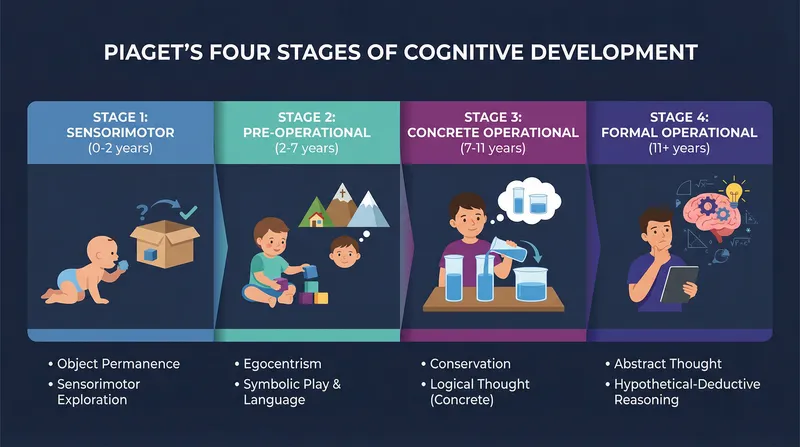
Your focus
- Identify the three main sections of the developing brain: forebrain, midbrain, and hindbrain.
- Describe the specific functions of the cerebellum and the medulla in human behaviour and survival.
- Explain how the early development of brain structures relates to the emergence of motor and cognitive abilities.
Show all 12 objectives
- Define the concepts of schemas, assimilation, accommodation, and equilibrium in the context of cognitive development.
- Outline the key characteristics and chronological order of Piaget's four stages of cognitive development.
- Evaluate Piaget's theory by identifying its strengths in educational settings and its weaknesses regarding the underestimation of children's abilities.
- Define the concepts of fixed and growth mindsets.
- Explain the relationship between ability, effort and learning outcomes.
- Evaluate the strengths and weaknesses of Dweck's mindset theory.
- Explain why factual knowledge must precede skill development according to Willingham.
- Describe strategies to support cognitive, physical and social development.
- Evaluate the strengths and weaknesses of Willingham's learning theory.
Development flashcards
Card 1 of 11
Neural tube
Development exam tips
Marking Points
- The forebrain develops into the cerebral cortex, which is responsible for higher cognitive functions.
- The midbrain acts as a relay station for auditory and visual processing and motor movement.
- The hindbrain develops into the cerebellum and medulla, which are essential for basic survival functions.
- The cerebellum is responsible for coordinating motor movements and balance.
- The medulla controls involuntary, autonomic functions such as heart rate and breathing.
- Schemas are mental structures that organise past experiences and provide a framework for understanding future experiences.
- Assimilation involves incorporating new information into an existing schema without changing it.
- Accommodation requires modifying an existing schema or creating a new one when new information cannot be assimilated.
- The sensorimotor stage is characterised by learning through sensory input and motor actions, culminating in object permanence.
- A key weakness of Piaget's theory is that subsequent research has shown children often achieve cognitive milestones earlier than he proposed.
- Identifying a fixed mindset as the belief that intelligence is static and cannot be changed.
- Explaining that a growth mindset involves the belief that intelligence can be developed through hard work and effort.
- Evaluating the theory by stating a strength, such as its positive impact on educational practices and student motivation.
- Evaluating the theory by stating a weakness, such as the overemphasis on effort which may ignore the importance of effective learning strategies.
- Explaining that factual knowledge is essential before students can develop problem-solving skills.
- Describing how practice and effort lead to automaticity, which reduces the cognitive load on working memory.
- Identifying a strategy for physical development, such as repetitive practice of motor movements to build muscle memory.
- Evaluating the theory by noting a strength, such as its foundation in cognitive neuroscience, or a weakness, like its limited application to creative subjects.
Examiner Tips
- 💡Use the mnemonic 'CereBELLum' to remember it helps you balance, like a bell swinging.
- 💡When describing the medulla, always specify that it controls 'involuntary' or 'autonomic' functions rather than just 'body functions'.
- 💡Ensure you can identify the relative locations of the forebrain, midbrain, and hindbrain on a diagram of early brain development.
- 💡Provide a concrete example, such as a child calling a horse a 'dog' (assimilation) before learning the new word (accommodation), to clearly distinguish the two processes.
- 💡Memorise the exact names and chronological order of the four stages: sensorimotor, pre-operational, concrete operational, and formal operational.
- 💡When evaluating Piaget's theory, contrast his idea of independent discovery learning with Vygotsky's emphasis on social interaction to highlight a theoretical weakness.
- 💡Use concrete examples of praise, such as 'you worked really hard on that', to illustrate how to foster a growth mindset.
- 💡When evaluating the theory, ensure you provide both a strength and a weakness to achieve full marks in extended response questions.
- 💡Clearly distinguish between ability as an innate talent and effort as hard work when explaining the components of the theory.
- 💡Memorise one specific strategy for each of the three areas of development to use in applied questions.
- 💡Link the concept of automaticity to working memory when explaining why practice and effort are important.
- 💡Use the term 'factual knowledge' explicitly rather than just 'information' to align with Willingham's specific terminology.
Common Mistakes
- Mistaking the functions of the cerebellum and the cerebrum; the cerebellum controls motor coordination and balance, whereas the cerebrum (part of the forebrain) controls higher cognitive functions.
- Believing the midbrain is responsible for complex thought; the midbrain primarily acts as a relay station for sensory and motor information, not higher-order thinking.
- Confusing the medulla with the spinal cord; the medulla is a specific structure in the hindbrain that controls autonomic functions like breathing, while the spinal cord transmits neural signals.
- Confusing assimilation and accommodation; assimilation adds to an existing schema without changing its core, whereas accommodation fundamentally alters the schema or creates a new one.
- Assuming the stages can occur in any order; Piaget argued that the four stages of cognitive development are invariant and must occur in a strict sequence.
- Believing equilibrium is a permanent state; equilibrium is a temporary state of cognitive balance that is disrupted by new, conflicting information, prompting further learning.
- Confusing fixed and growth mindsets; the correction is to remember that a fixed mindset means unchangeable, while a growth mindset implies development over time.
- Assuming that praising intelligence is beneficial; the correction is to understand that Dweck advocates praising effort to encourage a growth mindset.
- Believing that a growth mindset guarantees success; the correction is to recognise that effort must be paired with effective strategies and resources.
- Thinking that skills can be taught independently of facts; the correction is to state that Willingham argues factual knowledge must come first.
- Confusing cognitive, physical and social development strategies; the correction is to clearly categorise strategies, such as linking self-regulation specifically to social development.
- Assuming practice is only for physical skills; the correction is to explain that practice is also crucial for cognitive skills to achieve automaticity.