Longitudinal and Transverse Waves Explained Clearly
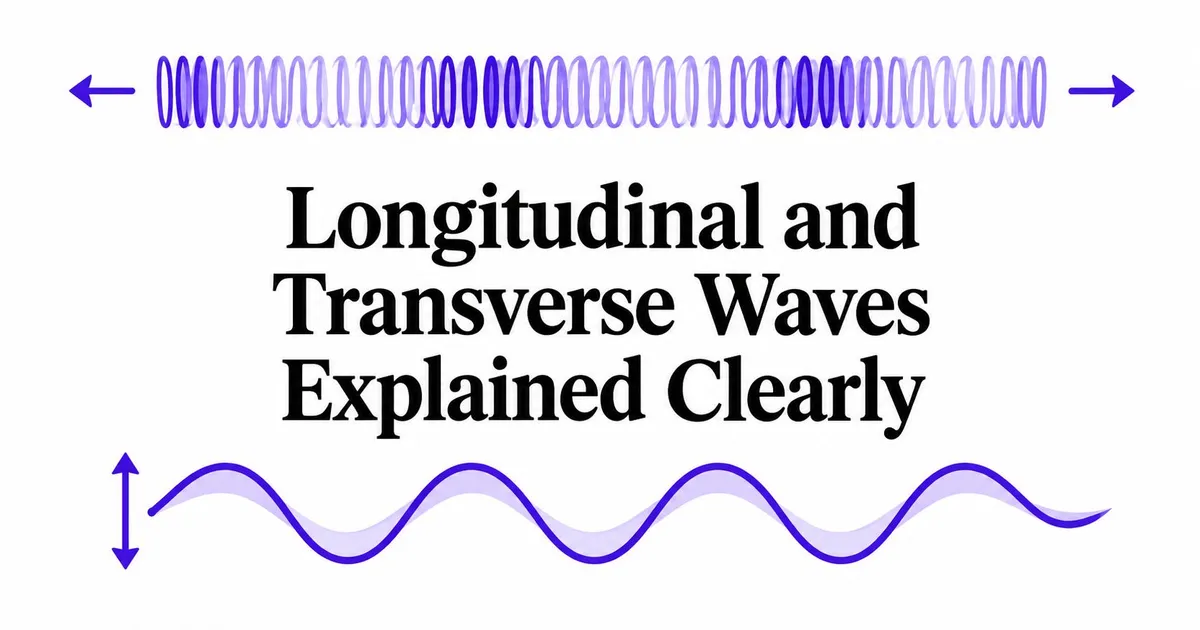
You're revising late, six topics still waiting, and the words longitudinal and transverse have started to blur together. One diagram has bumps, another has crowded lines, and suddenly crests look like compressions while particle motion gets confused with the direction the wave travels.
That confusion is common, but it's fixable. The key is one direction rule, followed by a small set of precise terms. By the end, you should be able to identify a wave diagram quickly, connect it to sound, water, earthquakes or electromagnetic waves, and write the wording examiners expect rather than a vague description.
Why This Topic Trips Up So Many Students
Wave diagrams are deceptive because they often show the same repeating pattern. A transverse wave is usually drawn with peaks and dips, while a longitudinal wave may be shown as alternating crowded and spread-out regions. On a page, both can look like a line that rises and falls, so students sometimes memorise the appearance without understanding what the particles are doing.
That approach breaks down as soon as a question changes the diagram. A mark scheme usually cares about the direction of oscillation compared with the direction of energy transfer, not whether the picture looks like a familiar wave. The BBC Bitesize guide to transverse and longitudinal waves reinforces the standard GCSE distinction used by UK learners.
The question to ask first
Don't begin by hunting for a crest. Ask:
Which way do the particles, or fields, oscillate?
If they move at right angles to the direction the wave transfers energy, the wave is transverse. If they move parallel to that direction, it's longitudinal. This works for a rope, sound in air, seismic waves and electromagnetic radiation.
The distinction matters beyond a one-mark definition. It explains why sound produces compressions and rarefactions, why water-surface ripples are treated as transverse in the curriculum, and why polarisation becomes important at A-Level. The AQA GCSE waves specification includes these definitions and examples.
Examiner's shortcut: Don't write only “the particles move up and down” or “the wave moves forwards”. State the relationship between the two directions.
You'll also need to separate the motion of the medium from the motion of the disturbance. In a wave, energy is transferred through the medium without a net transfer of the particles themselves, as outlined in the National Curriculum science programmes of study. That's why a rope section can move sideways while the pulse travels along the rope.
The Core Definitions and Direction Rule
Start with the master rule. A transverse wave has oscillations perpendicular to the direction of energy transfer. A longitudinal wave has oscillations parallel to the direction of energy transfer.
A skipping rope gives you a useful transverse picture. Flick one end up and down, and each small section of rope oscillates vertically while the disturbance travels along the rope. The rope's motion is at right angles to the energy transfer, so the wave is transverse.
A Slinky gives the longitudinal picture. Push and pull one end along its length, and the coils move backwards and forwards in the same direction as the pulse. The coils form crowded sections called compressions and more spread-out sections called rarefactions.
The features you must recognise
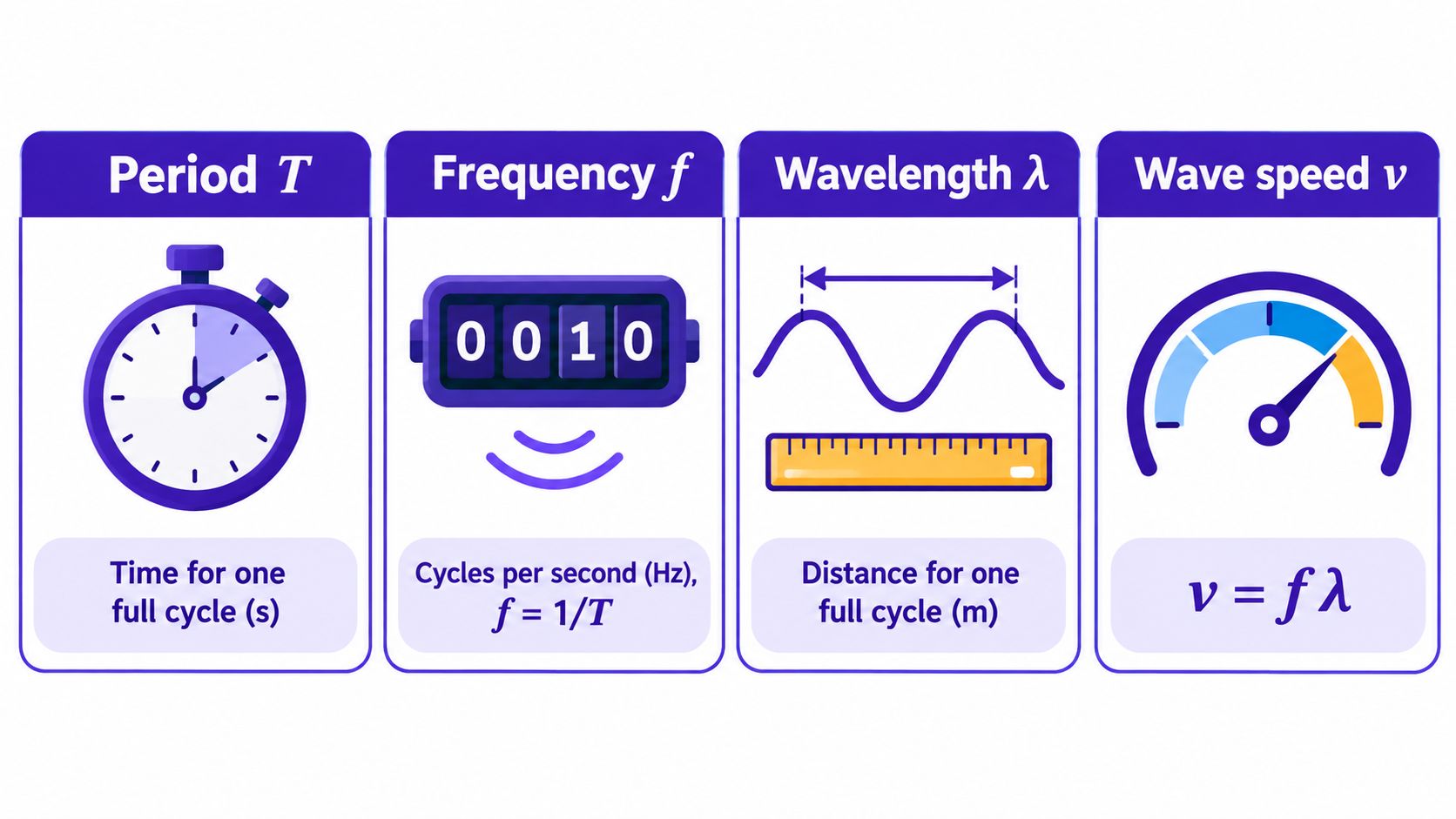
For a transverse wave, the high points are crests and the low points are troughs. The amplitude is the maximum displacement from the equilibrium position. The wavelength, written as λ, is the distance covered by one complete cycle, such as the distance from one crest to the next crest.
For a longitudinal wave, a compression is a region where particles are close together, while a rarefaction is a region where particles are further apart. The wavelength is measured from the centre of one compression to the centre of the next compression, or from one rarefaction centre to the next.
The same broad wave quantities apply to both types. Frequency, period, wavelength, amplitude and speed describe wave behaviour, but the transverse or longitudinal label depends on the direction of oscillation.
A useful comparison is:
| Feature | Transverse wave | Longitudinal wave |
|---|---|---|
| Oscillation direction | Perpendicular to energy transfer | Parallel to energy transfer |
| Visible features | Crests and troughs | Compressions and rarefactions |
| Typical example | Water-surface ripple | Sound in air |
| Exam diagnostic | Motion is at right angles | Motion is along the direction of travel |
For a concise recap, use this waves study guide for GCSE.
The sentence worth learning is:
“The oscillations are perpendicular to the direction of energy transfer.”
Change “perpendicular” to parallel and you have the longitudinal definition. If you're unsure, identify the direction of energy transfer first, then compare it with the particle motion. That method is more reliable than memorising the shape of a diagram.
The Maths Behind Wave Motion
The wave equation doesn't care whether the wave is longitudinal or transverse. In both cases, use:
v = fλ
Here, v is wave speed in metres per second, f is frequency in hertz, and λ is wavelength in metres. Frequency tells you how many complete cycles pass a point each second, while wavelength is the distance occupied by one complete cycle.
The period, T, is the time taken for one complete cycle, measured in seconds. Frequency and period are connected by:
f = 1/T
So, if a question gives you the period, find frequency by taking its reciprocal before using the wave equation.
Linking symbols to diagrams
On a transverse wave, measure λ between adjacent crests or adjacent troughs. On a longitudinal wave, measure it between adjacent compression centres or adjacent rarefaction centres. Don't measure from a compression to the nearest rarefaction, because that represents only part of a cycle.
The three useful rearrangements are:
- v = fλ
- f = v/λ
- λ = v/f
A triangle can help you remember which quantities multiply and divide, but writing the rearranged equation is safer in an exam. It shows your method and makes a correction easier if you spot a mistake.
A worked calculation
A sound wave has a frequency of 440 Hz and a wavelength of 0.77 m. Calculate its speed.
Write the equation first:
v = fλ
Substitute the values:
v = 440 × 0.77
Calculate:
v = 338.8 m/s
Rounded suitably:
v = 339 m/s
This is the structure to copy. Equation, substitution, calculation and unit. The GCSE wave speed study notes provide further practice with the same relationship.
Check units before substituting. Convert centimetres to metres, and convert kilohertz to hertz. A calculator can produce a neat answer from incorrect units, so unit conversion belongs before the calculation, not after it.
Real Examples You Already Know
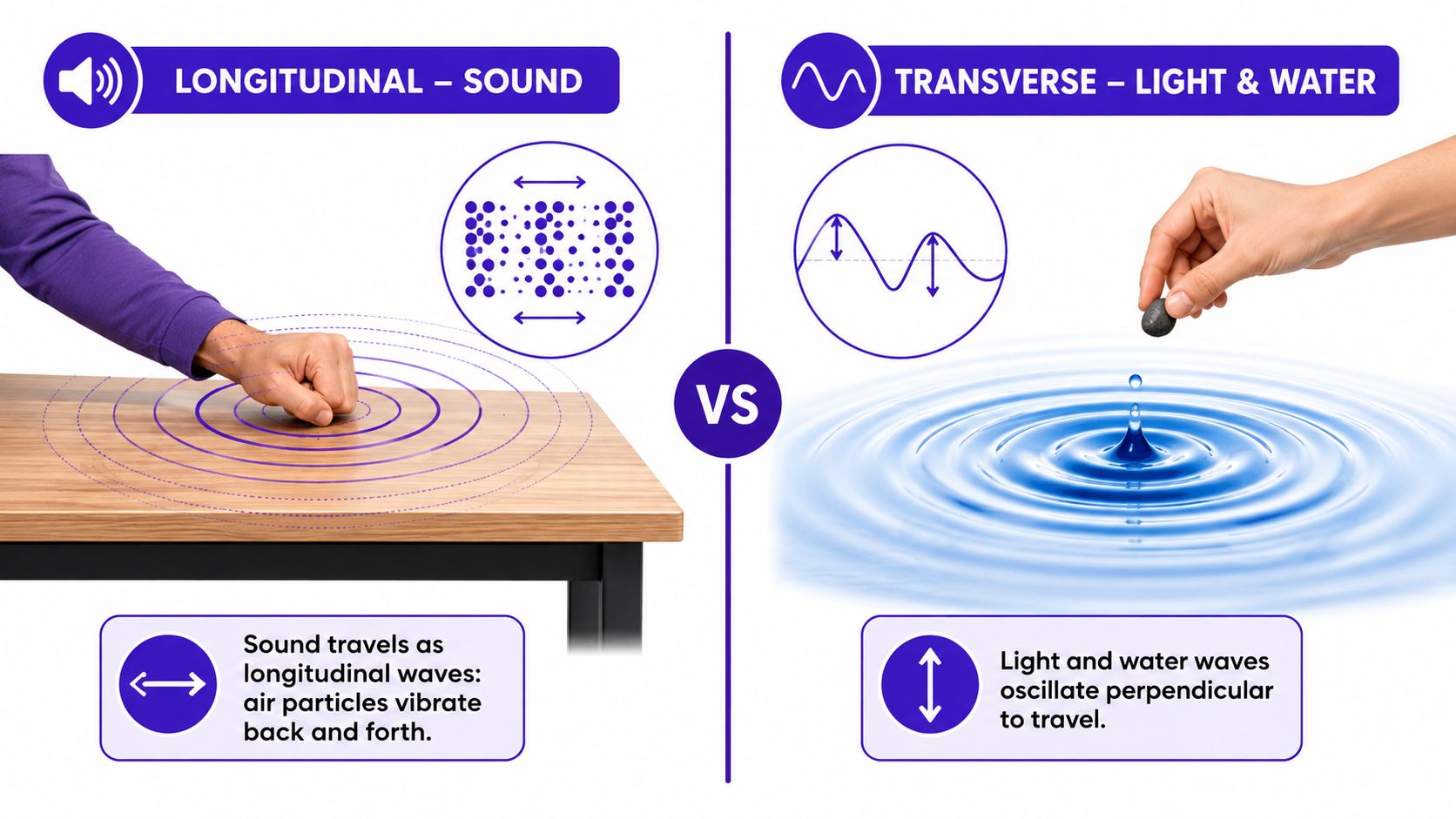
You hear a longitudinal wave whenever someone knocks on a desk. The knock makes the desk vibrate, and those vibrations push nearby air particles together. The crowded regions move through the air as compressions, followed by spread-out rarefactions, carrying energy towards your ear.
The air particles don't travel all the way from the desk to your ear. They oscillate backwards and forwards around their equilibrium positions, while the pressure disturbance travels outwards. That's the part students often leave out when they write that “sound moves through the air”.
Water, earthquakes and the ground beneath you
Drop a stone into a pond and ripples spread across the surface. The water at a particular point moves up and down while the disturbance spreads outwards, so surface water waves are treated as a transverse example in the UK curriculum.
Earthquakes provide a useful contrast because they produce different seismic wave motions. P-waves are longitudinal, with material oscillating parallel to the direction of propagation. S-waves are transverse, with oscillations perpendicular to that direction. The GCSE seismic waves study guide uses this distinction in an exam-focused context.
P-waves and S-waves also help you connect the definition to evidence. Their different motions mean they behave differently as they travel through Earth, so a question may ask you to identify the wave from a diagram rather than from its name.
Electromagnetic waves
Light, microwaves and X-rays belong to the electromagnetic family. Electromagnetic waves are transverse disturbances of electric and magnetic fields, so the oscillating fields are at right angles to the direction of energy transfer.
This is why the same basic classification appears in both everyday examples and advanced physics. A sound wave involves pressure changes in a medium, while an electromagnetic wave involves changing fields and can travel without a material medium.
Frequency also gives familiar experiences a physics connection. A higher sound frequency is associated with a higher pitch, while the wave equation links frequency, wavelength and speed. Water ripples give a visual version of the same idea, because you can observe repeated cycles moving across the surface.
Why Polarisation Matters at A-Level
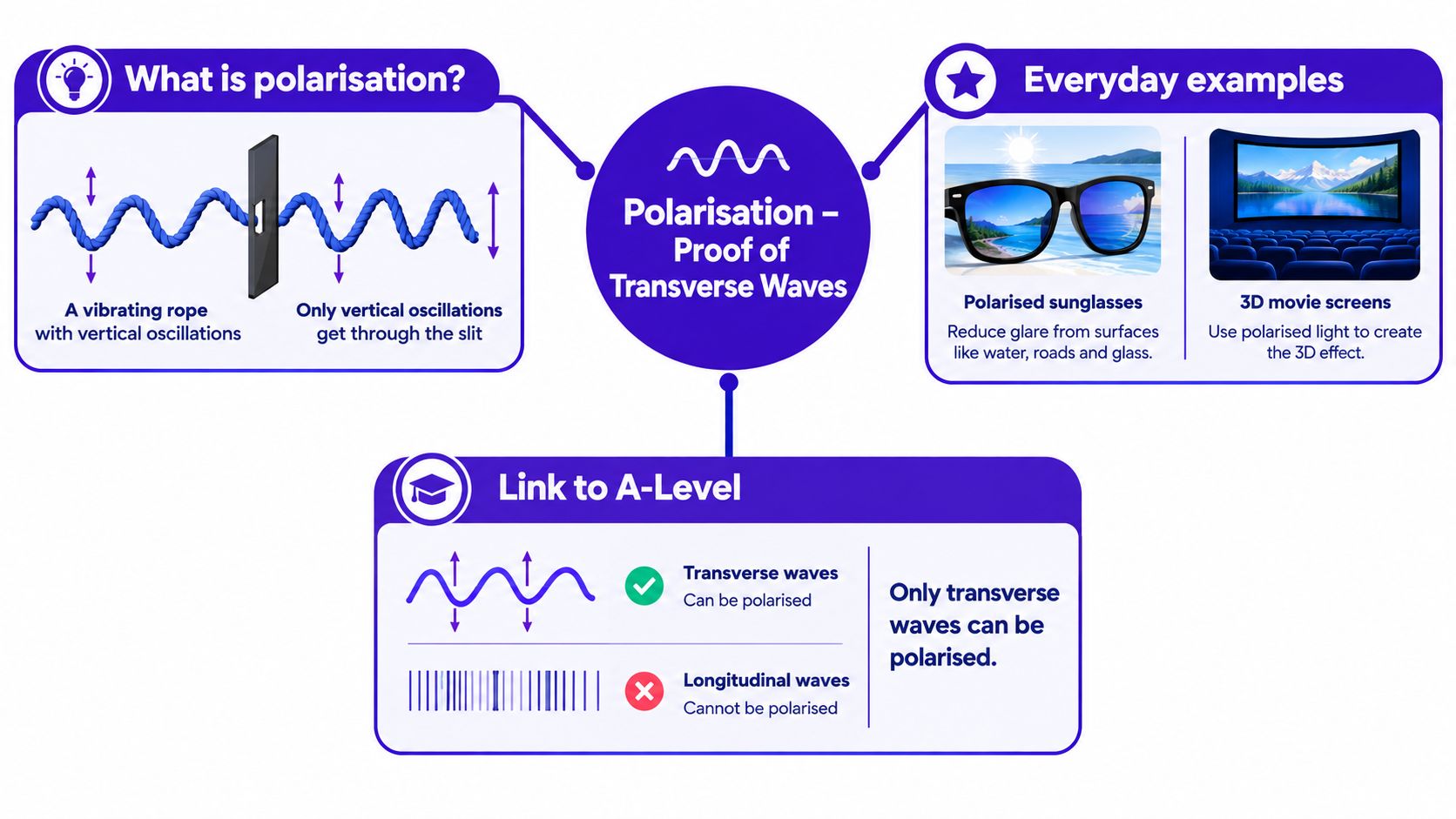
Polarisation is one of the clearest ways to prove that a wave is transverse. It means restricting the oscillations to one plane, perpendicular to the direction of travel. That restriction is possible only when the oscillations already occur at right angles to propagation.
Take a rope and pass it through a narrow vertical gap. Only vibrations in the matching direction can pass through. If you rotate the gap, you change which oscillations are allowed through. A longitudinal wave can't behave this way because its oscillations already run along the direction of travel, leaving no sideways plane to select.
The AQA A-Level waves specification treats polarisation as evidence that a wave is transverse. Many GCSE summaries stop too soon. At A-Level, you're expected to explain the reasoning, not recall that light is transverse.
Applications you can explain
Polaroid sunglasses are a familiar application. They reduce glare by absorbing light oscillating in an unwanted orientation, which demonstrates that light has a direction of oscillation that can be selected.
Radio aerials offer another useful example. The aerial's orientation affects how effectively it detects a signal because the receiving arrangement responds to the oscillating electric field. Rotating the aerial changes its alignment with the field.
Sound in air provides the contrast. Its oscillations are parallel to the direction of energy transfer, so sound cannot be polarised in the same way. Don't write that sound “doesn't have vibrations”. It does. The issue is that its vibrations don't have the transverse directions needed for polarisation.
A-Level wording: “Polarisation is evidence that a wave is transverse because only transverse oscillations can be restricted to one plane.”
For further board-specific revision, the A level WJEC Physics waves guide can help you practise applying the idea rather than memorising a label.

Exam Questions With Examiner Tips
Question one
A diagram shows alternating crowded and spread-out regions in air. Identify the crowded regions and state why the wave is longitudinal.
Model answer: The crowded regions are compressions. The particles vibrate parallel to the direction of energy transfer, producing compressions and rarefactions.
The command word state usually wants a direct answer, not a long paragraph. The terminology that earns the explanation mark is “parallel to the direction of energy transfer”. Saying only “the particles move backwards and forwards” may not establish the relationship clearly enough.
Question two
A wave has a frequency of 440 Hz and a wavelength of 0.77 m. Calculate its speed.
Model answer:
v = fλ
v = 440 × 0.77
v = 338.8 m/s
v = 339 m/s
Show the equation and substitution even if you can do the calculation mentally. If the question includes centimetres or kilohertz, convert first. Check whether the requested answer needs a particular number of significant figures, then include the unit.
Question three
Explain why polarisation provides evidence that light is a transverse wave. Describe what happens when a polarising filter is rotated.
Model answer: Polarisation restricts the oscillations of a wave to one plane. Only transverse waves can be polarised because their oscillations are perpendicular to the direction of energy transfer. Rotating the filter changes its orientation relative to the oscillating field, so the transmitted intensity changes.
The command word explain requires a reason, while describe requires the observed change or sequence. A strong response connects the filter, the direction of oscillation and the intensity. Avoid writing that the filter changes the wave's frequency or speed.
| Command word | What examiners expect | Example for this topic |
|---|---|---|
| State | A concise fact or label | “Sound is longitudinal.” |
| Describe | What happens, without needing a reason | “The transmitted intensity changes as the filter rotates.” |
| Explain | A linked reason using physics | “Only transverse waves can be polarised because their oscillations are perpendicular to energy transfer.” |
| Calculate | Equation, substitution, answer and unit | “v = fλ, then substitute the values.” |
The same habits help across AQA, Edexcel, OCR and WJEC papers. The board may alter the context, but precise vocabulary still protects the marks.
Common Mistakes and How to Avoid Them
Students often lose marks because they know a fact but answer a different question. Read the command word, identify what is moving, and state the direction relationship explicitly.
Mistake one
Weak answer: “The particles move up and down, so the energy moves forwards.”
Correct physics: Particle motion and energy transfer are different directions that must be compared.
Rescue sentence: “The oscillations are perpendicular to the direction of energy transfer, so the wave is transverse.”
Mistake two
Weak answer: “Sound is transverse because it can travel through solids.”
Correct physics: Sound in air is longitudinal. The medium doesn't decide the wave type on its own. The direction of oscillation does.
Rescue sentence: “Sound in air is longitudinal because air particles vibrate parallel to the direction of energy transfer.”
Mistake three
Weak answer: Calling every crowded section a rarefaction.
Correct physics: A compression has particles close together. A rarefaction has particles spread apart.
Rescue sentence: “The closely packed region is a compression, and the more widely spaced region is a rarefaction.”
Mistake four
Weak answer: “All electromagnetic waves need particles to travel through.”
Correct physics: Electromagnetic waves are transverse field disturbances, so they don't require a material medium in the way sound does.
Rescue sentence: “Electromagnetic waves are transverse and can transfer energy without a material medium.”
Mistake five
Weak answer: “This is transverse because it has a wave shape.”
Correct physics: A diagram's shape isn't enough. You must compare oscillation direction with energy transfer.
Rescue sentence: “The vibration is perpendicular for a transverse wave, or parallel for a longitudinal wave.”
Your last-minute checklist
- Direction: Compare oscillation with energy transfer.
- Features: Use crests and troughs for transverse waves.
- Pressure pattern: Use compressions and rarefactions for longitudinal waves.
- Equation: Use v = fλ, with consistent units.
- Evidence: Remember that polarisation demonstrates a transverse wave.
The rescue line, “vibration is parallel or longitudinal, perpendicular or transverse to energy transfer”, covers a large share of the terminology students drop on this topic. Write the relationship, not just the label.
MasteryMind offers UK GCSE and A-Level practice aligned with AQA, Edexcel, OCR and WJEC, including examiner-style feedback and step-by-step checking for physics calculations. Visit MasteryMind to practise identifying longitudinal and transverse waves, applying v = fλ, and answering polarisation questions with precise exam wording.
Ready to master this topic?
Practise with quizzes, blurt exercises and exam questions on MasteryMind.
7 days Premium · Then free forever · No card, no charge