AQA · GCSE · Biology
Course version: 8461 · Version from Sept 2018
Extinctions occur when there are no remaining individuals of a species…
Full specification wording
Extinction: Extinctions occur when there are no remaining individuals of a species still alive.
A species becomes extinct when its last individual dies, so no living members remain to reproduce.
- Point 1 of 2
Study notes
From the teaching notes for this specification point.
The idea
A species becomes extinct when its last individual dies, so no living members remain to reproduce. Extinction can follow a gradual decline or a sudden event. Causes include environmental change such as climate shift or habitat loss, new predators or competitors, and catastrophic events such as volcanic eruptions or asteroid impacts. Small populations are especially vulnerable because inbreeding, disease or a skewed sex ratio can reduce survival and reproduction further. Once numbers fall below a critical level, the species may be unable to recover even if conditions improve. Extinction is permanent: the species' gene pool is lost, although its fossils may still be studied.
What earns the marks
- Extinction means that no individuals of a species remain alive anywhere, so the species can no longer reproduce.
- Environmental changes such as climate change, habitat destruction or pollution can make conditions unsuitable for a species.
- New predators, competitors or diseases can reduce a population until no breeding individuals survive.
- Catastrophic events such as volcanic eruptions, asteroid impacts or major fires can destroy habitats or food sources rapidly.
- Small populations are at greater risk because genetic variation is low and chance events can remove the remaining individuals.
Common mistakes and how to put them right
Saying a species is extinct when only a local population has disappeared.
Put it right by checking that no individuals survive anywhere.
Confusing endangered with extinct.
Put it right by stating that endangered species still have living individuals.
Listing only one cause of extinction when asked to explain.
Put it right by giving several causes and linking each to a fall in population.
Exam tips
- Define extinction precisely in terms of no remaining living individuals before explaining a cause.
- Link each cause to a mechanism, such as loss of food or failure to breed, rather than naming the cause alone.
- Use examples of past mass extinctions or named endangered species to show the difference between extinct and at risk.
Try the lesson
The start of the Extinction: Extinctions occur when there are no remaining individuals of a species still alive. lesson, made from teaching notes for this specification point.
Have a go first
What is meant by extinction of a species?
Listen
A species becomes extinct when its last individual dies, so no living members remain to reproduce. Extinction can follow a gradual decline or a sudden event. Causes include environmental change such as climate shift or habitat loss, new predators or competitors, and catastrophic events such as volcanic eruptions or asteroid impacts. Small populations are especially vulnerable because inbreeding, disease or a skewed sex ratio can reduce survival and reproduction further. Once numbers fall below a critical level, the species may be unable to recover even if conditions improve. Extinction is permanent: the species' gene pool is lost, although its fossils may still be studied. A strong answer earns marks for these points. Extinction means that no individuals of a species remain alive anywhere, so the species can no longer reproduce. Environmental changes such as climate change, habitat destruction or pollution can make conditions unsuitable for a species. New predators, competitors or diseases can reduce a population until no breeding individuals survive. Catastrophic events such as volcanic eruptions, asteroid impacts or major fires can destroy habitats or food sources rapidly. A common slip: Saying a species is extinct when only a local population has disappeared. Instead, checking that no individuals survive anywhere. Exam tip: Define extinction precisely in terms of no remaining living individuals before explaining a cause.
See it
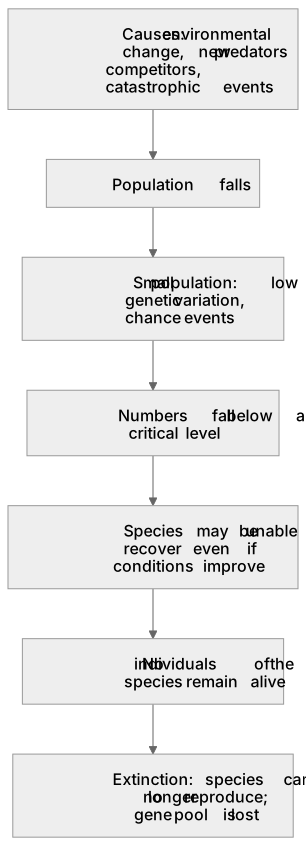
Put it in order
Put these steps in the order they happen.
- 1. Extinction: species can no longer reproduce; gene pool is lost
- 2. No individuals of the species remain alive
- 3. Small population: low genetic variation, chance events
- 4. Species may be unable to recover even if conditions improve
- 5. Causes: environmental change, new predators or competitors, catastrophic events
- 6. Population falls
- 7. Numbers fall below a critical level
Label the diagram
Some boxes have lost their names. Pick the right name for each number.
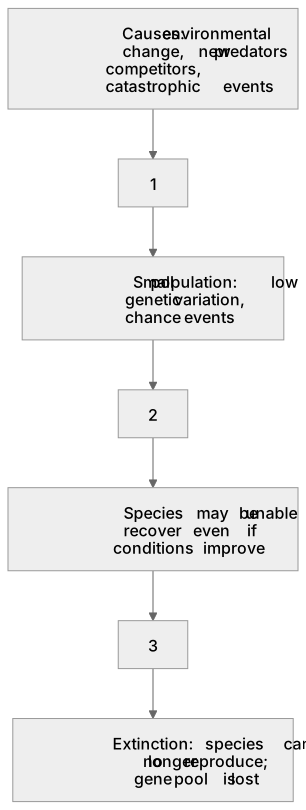
1Box 1
2Box 2
3Box 3
There is more to this lesson
The full lesson goes on to check your understanding and help you earn the marks. Create a free account to carry on, with your progress saved.
A week of Premium from your first lesson · Then the free plan continues · No card, no charge
Test your understanding of Extinction: Extinctions occur when there are no remaining individuals of a species still alive.
Active recall beats re-reading. Take an instant quiz now to test what you’ve learned and lock it into long-term memory.
A week of Premium from your first lesson · Then the free plan continues · No card, no charge