AQA · GCSE · Biology
Course version: 8461 · Version from Sept 2018
Students should be able to describe factors which may contribute to the…
Full specification wording
Extinction: Students should be able to describe factors which may contribute to the extinction of a species.
Extinction means no members of a species remain alive anywhere.
- Point 2 of 2
Study notes
From the teaching notes for this specification point.
The idea
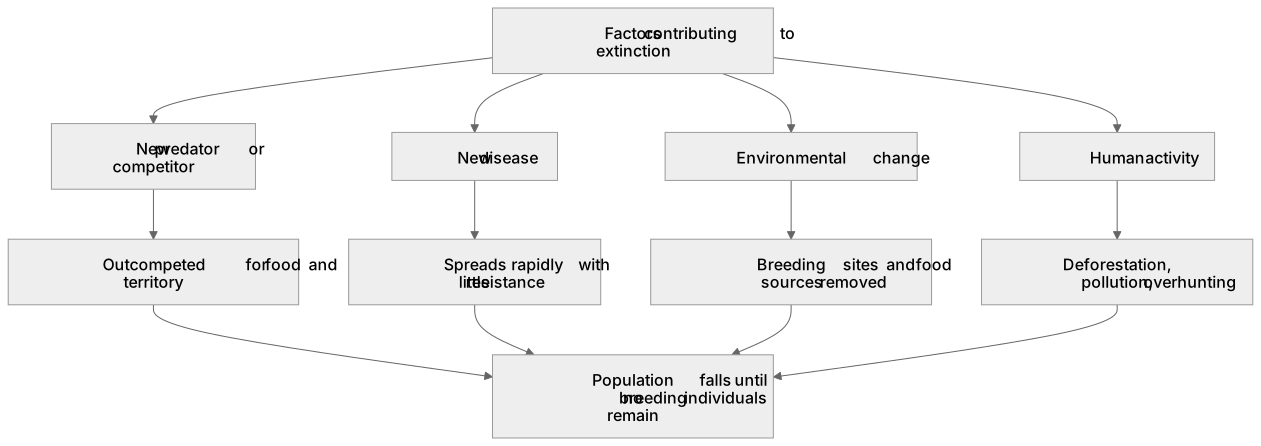
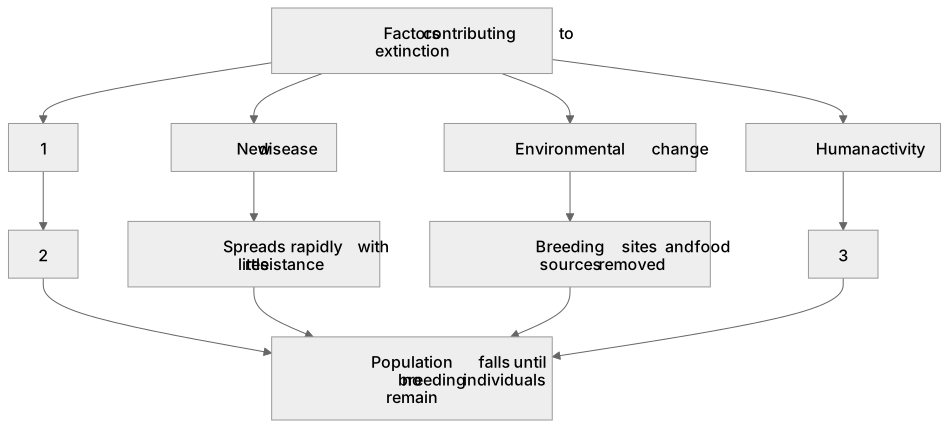
Extinction means no members of a species remain alive anywhere. Several factors can contribute, often acting together. A new predator or competitor may outcompete native species for food and territory. A new disease can spread rapidly through a population with little resistance. Environmental change, such as climate shifts, drought or habitat destruction, may remove breeding sites and food sources. Human activity, including deforestation, pollution and overhunting, accelerates these pressures. For example, introduced rats on islands prey on ground-nesting birds, while habitat loss removes their nesting cover, so the population cannot replace itself and eventually disappears. Describing means naming each factor and explaining how it reduces numbers until reproduction fails and the species is lost.
What earns the marks
- Identifies a named factor such as a new predator, competitor, disease, environmental change or human activity.
- Explains the mechanism by which the factor reduces the population, for example competition for limited food or destruction of breeding habitat.
- Links the factor to a fall in population size until no breeding individuals remain.
- Uses a specific example, such as an introduced predator or habitat loss, to support the description.
- Recognises that several factors often act together rather than in isolation.
Common mistakes and how to put them right
Confusing extinction with a species becoming endangered.
Put it right: Extinction means no living members remain.
Treating a single factor as always sufficient.
Put it right: Factors often combine and interact.
Describing extinction as an instant event.
Put it right: It is usually a gradual decline over generations.
Exam tips
- Use the command word describe: give clear points about each factor and how it acts.
- Support each factor with a brief named example to show understanding.
- Link factors to population decline and loss of breeding, not just to harm to individuals.
Try the lesson
The start of the Extinction: Students should be able to describe factors which may contribute to the extinction of a species. lesson, made from teaching notes for this specification point.
Have a go first
Which factor may contribute to the extinction of a species?
Listen
Extinction means no members of a species remain alive anywhere. Several factors can contribute, often acting together. A new predator or competitor may outcompete native species for food and territory. A new disease can spread rapidly through a population with little resistance. Environmental change, such as climate shifts, drought or habitat destruction, may remove breeding sites and food sources. Human activity, including deforestation, pollution and overhunting, accelerates these pressures. For example, introduced rats on islands prey on ground-nesting birds, while habitat loss removes their nesting cover, so the population cannot replace itself and eventually disappears. Describing means naming each factor and explaining how it reduces numbers until reproduction fails and the species is lost. A strong answer earns marks for these points. Identifies a named factor such as a new predator, competitor, disease, environmental change or human activity. Explains the mechanism by which the factor reduces the population, for example competition for limited food or destruction of breeding habitat. Links the factor to a fall in population size until no breeding individuals remain. Uses a specific example, such as an introduced predator or habitat loss, to support the description. A common slip: Confusing extinction with a species becoming endangered. Instead, extinction means no living members remain. Exam tip: Use the command word describe: give clear points about each factor and how it acts.
See it
Label the diagram
Some boxes have lost their names. Pick the right name for each number.
1Box 1
2Box 2
3Box 3
There is more to this lesson
The full lesson goes on to check your understanding and help you earn the marks. Create a free account to carry on, with your progress saved.
A week of Premium from your first lesson · Then the free plan continues · No card, no charge
Test your understanding of Extinction: Students should be able to describe factors which may contribute to the extinction of a species.
Active recall beats re-reading. Take an instant quiz now to test what you’ve learned and lock it into long-term memory.
A week of Premium from your first lesson · Then the free plan continues · No card, no charge