OCR · GCSE · Biology
Course version: J247 · Version from Sept 2018
Explain the interactions of FSH, LH, oestrogen and progesterone in the…
Full specification wording
Coordination and control – the endocrine system: explain the interactions of FSH, LH, oestrogen and progesterone in the control of the menstrual cycle (Higher tier only)
The menstrual cycle is governed by precise hormonal feedback interactions.
- Point 6 of 11
- 4 key terms
Study notes
From the teaching notes for this specification point.
The idea
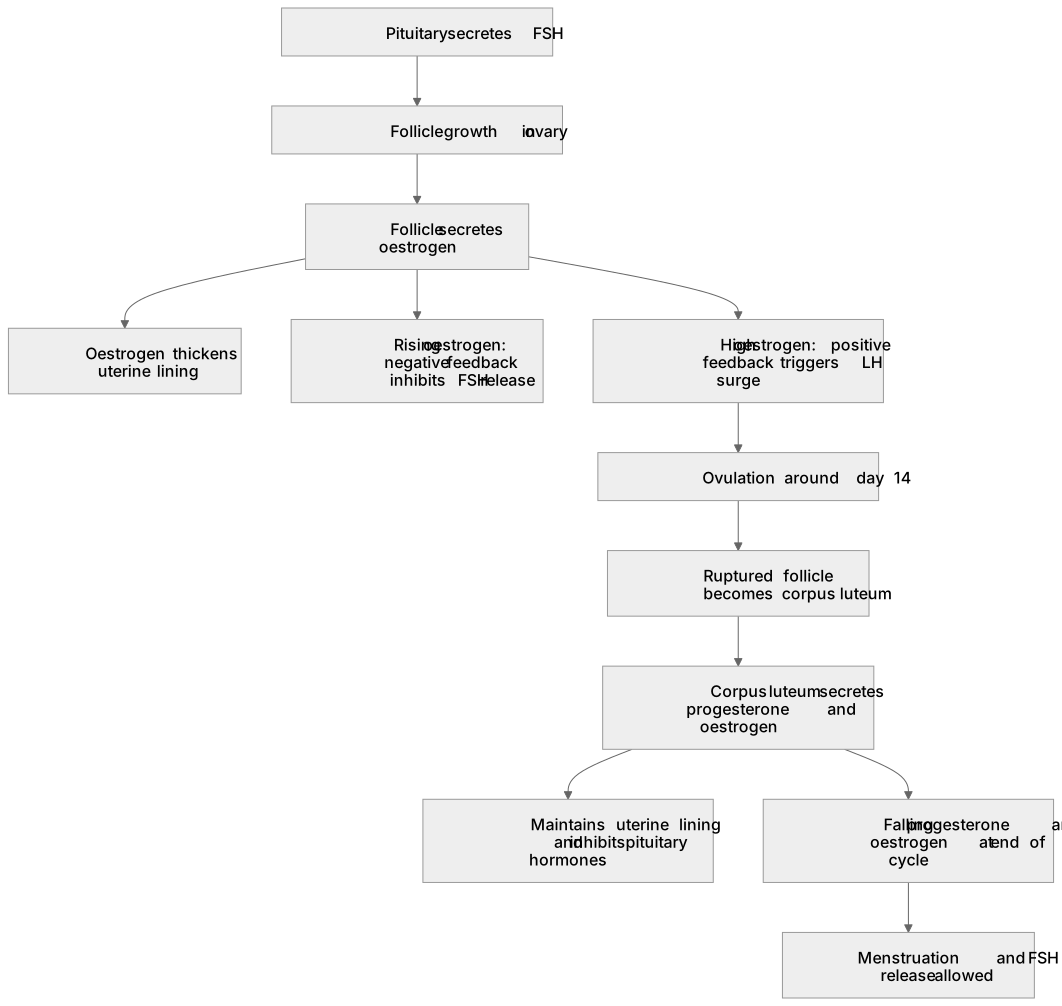
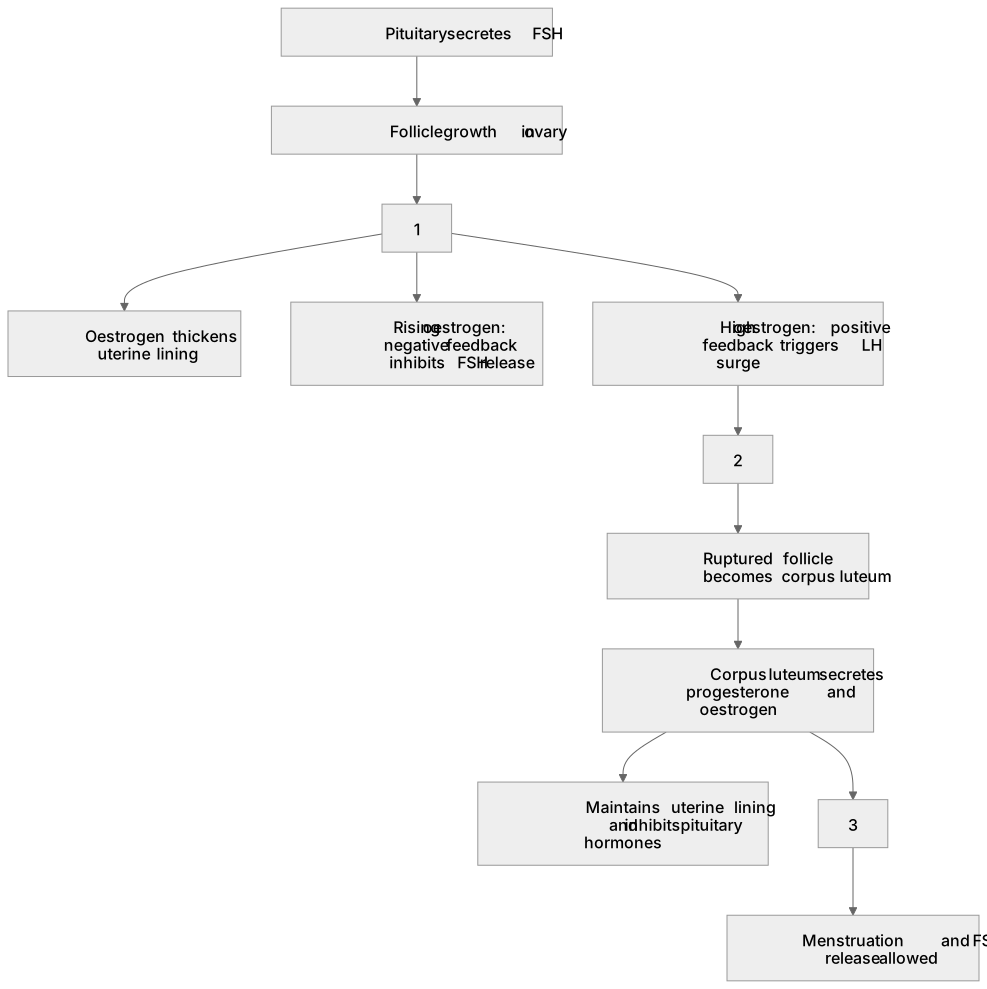
The menstrual cycle is governed by precise hormonal feedback interactions. Early in the cycle, the pituitary secretes follicle-stimulating hormone, promoting follicle growth in an ovary. The growing follicle secretes oestrogen, which thickens the uterine lining. Rising oestrogen exerts negative feedback on the pituitary, inhibiting follicle-stimulating hormone release to prevent multiple follicles maturing. High concentrations of oestrogen eventually trigger a surge in luteinising hormone release from the pituitary via positive feedback, inducing ovulation around day 14. The ruptured follicle becomes the corpus luteum, secreting progesterone and oestrogen, which inhibit both pituitary hormones and maintain the uterine lining.
What earns the marks
- Explain that rising oestrogen from maturing follicles exerts negative feedback to inhibit follicle-stimulating hormone release.
- Describe how peak oestrogen levels stimulate a surge in luteinising hormone secretion from the pituitary, triggering ovulation.
- State that the corpus luteum secretes progesterone and oestrogen, maintaining the uterine lining and inhibiting pituitary hormones.
- Explain that falling progesterone and oestrogen levels at the end of the cycle cause menstruation and allow follicle-stimulating hormone release.
Common mistakes and how to put them right
Failing to identify that oestrogen exhibits both negative feedback on follicle-stimulating hormone and positive feedback triggering luteinising hormone.
Forgetting that the corpus luteum degenerates if fertilisation does not occur, leading to a drop in progesterone.
Confusing which hormone surge directly causes ovulation (it is luteinising hormone, not follicle-stimulating hormone).
Exam tips
- Always explain the sequence step-by-step: FSH causes follicle growth; follicle makes oestrogen; oestrogen spike causes LH surge; LH triggers ovulation; corpus luteum makes progesterone.
- Remember that high progesterone inhibits both FSH and LH, preventing new follicles from maturing during the second half of the cycle.
Try the lesson
The start of the Coordination and control – the endocrine system: explain the interactions of FSH, LH, oestrogen and progesterone in the control of the menstrual cycle (Higher tier only) lesson, made from teaching notes for this specification point.
Have a go first
Which hormone is secreted by the pituitary gland and stimulates the development and maturation of a follicle in the ovary during the first part of the menstrual cycle?
Listen
The menstrual cycle is governed by precise hormonal feedback interactions. Early in the cycle, the pituitary secretes follicle-stimulating hormone, promoting follicle growth in an ovary. The growing follicle secretes oestrogen, which thickens the uterine lining. Rising oestrogen exerts negative feedback on the pituitary, inhibiting follicle-stimulating hormone release to prevent multiple follicles maturing. High concentrations of oestrogen eventually trigger a surge in luteinising hormone release from the pituitary via positive feedback, inducing ovulation around day 14. The ruptured follicle becomes the corpus luteum, secreting progesterone and oestrogen, which inhibit both pituitary hormones and maintain the uterine lining. A strong answer earns marks for these points. explain that rising oestrogen from maturing follicles exerts negative feedback to inhibit follicle-stimulating hormone release. describe how peak oestrogen levels stimulate a surge in luteinising hormone secretion from the pituitary, triggering ovulation. state that the corpus luteum secretes progesterone and oestrogen, maintaining the uterine lining and inhibiting pituitary hormones. explain that falling progesterone and oestrogen levels at the end of the cycle cause menstruation and allow follicle-stimulating hormone release. Exam tip: Always explain the sequence step-by-step: FSH causes follicle growth; follicle makes oestrogen; oestrogen spike causes LH surge; LH triggers ovulation; corpus luteum makes progesterone.
See it
Key words
Say what each word means before you turn the card.
hormonal feedback
Try answering aloud or in your head before turning the card.
ovulation
Try answering aloud or in your head before turning the card.
corpus luteum
Try answering aloud or in your head before turning the card.
menstrual regulation
Try answering aloud or in your head before turning the card.
See every definition
- hormonal feedback
- Rising oestrogen inhibits follicle-stimulating hormone release, while high oestrogen triggers a luteinising hormone surge, and progesterone inhibits both pituitary hormones.
- ovulation
- Induced around day 14 by a surge in luteinising hormone release from the pituitary via positive feedback.
- corpus luteum
- The ruptured follicle becomes this structure, secreting progesterone and oestrogen, which inhibit both pituitary hormones and maintain the uterine lining.
- menstrual regulation
- Falling progesterone and oestrogen levels at the end of the cycle cause menstruation and allow follicle-stimulating hormone release.
Label the diagram
Some boxes have lost their names. Pick the right name for each number.
1Box 1
2Box 2
3Box 3
There is more to this lesson
The full lesson goes on to check your understanding and help you earn the marks. Create a free account to carry on, with your progress saved.
A week of Premium from your first lesson · Then the free plan continues · No card, no charge
Test your understanding of Coordination and control – the endocrine system: explain the interactions of FSH, LH, oestrogen and progesterone in the control of the menstrual cycle (Higher tier only)
Active recall beats re-reading. Take an instant quiz now to test what you’ve learned and lock it into long-term memory.
A week of Premium from your first lesson · Then the free plan continues · No card, no charge