OCR · GCSE · Biology
Course version: J247 · Version from Sept 2018
Describe the role of hormones in human reproduction including the control…
Full specification wording
Coordination and control – the endocrine system: describe the role of hormones in human reproduction including the control of the menstrual cycle (to include: oestrogen, progesterone, FSH and testosterone)
Reproductive hormones regulate secondary sexual characteristics, gametogenesis, and the human menstrual cycle.
- Point 5 of 11
- 4 key terms
Study notes
From the teaching notes for this specification point.
The idea
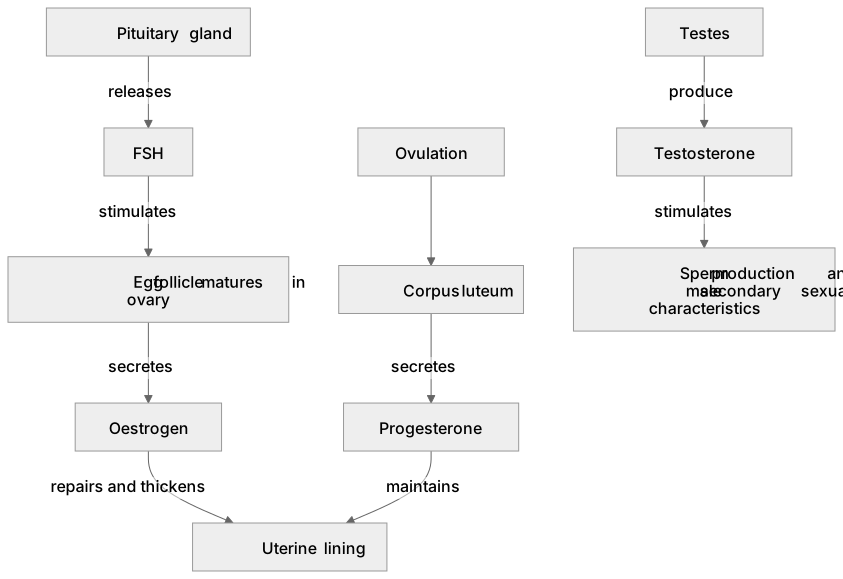
Reproductive hormones regulate secondary sexual characteristics, gametogenesis, and the human menstrual cycle. In males, testosterone is produced by the testes; it stimulates sperm production, vocal cord deepening, and facial hair growth. In females, the menstrual cycle is coordinated by four key hormones over approximately 28 days. Follicle-stimulating hormone is released by the pituitary gland to stimulate an egg follicle to mature within an ovary. Oestrogen, secreted by the maturing ovarian follicle, repairs and thickens the vascular uterine endometrium. Following ovulation, progesterone is secreted by the corpus luteum to maintain the uterine lining in preparation for a fertilised embryo.
What earns the marks
- State that testosterone produced by the testes stimulates sperm production and male secondary sexual characteristics.
- Explain that follicle-stimulating hormone secreted by the pituitary gland causes an egg follicle to mature in an ovary.
- Describe the role of oestrogen in repairing and thickening the uterine lining during the first half of the cycle.
- Describe the role of progesterone in maintaining the vascularised uterine lining during the second half of the cycle.
Common mistakes and how to put them right
Stating that progesterone builds the uterine lining, rather than explaining that oestrogen builds it and progesterone maintains it.
Confusing the site of production of follicle-stimulating hormone (pituitary) with that of oestrogen and progesterone (ovaries).
Forgetting that testosterone is also responsible for secondary sexual characteristics in adolescent males.
Exam tips
- Remember that follicle-stimulating hormone comes from the pituitary gland, while oestrogen and progesterone are produced in the ovaries.
- Learn the precise roles: oestrogen builds the lining, while progesterone keeps it thick and spongy for implantation.
Try the lesson
The start of the Coordination and control – the endocrine system: describe the role of hormones in human reproduction including the control of the menstrual cycle (to include: oestrogen, progesterone, FSH and testosterone) lesson, made from teaching notes for this specification point.
Have a go first
Which hormone is responsible for the development of male secondary sexual characteristics during puberty?
Listen
Reproductive hormones regulate secondary sexual characteristics, gametogenesis, and the human menstrual cycle. In males, testosterone is produced by the testes; it stimulates sperm production, vocal cord deepening, and facial hair growth. In females, the menstrual cycle is coordinated by four key hormones over approximately 28 days. Follicle-stimulating hormone is released by the pituitary gland to stimulate an egg follicle to mature within an ovary. Oestrogen, secreted by the maturing ovarian follicle, repairs and thickens the vascular uterine endometrium. Following ovulation, progesterone is secreted by the corpus luteum to maintain the uterine lining in preparation for a fertilised embryo. A strong answer earns marks for these points. state that testosterone produced by the testes stimulates sperm production and male secondary sexual characteristics. explain that follicle-stimulating hormone secreted by the pituitary gland causes an egg follicle to mature in an ovary. describe the role of oestrogen in repairing and thickening the uterine lining during the first half of the cycle. describe the role of progesterone in maintaining the vascularised uterine lining during the second half of the cycle. Exam tip: Remember that follicle-stimulating hormone comes from the pituitary gland, while oestrogen and progesterone are produced in the ovaries.
See it
Key words
Say what each word means before you turn the card.
testosterone
Try answering aloud or in your head before turning the card.
menstrual cycle
Try answering aloud or in your head before turning the card.
uterine endometrium
Try answering aloud or in your head before turning the card.
follicle-stimulating hormone
Try answering aloud or in your head before turning the card.
See every definition
- testosterone
- Produced by the testes, it stimulates sperm production and male secondary sexual characteristics.
- menstrual cycle
- Coordinated by four key hormones over approximately 28 days in females.
- uterine endometrium
- Repaired and thickened by oestrogen, then maintained by progesterone in preparation for a fertilised embryo.
- follicle-stimulating hormone
- Released by the pituitary gland to stimulate an egg follicle to mature within an ovary.
Label the diagram
Some boxes have lost their names. Pick the right name for each number.
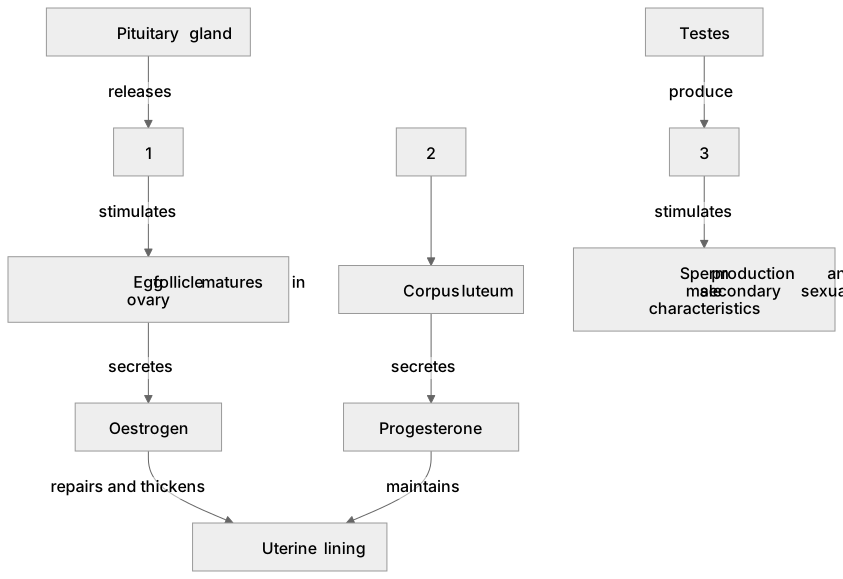
1Box 1
2Box 2
3Box 3
There is more to this lesson
The full lesson goes on to check your understanding and help you earn the marks. Create a free account to carry on, with your progress saved.
A week of Premium from your first lesson · Then the free plan continues · No card, no charge
Test your understanding of Coordination and control – the endocrine system: describe the role of hormones in human reproduction including the control of the menstrual cycle (to include: oestrogen, progesterone, FSH and testosterone)
Active recall beats re-reading. Take an instant quiz now to test what you’ve learned and lock it into long-term memory.
A week of Premium from your first lesson · Then the free plan continues · No card, no charge