OCR · GCSE · Biology
Course version: J247 · Version from Sept 2018
Describe the structure of the nervous system (to include: Central Nervous…
Full specification wording
Coordination and control – the nervous system: describe the structure of the nervous system (to include: Central Nervous System, sensory, motor and relay neurones, sensory receptors, synapse and effectors, details of the structure of sensory and motor neurones required)
The human nervous system consists of the Central Nervous System (brain and spinal cord) and peripheral nerves linking it to the body.
- Point 2 of 9
- 3 key terms
Study notes
From the teaching notes for this specification point.
The idea
The human nervous system consists of the Central Nervous System (brain and spinal cord) and peripheral nerves linking it to the body. Sensory receptors detect stimuli and start electrical impulses. Sensory neurones carry impulses towards the spinal cord: they have dendrites leading to a long dendron, a cell body in the dorsal root ganglion, and a shorter axon. Motor neurones have their cell body and many dendrites in the central grey matter and a long axon insulated by a fatty myelin sheath, ending at an effector. Effectors are muscles that contract or glands that secrete chemical substances, which may include hormones but also other secretions such as enzymes or sweat. Relay neurones connect sensory and motor pathways. A synapse is the microscopic gap between adjacent neurones, across which a chemical neurotransmitter diffuses.
What earns the marks
- Identifying the Central Nervous System as the brain and spinal cord.
- Distinguishing sensory neurones, with the cell body positioned along the axon in the dorsal root ganglion, from motor neurones, with the cell body at the dendrite end in the grey matter.
- Describing effectors as muscles that contract or glands that secrete chemical substances, which may include hormones but also other secretions.
- Explaining that the myelin sheath insulates the axon and speeds up transmission of the nerve impulse.
- Describing a synapse as a small gap between neurones across which a chemical neurotransmitter diffuses.
Common mistakes and how to put them right
Confusing the position of the cell body in sensory and motor neurones.
Put it right by remembering the sensory cell body lies partway along the fibre in the dorsal root ganglion, while the motor cell body sits at the dendrite end.
Believing the electrical impulse jumps physically across the synaptic gap.
Put it right by stating that a chemical neurotransmitter diffuses across the gap.
Defining an effector only as a muscle.
Put it right by adding that glands are also effectors and secrete chemical substances, not only hormones.
Exam tips
- Check axon diagrams carefully: a sensory neurone has its cell body positioned halfway along the nerve fibre, whereas a motor neurone has its cell body at one terminal end.
- State clearly that effectors carry out responses, explicitly naming muscle contraction or gland secretion, and give a named example such as a sweat gland or salivary gland.
Try the lesson
The start of the Coordination and control – the nervous system: describe the structure of the nervous system (to include: Central Nervous System, sensory, motor and relay neurones, sensory receptors, synapse and effectors, details of the structure of sensory and motor neurones required) lesson, made from teaching notes for this specification point.
Have a go first
Which part of the nervous system is made up of the brain and the spinal cord?
Listen
The human nervous system consists of the Central Nervous System (brain and spinal cord) and peripheral nerves linking it to the body. Sensory receptors detect stimuli and start electrical impulses. Sensory neurones carry impulses towards the spinal cord: they have dendrites leading to a long dendron, a cell body in the dorsal root ganglion, and a shorter axon. Motor neurones have their cell body and many dendrites in the central grey matter and a long axon insulated by a fatty myelin sheath, ending at an effector. Effectors are muscles that contract or glands that secrete chemical substances, which may include hormones but also other secretions such as enzymes or sweat. Relay neurones connect sensory and motor pathways. A synapse is the microscopic gap between adjacent neurones, across which a chemical neurotransmitter diffuses. A strong answer earns marks for these points. Identifying the Central Nervous System as the brain and spinal cord. Distinguishing sensory neurones, with the cell body positioned along the axon in the dorsal root ganglion, from motor neurones, with the cell body at the dendrite end in the grey matter. Describing effectors as muscles that contract or glands that secrete chemical substances, which may include hormones but also other secretions. Explaining that the myelin sheath insulates the axon and speeds up transmission of the nerve impulse. A common slip: Confusing the position of the cell body in sensory and motor neurones. Instead, remembering the sensory cell body lies partway along the fibre in the dorsal root ganglion, while the motor cell body sits at the dendrite end. Exam tip: Check axon diagrams carefully: a sensory neurone has its cell body positioned halfway along the nerve fibre, whereas a motor neurone has its cell body at one terminal end.
See it
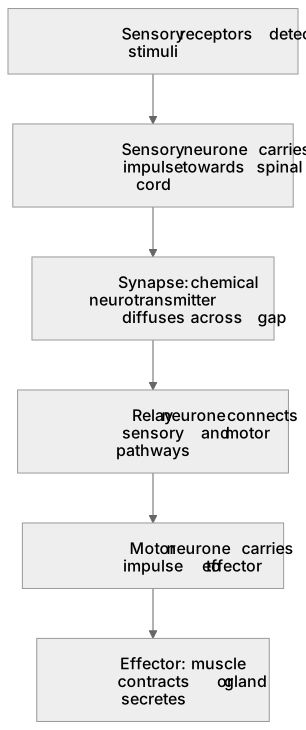
Put it in order
Put these steps in the order they happen.
- 1. Synapse: chemical neurotransmitter diffuses across gap
- 2. Sensory neurone carries impulse towards spinal cord
- 3. Sensory receptors detect stimuli
- 4. Effector: muscle contracts or gland secretes
- 5. Motor neurone carries impulse to effector
- 6. Relay neurone connects sensory and motor pathways
Key words
Say what each word means before you turn the card.
synapse
Try answering aloud or in your head before turning the card.
effectors
Try answering aloud or in your head before turning the card.
myelin sheath
Try answering aloud or in your head before turning the card.
See every definition
- synapse
- The microscopic gap between adjacent neurones, across which a chemical neurotransmitter diffuses.
- effectors
- Muscles that contract or glands that secrete chemical substances, which may include hormones but also other secretions such as enzymes or sweat.
- myelin sheath
- A fatty covering that insulates the axon and speeds up transmission of the nerve impulse.
Label the diagram
Some boxes have lost their names. Pick the right name for each number.
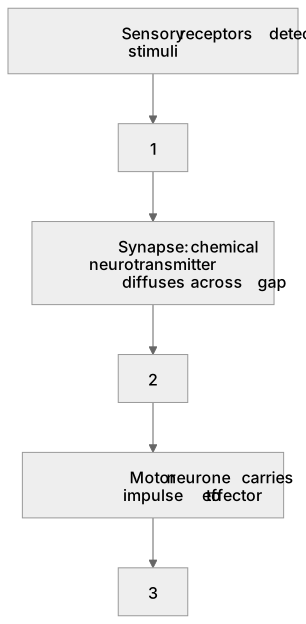
1Box 1
2Box 2
3Box 3
There is more to this lesson
The full lesson goes on to check your understanding and help you earn the marks. Create a free account to carry on, with your progress saved.
A week of Premium from your first lesson · Then the free plan continues · No card, no charge
Test your understanding of Coordination and control – the nervous system: describe the structure of the nervous system (to include: Central Nervous System, sensory, motor and relay neurones, sensory receptors, synapse and effectors, details of the structure of sensory and motor neurones required)
Active recall beats re-reading. Take an instant quiz now to test what you’ve learned and lock it into long-term memory.
A week of Premium from your first lesson · Then the free plan continues · No card, no charge