OCR · GCSE · Biology
Course version: J247 · Version from Sept 2018
Calculate the efficiency of biomass transfers between trophic levels and…
Full specification wording
Ecosystems: calculate the efficiency of biomass transfers between trophic levels and explain how this affects the number of trophic levels in a food chain (content found only in the biology separate science qualification)
The efficiency of biomass transfer between successive trophic levels is calculated using the formula: efficiency equals the biomass transferred to the higher trophic level divided by the biomass…
- Point 15 of 15
- 3 key terms
Study notes
From the teaching notes for this specification point.
The idea
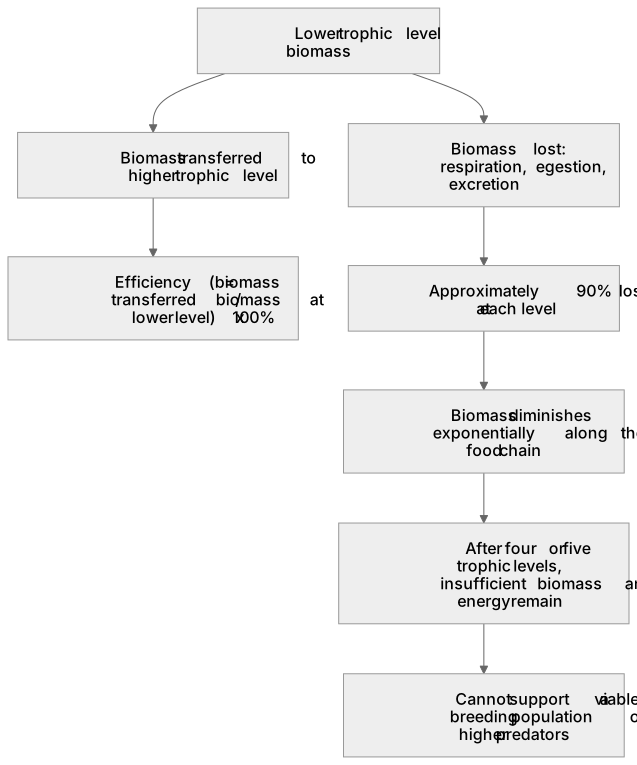
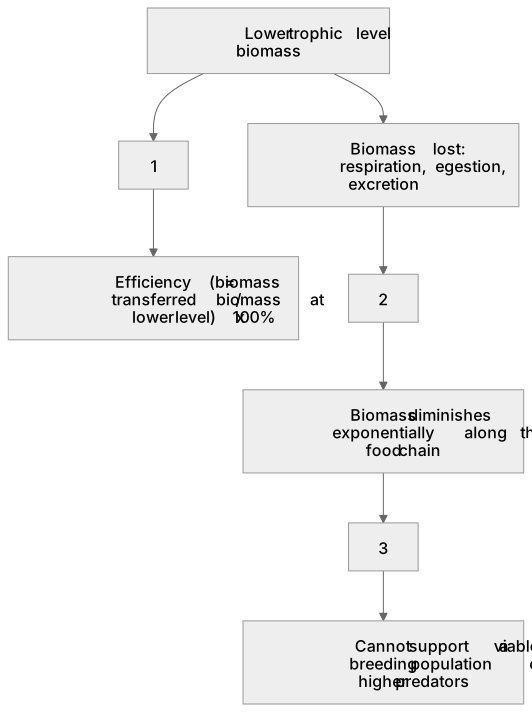
The efficiency of biomass transfer between successive trophic levels is calculated using the formula: efficiency equals the biomass transferred to the higher trophic level divided by the biomass at the lower trophic level, multiplied by one hundred percent. In natural ecosystems, transfer efficiency is remarkably low, typically around ten percent (ranging between five and twenty percent). Because approximately ninety percent of available biomass is lost at each feeding link through respiration, egestion, and excretion, total biomass diminishes exponentially along the food chain. Consequently, after four or five trophic levels, insufficient biomass and energy remain to support a viable breeding population of higher predators.
What earns the marks
- Calculate biomass transfer efficiency: (biomass in higher trophic level / biomass in lower trophic level) multiplied by 100.
- State that typical biomass transfer efficiency between trophic levels is approximately 10 percent.
- Explain that roughly 90 percent of biomass is dissipated at each level via cellular respiration, movement, egestion, and excretion.
- Explain that exponential loss of biomass limits food chains to four or five trophic levels, as insufficient energy remains to support top predators.
Common mistakes and how to put them right
Inverting the efficiency formula, dividing the lower trophic biomass by the higher trophic biomass.
Stating that food chains end because organisms run out of space rather than because available biomass and energy become insufficient.
Forgetting to multiply the fractional efficiency by 100 to express it as a percentage.
Exam tips
- Use the formula: Efficiency equals (biomass at higher level divided by biomass at lower level) multiplied by 100%.
- To explain why food chains rarely exceed 4 or 5 levels, always state that too much biomass and energy is lost at each step to sustain another viable trophic level.
Try the lesson
The start of the Ecosystems: calculate the efficiency of biomass transfers between trophic levels and explain how this affects the number of trophic levels in a food chain (content found only in the biology separate science qualification) lesson, made from teaching notes for this specification point.
Have a go first
In a food chain, the biomass transfer from primary consumers to secondary consumers is 15%. If the primary consumers contain 8000 kJ of biomass energy, how much energy is transferred to the secondary consumers?
Listen
The efficiency of biomass transfer between successive trophic levels is calculated using the formula: efficiency equals the biomass transferred to the higher trophic level divided by the biomass at the lower trophic level, multiplied by one hundred percent. In natural ecosystems, transfer efficiency is remarkably low, typically around ten percent (ranging between five and twenty percent). Because approximately ninety percent of available biomass is lost at each feeding link through respiration, egestion, and excretion, total biomass diminishes exponentially along the food chain. Consequently, after four or five trophic levels, insufficient biomass and energy remain to support a viable breeding population of higher predators. A strong answer earns marks for these points. calculate biomass transfer efficiency: (biomass in higher trophic level / biomass in lower trophic level) multiplied by 100. state that typical biomass transfer efficiency between trophic levels is approximately 10 percent. explain that roughly 90 percent of biomass is dissipated at each level via cellular respiration, movement, egestion, and excretion. explain that exponential loss of biomass limits food chains to four or five trophic levels, as insufficient energy remains to support top predators. Exam tip: Use the formula: Efficiency equals (biomass at higher level divided by biomass at lower level) multiplied by 100%.
See it
Key words
Say what each word means before you turn the card.
transfer efficiency
Try answering aloud or in your head before turning the card.
food chain length
Try answering aloud or in your head before turning the card.
energy dissipation
Try answering aloud or in your head before turning the card.
See every definition
- transfer efficiency
- Calculated as the biomass transferred to the higher trophic level divided by the biomass at the lower trophic level, multiplied by one hundred percent.
- food chain length
- Limited to four or five trophic levels because insufficient biomass and energy remain to support a viable breeding population of higher predators.
- energy dissipation
- Roughly 90 percent of biomass is dissipated at each level via cellular respiration, movement, egestion, and excretion.
Label the diagram
Some boxes have lost their names. Pick the right name for each number.
1Box 1
2Box 2
3Box 3
There is more to this lesson
The full lesson goes on to check your understanding and help you earn the marks. Create a free account to carry on, with your progress saved.
A week of Premium from your first lesson · Then the free plan continues · No card, no charge
Test your understanding of Ecosystems: calculate the efficiency of biomass transfers between trophic levels and explain how this affects the number of trophic levels in a food chain (content found only in the biology separate science qualification)
Active recall beats re-reading. Take an instant quiz now to test what you’ve learned and lock it into long-term memory.
A week of Premium from your first lesson · Then the free plan continues · No card, no charge