OCR · GCSE · Biology
Course version: J247 · Version from Sept 2018
Use fractions and percentages (content found only in the biology separate…
Full specification wording
Ecosystems: Use fractions and percentages (content found only in the biology separate science qualification)
Ecological analysis involves using fractions and percentages to model energy transfers, nutrient cycles, and community structures.
- Point 3 of 15
- 4 key terms
Study notes
From the teaching notes for this specification point.
The idea
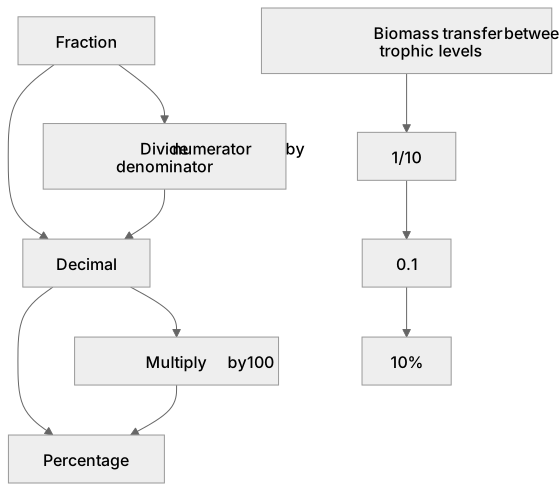
Ecological analysis involves using fractions and percentages to model energy transfers, nutrient cycles, and community structures. Learners convert fractional proportions into percentages and decimals to evaluate ecological efficiency, such as expressing the ten percent transfer between trophic levels as one tenth or zero point one. In field sampling, the relative abundance of a plant or animal species within a quadratted community is expressed as a fraction or percentage of the total community count. Fractions and percentages are also applied when calculating the proportion of incident solar energy captured by primary producers during photosynthesis or biomass lost through respiration.
What earns the marks
- Convert between fractional, decimal, and percentage representations of ecological data.
- Calculate the relative abundance of a species as a percentage or fraction of the total population.
- Express biomass transfer efficiency between trophic levels as both a fraction and a percentage.
- Calculate the fraction of light energy fixed by autotrophic producers in an ecosystem.
Common mistakes and how to put them right
Confusing fractions with ratios, such as writing three-quarters when the ratio of parts is three to one.
Failing to simplify fractional expressions to their lowest terms.
Making arithmetic errors when converting fractional efficiencies into percentages.
Exam tips
- To convert a fraction to a percentage, divide the numerator by the denominator and multiply by 100.
- Remember that the typical efficiency of biomass transfer between trophic levels is approximately 10%, which corresponds to 1/10.
Try the lesson
The start of the Ecosystems: Use fractions and percentages (content found only in the biology separate science qualification) lesson, made from teaching notes for this specification point.
Have a go first
In a food chain, 3 out of every 5 units of energy are lost between trophic levels. What fraction of the energy is lost?
Listen
Ecological analysis involves using fractions and percentages to model energy transfers, nutrient cycles, and community structures. Learners convert fractional proportions into percentages and decimals to evaluate ecological efficiency, such as expressing the ten percent transfer between trophic levels as one tenth or zero point one. In field sampling, the relative abundance of a plant or animal species within a quadratted community is expressed as a fraction or percentage of the total community count. Fractions and percentages are also applied when calculating the proportion of incident solar energy captured by primary producers during photosynthesis or biomass lost through respiration. A strong answer earns marks for these points. convert between fractional, decimal, and percentage representations of ecological data. calculate the relative abundance of a species as a percentage or fraction of the total population. express biomass transfer efficiency between trophic levels as both a fraction and a percentage. calculate the fraction of light energy fixed by autotrophic producers in an ecosystem. Exam tip: To convert a fraction to a percentage, divide the numerator by the denominator and multiply by 100.
See it
Key words
Say what each word means before you turn the card.
fractions and percentages
Try answering aloud or in your head before turning the card.
relative abundance
Try answering aloud or in your head before turning the card.
trophic efficiency
Try answering aloud or in your head before turning the card.
mathematical conversions
Try answering aloud or in your head before turning the card.
See every definition
- fractions and percentages
- Used to model energy transfers, nutrient cycles and community structures, converting fractional proportions into percentages and decimals to evaluate ecological efficiency.
- relative abundance
- The amount of a plant or animal species within a quadratted community, expressed as a fraction or percentage of the total community count.
- trophic efficiency
- Biomass transfer efficiency between trophic levels, expressed as both a fraction and a percentage, with a typical value of approximately 10%, corresponding to 1/10.
- mathematical conversions
- Converting between fractional, decimal and percentage representations of ecological data, dividing the numerator by the denominator and multiplying by 100.
Label the diagram
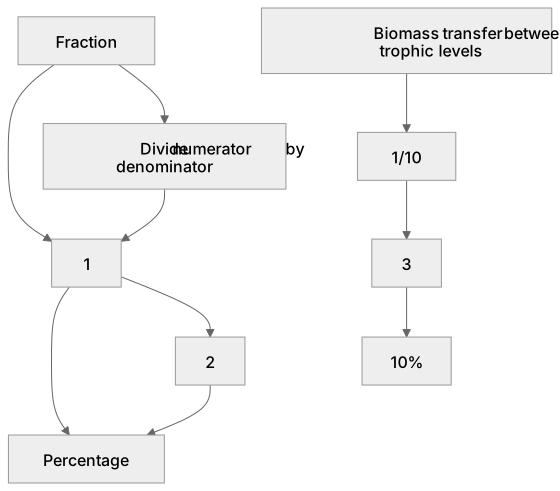
Some boxes have lost their names. Pick the right name for each number.
1Box 1
2Box 2
3Box 3
There is more to this lesson
The full lesson goes on to check your understanding and help you earn the marks. Create a free account to carry on, with your progress saved.
A week of Premium from your first lesson · Then the free plan continues · No card, no charge
Test your understanding of Ecosystems: Use fractions and percentages (content found only in the biology separate science qualification)
Active recall beats re-reading. Take an instant quiz now to test what you’ve learned and lock it into long-term memory.
A week of Premium from your first lesson · Then the free plan continues · No card, no charge